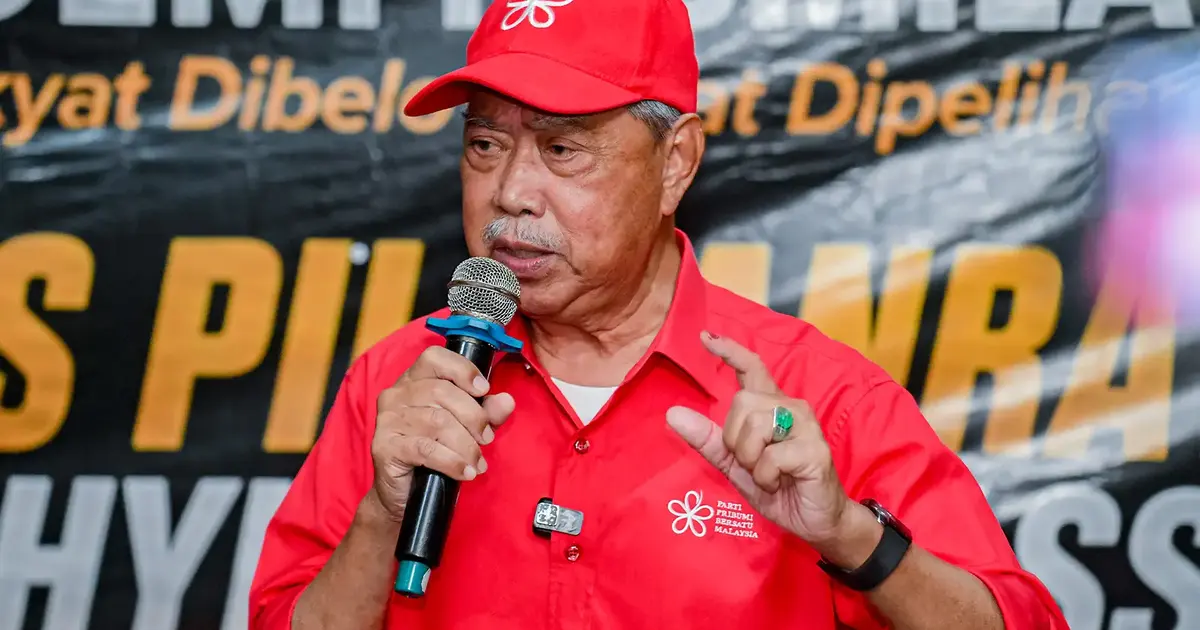
Bersatu president Muhyiddin Yassin has responded sharply to allegations that his party is overstepping boundaries in electoral matters, rejecting the characterisation of the coalition's election activities as improper meddling. The dispute reflects broader tensions within Malaysia's coalition politics as parties navigate their roles and responsibilities during electoral cycles.
Muhyiddin's defence centres on a fundamental principle of democratic participation: that every political party, by its very nature, enters electoral contests with the intention of securing victory. This framing positions Bersatu's campaign efforts as entirely consistent with standard political practice rather than as an exceptional or problematic intervention. The argument underscores how parties interpret their mandate to campaign and mobilise support as a core democratic right.
The criticism from Khaled appears to stem from concerns about Bersatu's activism or influence in areas where other coalition partners might view the party as overstepping its traditional role. Such tensions frequently emerge in multi-party coalitions where members compete for electoral gains while needing to maintain coalition unity. Malaysia's political landscape has grown increasingly complex since Bersatu's emergence as a significant player, particularly following the 2022 general election and subsequent political realignments.
Bersatu's positioning within Malaysian politics remains contested. The party, founded by former prime minister Mahathir Mohamad in 2016 before being dissolved and reformed, has shifted between coalition arrangements and opposition roles. These transitions have created uncertainty among other political actors regarding Bersatu's strategic intentions and its approach to electoral competition. Khaled's comments may reflect underlying anxieties about the party's influence trajectory and ambitions.
Muhyiddin's rebuttal strategy appears designed to normalise Bersatu's election activities by framing them as conventional political behaviour. By asserting that all parties compete to win, he attempts to deflate the suggestion that Bersatu is doing anything unusual or inappropriate. This rhetorical approach seeks to reposition the narrative from one of boundary-crossing to one of standard democratic engagement.
The dispute also carries implications for coalition stability. When constituent members publicly criticise each other's electoral strategies, it can signal underlying fractures in the alliance. For Malaysian voters and investors watching coalition dynamics, such public disagreements sometimes precede broader coalition restructuring or realignment. The current exchange suggests potential vulnerabilities in how coalition members coordinate their electoral approaches and resolve disputes over campaign boundaries.
For Southeast Asia more broadly, this Malaysian dispute reflects common challenges in multi-party democracies where coalitions must balance competition with cooperation. Thailand, Indonesia, and the Philippines have all grappled with similar tensions between coalition partners pursuing individual electoral interests and maintaining collective cohesion. How Malaysia's political parties resolve such disputes often influences perceptions of democratic maturity and institutional stability in the region.
Muhyiddin's assertion that electoral competition is an inherent feature of democratic systems appears designed to place Bersatu's activities beyond criticism. However, Khaled's concerns may point to specific campaign tactics or resource allocation patterns rather than the mere fact of Bersatu's participation in elections. The underlying disagreement may involve disputes about how intensely parties should campaign in constituencies where they have coalition partners or how aggressively they should pursue seats traditionally held by allies.
The timing and nature of this public exchange merit attention. Political disputes that reach media attention often indicate that behind-the-scenes negotiations have failed to resolve the underlying issue. Khaled's willingness to make public statements about Bersatu suggests either a breakdown in coalition communication mechanisms or a deliberate decision to air grievances before the public. Either scenario indicates pressure points within the broader coalition structure that could have electoral consequences.
Bersatu's recent political trajectory makes it particularly sensitive to allegations of overreach or destabilising behaviour. The party's history of shifting alliances and leadership transitions has created a context where other parties might view its actions with heightened scrutiny. Muhyiddin's defensive posture reflects an awareness that Bersatu operates under greater scrutiny than more established parties, requiring him to justify activities that might otherwise be accepted as routine.
The substantive question underlying this dispute concerns the rules and norms governing coalition elections. Are there unwritten agreements about which constituencies parties should contest? Should coalition members prioritise supporting allied candidates over competing aggressively for seats? These questions remain largely unresolved in Malaysian political practice, creating space for disagreement when parties interpret their roles differently.
Moving forward, how Muhyiddin and Khaled resolve this dispute could influence broader coalition dynamics heading toward the next electoral cycle. If coalition members cannot reach consensus on electoral boundaries and campaign intensities, parties may pursue individual electoral strategies that ultimately weaken overall coalition performance. Conversely, establishing clearer ground rules for coalition electoral competition could enhance predictability and reduce public tensions.
For Malaysian voters observing this exchange, the incident provides insight into how coalition partners manage internal differences. The public nature of this disagreement suggests that despite formal alliance structures, Malaysian coalition politics remains personalised and sometimes contentious. Understanding these dynamics is crucial for voters attempting to evaluate coalition stability and predict potential realignments as the political calendar advances.

