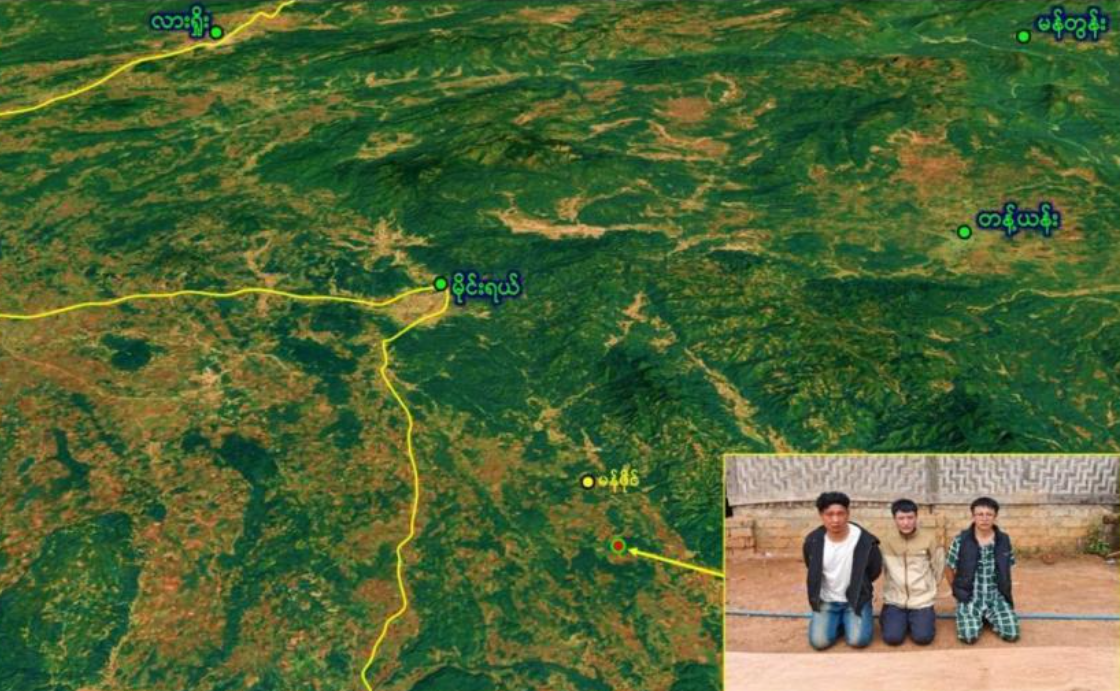
Myanmar's military forces have apprehended three Chinese nationals suspected of orchestrating an online gambling scam network in Mongyai Township, a remote area in northern Shan State near the Chinese border. The August 26 operation represents a significant escalation in Myanmar's campaign to dismantle illegal gambling operations that have increasingly exploited porous border regions to evade detection and prosecution.
The three men, who allegedly crossed into Myanmar illegally, were detained approximately 26 kilometres southeast of Mongyai town and about five kilometres south of Manphai Village, an isolated settlement that residents reported had become a hub for scam gambling activities. Their arrest underscores a troubling trend across Southeast Asia, where criminal networks exploit ungoverned spaces and weak regulatory oversight in border regions to establish sophisticated fraud operations that target victims across multiple countries and time zones.
Myanmar's government has prioritised combating online scams and gambling schemes as part of a broader national strategy to restore stability and economic confidence. The initiative reflects growing regional concern about transnational organised crime networks that leverage digital technology to prey on unsuspecting victims. Border areas, particularly in conflict-affected regions like Shan State, have become especially vulnerable to such operations because military and civilian law enforcement resources are often stretched thin managing security threats.
The scale of equipment recovered during the raid illustrates the operational sophistication of these scam networks. Authorities seized twenty-five mobile phones, five all-in-one computers, two power stations, one Starlink satellite internet device, and ten communication radios—tools that enabled the suspects to maintain connections with accomplices and customers across geographic boundaries. The confiscation of satellite internet equipment is particularly significant, as it suggests the network had deliberately established itself in a remote location beyond conventional connectivity, deliberately chosen to evade surveillance and detection by authorities.
Beyond the electronic equipment, military personnel dismantled substantial physical infrastructure including a fifty-by-twenty-foot corrugated iron building with bamboo walls and five large tarpaulin shelters of varying dimensions. This investment in semi-permanent structures indicates the operation had intended to maintain long-term presence in the region, suggesting the network was well-funded and had established supply chains for materials and personnel logistics. The deliberate construction choices—using materials easily sourced locally and quickly dismantled—reveal operational tradecraft designed to maintain low visibility while providing adequate workspace for multiple operators.
The information that triggered the operation came from local residents who reported the suspicious presence of individuals establishing makeshift encampments in their township. This grassroots intelligence underscores the importance of community engagement in counter-scam efforts, as locals often first notice the telltale signs of illegal operations—unusual construction activity, irregular hours, unfamiliar faces, and electronic equipment installation in unexpected locations. Myanmar's authorities have attempted to leverage these community observations as part of their broader enforcement strategy.
For Malaysia and other Southeast Asian nations, this Myanmar operation carries important implications. Online gambling scams originating from border regions in Myanmar, Thailand, and Cambodia have directly targeted Malaysian citizens and businesses. Many scam networks maintain customer databases spanning multiple countries, meaning victims in Kuala Lumpur or Penang may have been interacting with operators based in Mongyai or similar remote locations. The transnational nature of these networks means that Malaysian authorities benefit when neighbouring countries successfully disrupt operations, even if the perpetrators are not Malaysian citizens.
The investigation and arrest process in Myanmar follows its own legal framework, with the three Chinese nationals facing action under existing Myanmar laws following completion of questioning. The outcome of such cases often depends on bilateral cooperation agreements between Myanmar and China, as well as the specific charges prosecutors pursue. Authorities have indicated that systematic demolition of illegally constructed shelters will continue as a deterrent measure, though enforcement remains challenging in remote border areas with limited state capacity.
Myanmar's intensified crackdown reflects international pressure on Southeast Asian governments to address online scams that have become increasingly sophisticated and damaging. Criminal networks have invested heavily in developing methods to evade law enforcement, including using virtual private networks, cryptocurrency transactions, and mobile-first platforms to obscure their operations. The reliance on satellite internet in this case suggests operators anticipated conventional network monitoring, requiring authorities to develop more advanced detection capabilities.
The broader campaign against online gambling scams in Myanmar must contend with significant challenges: the region's complex geography, overlapping jurisdictions in conflict zones, limited technical capacity in some units, and the constant evolution of criminal methodologies. However, successful operations like the Mongyai raid demonstrate that with sufficient political will and resource commitment, authorities can dismantle established networks. The seized Starlink device particularly indicates that even sophisticated technological advantage can be neutralised through coordinated security operations.
For regional observers, the Myanmar operation suggests that transnational cooperation on online crime is gradually improving, though significant gaps remain. Malaysian readers concerned about scam fraud should understand that perpetrators often operate across borders, making domestic law enforcement efforts only partially effective. International cooperation through ASEAN frameworks, Interpol, and bilateral agreements becomes essential when criminal networks exploit geographic boundaries to fragment investigation efforts and evade prosecution.
Looking forward, Myanmar authorities have committed to preventing online scam gambling operations from re-establishing footholds in border regions through systematic dismantling of infrastructure and continued security operations. Whether this commitment translates into sustained results will depend on resource allocation, training of security personnel in cybercrime investigation, and cooperation with neighbouring countries to prevent networks from simply relocating to adjacent territories. The operation in Mongyai represents a tactical victory; strategic success requires sustained effort across the region.

