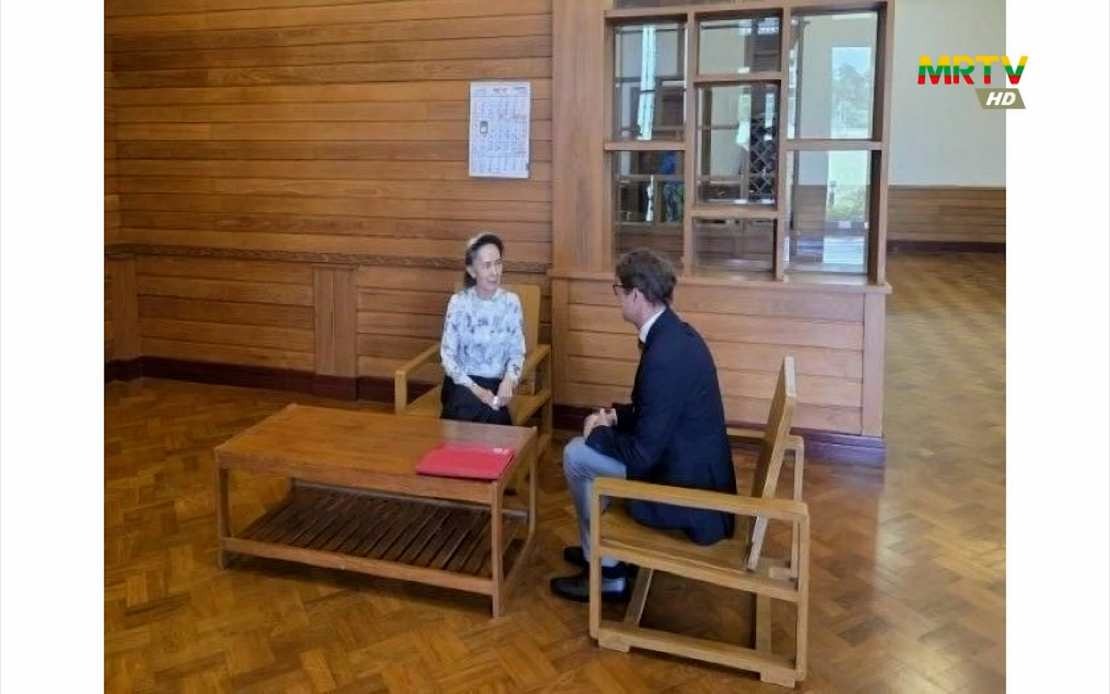
Myanmar's military-backed administration confirmed on Monday that Aung San Suu Kyi, the country's detained former leader, met with a representative of the International Committee of the Red Cross in the capital city of Naypyitaw. The encounter with Arnaud de Baecque, the ICRC's Resident Representative to Myanmar, marks a significant development in efforts by regional governments to verify the well-being of the 81-year-old Nobel Peace Prize laureate, who has remained largely out of public view since her detention began following the military coup in February 2021.
The meeting comes amid mounting pressure from Southeast Asian nations seeking direct access to Suu Kyi to independently assess her health and conditions of detention. Regional governments have grown increasingly concerned about the opacity surrounding her situation, particularly following claims by Myanmar's junta-aligned administration that she is in good health. Thailand's Foreign Minister Sihasak Phuangketkeow explicitly called for such verification mechanisms during recent ASEAN discussions in Bangkok, underscoring the region's anxiety about the political prisoner's fate. The Philippines had previously submitted a formal request for an ASEAN special envoy to visit Suu Kyi, a request that Myanmar's government has thus far declined.
Suu Kyi has been imprisoned continuously since the February 2021 dawn coup that demolished the elected civilian government she led, plunging the impoverished nation into profound political and economic upheaval. The military's seizure of power triggered widespread civil unrest, armed conflict with resistance forces, and a humanitarian crisis that has destabilized one of Southeast Asia's most strategically important countries. In the three and a half years since her detention began, the former leader has become the symbolic focal point of international opposition to the military regime, transforming her imprisonment into a regional and global concern that extends far beyond Myanmar's borders.
Photographs released by government spokeswoman Khine Khine Soe purporting to document the Monday meeting show Suu Kyi in traditional Burmese dress seated with de Baecque in a minimally furnished room containing only basic furniture. Additional images provide an uncommon view into what appears to be her residence, depicting her cutting a birthday cake bearing her name. One photograph displays the cake inscribed with "Happy Birthday Aunty Suu 19.6.2026," suggesting the images were taken on or near her birthday. However, Reuters could not independently verify the location or timing of these photographs, and no evidence emerged of the images circulating online prior to Monday's official release, raising questions about their authenticity and the conditions under which they were obtained.
The visibility challenges surrounding Suu Kyi have persisted since the coup, with no foreign leader or official diplomat having publicly confirmed a meeting with her. Her son, Kim Aris, disclosed last December that he receives only fragmentary, secondhand information about his mother's health, including troubling reports concerning her heart, bone, and dental problems. He emphasized the profound isolation of their separation, noting that years have passed without direct communication and expressing deep fears about her mortality. This family testimony starkly contrasts with the junta's repeated assertions that Suu Kyi remains in excellent health, creating a credibility gap that regional governments are increasingly keen to resolve.
Suu Kyi faces a substantial accumulated sentence stemming from convictions handed down following hastily conducted secret trials in the period immediately following the coup. She was originally condemned to thirty-three years imprisonment on charges encompassing corruption, election fraud incitement, and violations of state secrecy legislation. These convictions and the sentences themselves have been widely characterized by her political allies and international observers as fabricated charges designed to permanently eliminate her as a political force. Her legal team has noted that the original sentence was subsequently reduced to twenty-seven years, and then cut by one-sixth in April, leaving her with eighteen years remaining to serve—a substantial period that extends deep into her later years.
The fundamental legitimacy of the charges against Suu Kyi remains contested within Myanmar's political sphere and internationally. Legal experts and human rights organizations have catalogued extensive procedural irregularities during her trials, questioning whether she received fair judicial processes. Her supporters argue persuasively that the military has weaponized the courts to neutralize the country's most popular politician and foreclose any possibility of her return to public life. In a nation of 51 million people, Suu Kyi commanded extraordinary grassroots support and represented the aspirations of Myanmar's democratic movement—making her indefinite incarceration a powerful means through which the junta maintains political control.
Recent developments have shifted the immediate dynamics of Suu Kyi's detention. In late April, following military-orchestrated elections designed to legitimize junta rule and install former leader Min Aung Hlaing as president, Myanmar's authorities announced that Suu Kyi had been transferred to house arrest. This administrative reclassification suggests an incremental loosening of physical constraints, though it provides no substantive improvement in her fundamental lack of freedom or her ability to communicate with the outside world. The designation of house arrest, while technically less restrictive than formal imprisonment, still constitutes denial of liberty and represents continued political control over her person and movements.
The apparent willingness to permit a Red Cross visit represents a tactical adjustment rather than a fundamental policy shift toward transparency. Myanmar's military administration has consistently resisted broader international monitoring mechanisms and has declined multiple specific requests from ASEAN governments for direct access to Suu Kyi. By allowing a controlled meeting with a Red Cross official while carefully curating photographic documentation, the regime can claim to be responding to international concerns while maintaining strict control over the narrative and restricting the possibility of independent verification. The ICRC's own assessment of Suu Kyi's condition remains undisclosed, and it is unclear whether the organization will issue independent findings about her health and detention conditions.
For Southeast Asian observers and governments, Suu Kyi's case encapsulates broader concerns about democratic backsliding and military authoritarianism within the region. Her imprisonment symbolizes the broader suppression of democratic movements and resistance to military rule throughout Myanmar, which has spawned armed conflicts, refugee flows affecting neighboring Thailand and Bangladesh, and economic disruption across the region's supply chains and investment patterns. The difficulty in obtaining reliable information about Suu Kyi's condition mirrors the opacity and information control characterizing Myanmar's governance generally, making her situation emblematic of wider regional instability.
Historically, Suu Kyi endured fifteen years of house arrest under Myanmar's previous military junta, confined to her family residence beside Yangon's Inya Lake. From behind the metal gates of that property, she delivered speeches to devoted supporters that became legendary symbols of resistance to authoritarian rule. Her eventual release and rise to political leadership represented what many in Southeast Asia viewed as a triumph of democratic persistence over military dictatorship. Her current imprisonment thus registers as a particularly acute reversal for regional observers who believed Myanmar had embarked on an irreversible democratic trajectory. The contrast between her earlier house arrest and current detention underscores how the military has learned to deploy legal mechanisms and administrative structures to achieve what straightforward military custody accomplished previously, rendering her political elimination more institutionally embedded and harder to reverse through international pressure.

