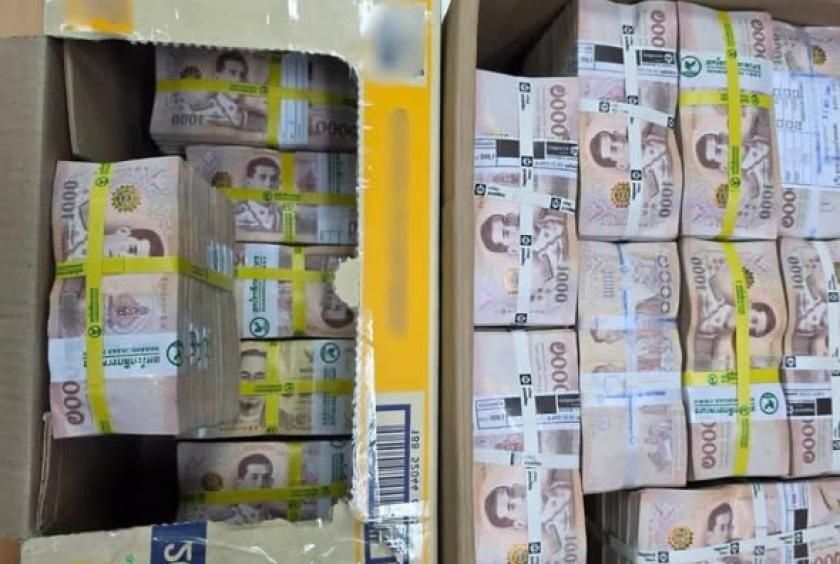
Thai customs enforcement at the Mae Sai border crossing has intercepted what authorities describe as a significant attempt to illegally transport Thai currency across the Myanmar frontier. The operation, conducted at the Thai-Myanmar Friendship Bridge checkpoint, resulted in the seizure of 23.023 million baht—approximately US$689,077—and the detention of a 31-year-old Myanmar national driving a vehicle registered in Myanmar.
The bust unfolded when customs officials became suspicious of a privately owned vehicle displaying Myanmar licence plates as it approached the border checkpoint. Rather than allowing the crossing to proceed, officers conducted a thorough inspection of the vehicle's contents. Their vigilance proved warranted when they discovered an elaborate concealment scheme involving everyday foodstuffs as cover for substantial quantities of Thai currency.
The smuggling method employed showed careful planning and attention to disguise. Officers found bundles of 1,000-baht banknotes systematically wrapped in plastic bags and then placed inside cartons ostensibly containing dried fish and potatoes. The first carton examined yielded approximately 17 million baht, while a second container held an additional 6.023 million baht. The precision with which the cash had been packaged and hidden suggested this was not merely a casual attempt but rather part of a potentially organized operation.
Under Thai law, the transport of currency across international borders is heavily regulated, and unauthorized movement of substantial sums violates multiple statutes. Thai authorities have charged the driver under the Customs Act and the country's foreign exchange control regulations, which strictly govern the movement of Thai baht beyond national boundaries. These regulations exist partly to monitor capital flows and prevent illicit financial activities, including money laundering, financing of illegal operations, and tax evasion.
The case raises important questions for Myanmar and the broader Southeast Asian region regarding cross-border financial crime. The Mae Sai checkpoint sits at a crucial junction in the Golden Triangle region, where enforcement challenges compound due to the volume of legitimate trade and the proximity to porous frontier areas. Currency smuggling operations often operate in conjunction with other illicit activities, and Thai investigators have indicated they are pursuing leads to identify potential accomplices or networks involved in organizing such transfers.
Myanmar has experienced significant economic instability and capital flight pressures since the February 2021 military coup, which has intensified pressure on the country's currency reserves and created incentives for moving assets across borders. Thai authorities see patterns in such smuggling attempts—individuals attempting to move large sums often do so on behalf of wealthier individuals or organizations seeking to relocate funds beyond government oversight or banking channels.
The detained driver is currently being held at Mae Sai Police Station as investigators work to establish the broader context of the attempted smuggling. Thai police have indicated they are actively seeking information about who organized the operation, the ultimate destination of the funds, and whether this represents an isolated incident or part of a continuing pattern. Such investigations typically expand beyond the apprehended individual to identify financiers, coordinators, and recipients of smuggled currency.
The Mae Sai border crossing, one of Thailand's most heavily trafficked international checkpoints, handles thousands of vehicles daily. The volume of traffic creates both opportunities for enforcement and challenges in detecting sophisticated smuggling schemes. Customs agencies have incremented their scanning and inspection protocols, though the trade-off between facilitating legitimate commerce and interdicting contraband remains constantly calibrated.
For Malaysian readers and businesses in Southeast Asia, this case illustrates the regulatory environment at international borders throughout the region. Thailand maintains stringent currency controls that extend to neighbouring countries, and similar regulations exist across ASEAN nations. Legitimate businesses moving between countries must ensure compliance with foreign exchange declarations and documentation requirements, as inadvertent violations can result in serious legal consequences.
The incident also underscores vulnerabilities in informal financial systems that operate throughout the region. Substantial sums moving via undeclared channels represent a security risk and complicate efforts by authorities to combat money laundering and terrorist financing. Regional law enforcement agencies increasingly cooperate to share intelligence about smuggling routes, methods, and organized networks operating across ASEAN borders.
As the investigation continues, Thai authorities remain focused on determining whether the 31-year-old driver was a minor participant in a larger operation or possessed more detailed knowledge of the network's structure. Cooperation from Myanmar authorities may prove essential in developing a complete picture of the smuggling operation and identifying other individuals potentially involved. The seized currency remains in Thai custody pending the outcome of legal proceedings, which could extend over several months given the complexity of investigating cross-border financial crimes.

