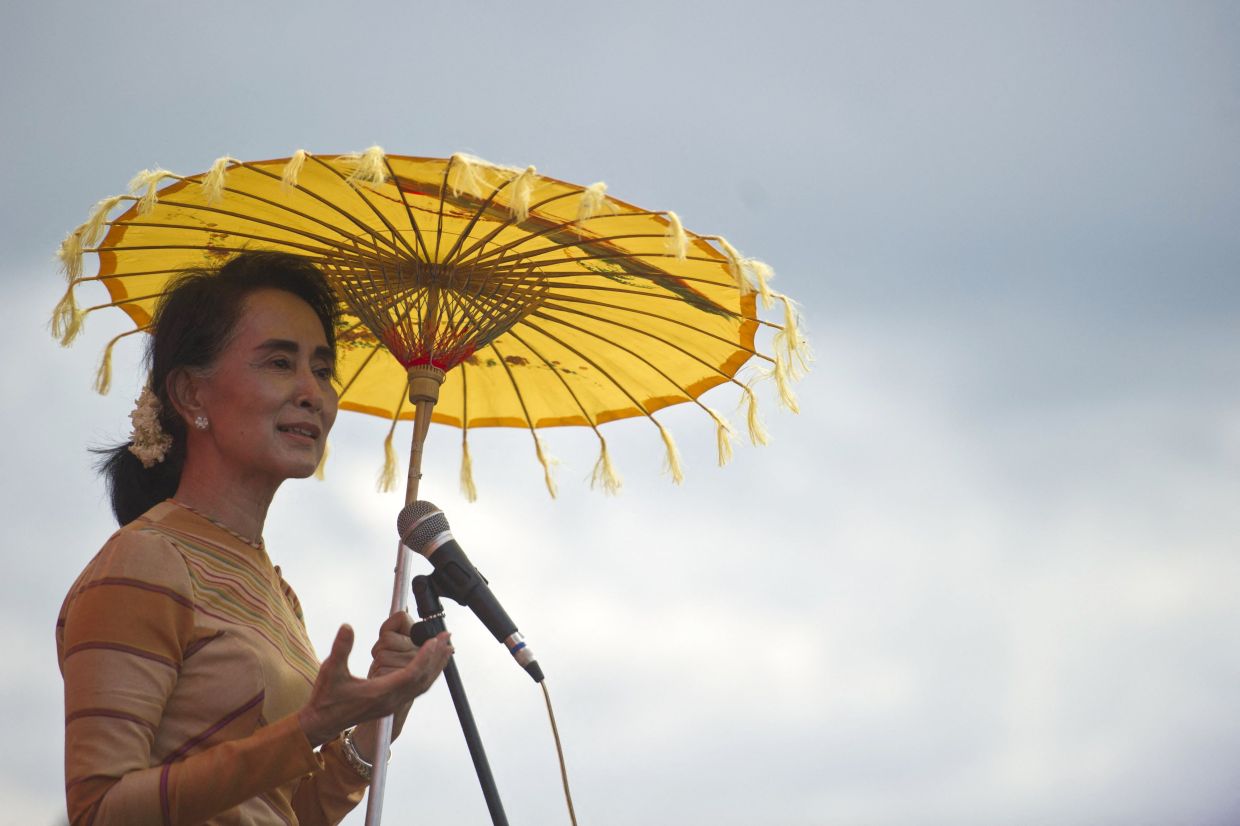
Myanmar's military government has once again rebuffed efforts by the Association of Southeast Asian Nations to gain access to deposed leader Aung San Suu Kyi, who recently turned 81 while imprisoned. The regime's spokesperson Khaing Khaing Soe rejected an appeal from Asean chair the Philippines' Foreign Secretary Maria Theresa Lazaro at a press conference on June 30, citing legal proceedings against the former Myanmar leader and her status as a convicted prisoner ineligible for foreign visitors. This latest refusal follows a similar denial during Lazaro's previous visit to Myanmar's capital Naypyitaw on January 7, marking a consistent pattern of stonewalling from Naypyidaw.
The repeated denials carry significant meaning for Asean's standing in Myanmar. Observers note that the junta leadership under Min Aung Hlaing, now positioned as president after relinquishing his military chief role in April, clearly believes the ten-nation bloc wields minimal influence over its affairs. Hunter Marston of the Lowy Institute articulated this dynamic bluntly: the military regime calculates that Myanmar's strategic value to Asean outweighs any pressure the grouping can exert. This asymmetry in perceived leverage fundamentally undermines Asean's ability to shape outcomes in one of its most troubled member states, a weakness that becomes increasingly apparent with each rejected diplomatic initiative.
The junta's willingness to grant access to select foreign dignitaries while blanket-refusing Asean representatives further illustrates its discriminatory approach to international engagement. Former Thai foreign minister Don Pramudwinai succeeded in meeting Suu Kyi during a July 2023 visit to Naypyitaw, and Chinese Foreign Minister Wang Yi reportedly secured access during his April 2024 trip to the capital. These selective permissions reveal whom the military regime genuinely prioritises as strategic partners and whose concerns it takes seriously. Marston emphasised that such selectivity functions as a power play, demonstrating the junta's determination to control the political narrative around Suu Kyi's detention and to dictate the terms of international engagement.
At the heart of this standoff lies Asean's Five-Point Consensus, a peace plan developed immediately after the February 2021 coup to address Myanmar's descent into violence and chaos. The plan calls for an immediate ceasefire, humanitarian aid access, dialogue between the military and opposition forces, and critically, the appointment of an Asean special envoy empowered to meet all relevant parties, including Suu Kyi. However, Min Aung Hlaing has shown minimal regard for these conditions, instead consolidating power through a carefully controlled election earlier this year that international observers widely dismissed as a charade. The junta's refusal to permit Asean envoys to meet Suu Kyi represents a direct violation of the consensus framework, yet carries minimal concrete consequences for Myanmar.
The human toll of the conflict since the coup underscores the urgency of Asean's diplomatic efforts. According to Armed Conflict Location & Event Data, an independent global conflict monitor, at least 100,000 people have died in Myanmar since the putsch, a death toll comparable to many of the world's major armed conflicts yet receiving limited international attention. Beyond fatalities, countless others face displacement, economic collapse, and destruction of civil society structures. Asean's inability to influence Myanmar's trajectory directly impacts humanitarian conditions across the region and threatens to destabilise border areas affecting Thailand, Bangladesh, and other neighbours. The regime's dismissal of regional pressure thus has consequences that extend well beyond Myanmar's borders.
Suu Kyi's current situation remains murky and deeply concerning. She is serving a reduced sentence of approximately 18 years after the military regime has periodically commuted portions of her original 33-year conviction on charges including violations of the Official Secrets Act and corruption allegations. Credible international observers and her legal representatives have consistently characterised these charges as politically motivated and the convictions as fundamentally unjust. Most alarmingly, following reports in April that she was placed under house arrest, independent sources have neither seen nor heard from her, creating a profound information vacuum regarding her actual condition and treatment. Her son, Kim Aris, expressed both disappointment and unsurprise at Asean's failed request, noting that the regime's isolation of his mother from external contact raises troubling questions about what authorities are attempting to conceal.
The inability of Kim Aris himself to visit or communicate with his mother for five years speaks volumes about the regime's approach to Suu Kyi. Despite repeated official assurances of her good health, the junta's blanket prohibition on contact with family members and international representatives contradicts any genuine claim that detention is merely a legal matter. The regime's justification—that convicted prisoners cannot meet foreign visitors—applies inconsistently when the same rules do not prevent visits from favoured nations. This arbitrary application reveals the political calculation underlying Suu Kyi's incarceration, transforming her case from a legal matter into a question of the regime's willingness to acknowledge any external scrutiny of Myanmar's internal arrangements.
Phyo Win Latt, an independent historian of Myanmar, provided incisive analysis of the regime's actual objectives. The junta's rejection of Asean access to Suu Kyi fundamentally rests on its refusal to acknowledge Asean's legitimacy as a supervisory force over Myanmar's political settlement. The military government desires Asean recognition and reintegration into regional forums but explicitly rejects the notion that the grouping should exercise scrutiny over how it treats political prisoners or manages its internal affairs. This distinction proves critical: Naypyitaw wants the benefits of Asean membership and engagement without accepting any corresponding obligations or external accountability. Such a stance naturally conflicts with Asean's stated commitment to dialogue and non-military solutions to regional conflicts.
From the junta's perspective, the Five-Point Consensus constitutes unfair selectivity applied exclusively to Myanmar. Min Aung Hlaing's government has questioned why Asean vigorously enforces conditions on Myanmar when it remains notably passive regarding other member states' disputes, pointing specifically to Thailand's unresolved territorial disagreements with Cambodia. This argument contains a kernel of truth: Asean has historically prioritised non-interference in members' affairs to a degree that undermines collective problem-solving. Yet the comparison proves facile, as Myanmar's descent into mass violence and humanitarian catastrophe represents a qualitatively different category of crisis demanding proportional regional response. The regime's framing of accountability mechanisms as unfair represents a classic rationalization for non-compliance rather than a legitimate grievance.
Asean's indefinite ban on Min Aung Hlaing's participation in leaders' summits reflects the grouping's limited but still meaningful leverage. Since the coup, the bloc has excluded the Myanmar leader from attending association meetings, signalling displeasure while falling short of more punitive measures. However, the regime's apparent indifference to this exclusion—viewing it as inconsequential to its core interests—demonstrates the limits of symbolic sanctions. The ban continues primarily to maintain Asean's credibility with its own Five-Point Consensus rather than to coerce Myanmar's compliance. As time passes and the situation shows no signs of resolution, even this minimal measure risks becoming irrelevant, further eroding Asean's regional authority.
The broader implications for Southeast Asian stability warrant serious consideration from Malaysia and other concerned nations. Myanmar's trajectory will significantly impact regional dynamics, from refugee flows and cross-border instability to great power competition for influence. China's visible cultivation of ties with the junta, evidenced by Wang Yi's access to Suu Kyi, contrasts sharply with Asean's exclusion, suggesting that Myanmar may increasingly orient toward Beijing rather than its regional peers. This geopolitical realignment carries consequences for the balance of power within Asean and beyond. If the region's most developed countries cannot collectively influence one member state's conduct, questions about Asean's relevance to regional security architecture become increasingly pressing.

