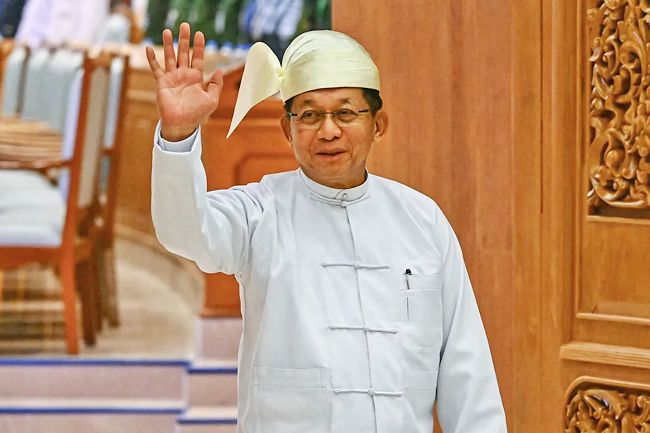
Myanmar's military leader Min Aung Hlaing is set to visit Thailand next month for talks with Prime Minister Anutin Charnvirakul scheduled for August 6 and 7 in Bangkok, according to Thailand's foreign minister Sihasak Phuangketkeow, who announced the visit following discussions with ASEAN counterparts in Manila. The planned engagement signals Thailand's determination to maintain diplomatic momentum with Myanmar despite the country's international isolation stemming from the 2021 military coup that ousted democratically elected leader Aung San Suu Kyi.
Thailand's diplomatic push represents a significant outlier within ASEAN, as most member states have grown increasingly critical of Myanmar's military junta. While Myanmar technically retains ASEAN membership, the bloc has formally excluded it from major summits and meetings since the coup, reflecting widespread disapproval of the military's seizure of power. This punitive approach has created a growing rift within the ten-nation regional organisation, with Thailand's willingness to engage directly with Min Aung Hlaing exposing fundamental disagreements over how best to handle the Myanmar crisis.
Geographical proximity and humanitarian concerns form the backbone of Thailand's distinctive approach. Sharing an extensive border with Myanmar and hosting millions of refugees fleeing civil conflict, Thailand faces immediate and pressing consequences from instability across its frontier. The country has become a primary destination for those escaping the violence that has engulfed Myanmar since the coup, placing Bangkok under considerable pressure to find diplomatic solutions that might alleviate the humanitarian toll and stabilise the border region.
Sihasak characterised the upcoming bilateral meetings as part of a "dual-track approach" that balances immediate practical concerns with longer-term ASEAN objectives. He emphasised that Thailand intends to address concrete transnational issues including organised crime networks, online scams originating from Myanmar, and the drug trade that has plagued the region for decades. These problems directly affect Thailand's security and require direct engagement with the Myanmar authorities, even if broader political reconciliation remains distant.
However, Thailand's pragmatic engagement strategy has generated considerable friction within ASEAN circles. During the Manila discussions, Sihasak noted that foreign ministers engaged in what he described as "frank and candid" exchanges about how the bloc should measure progress toward Myanmar's normalisation. The underlying tension reflects fundamental disagreement about whether incremental improvements justify continued diplomatic engagement or whether the junta should face sustained international pressure.
The definition of progress itself has become contentious. Sihasak outlined potential benchmarks that might indicate movement toward resolution, including whether Myanmar's government would grant ASEAN's special envoy access to detained former leader Suu Kyi, or whether violence along the Thai-Myanmar border could be reduced. These metrics highlight the minimum standards Thailand considers achievable in the near term, while still falling short of ASEAN's original five-point peace plan that demands democratic reforms and respect for human rights.
Thailand's approach explicitly acknowledges that fundamental political transformation in Myanmar will not materialise quickly or easily. Sihasak's statement that "it's not going to happen overnight" and that "some progress will come incrementally" reflects a calculated decision to pursue modest, measurable gains rather than holding out for comprehensive democratic change. This represents a significant departure from ASEAN's traditionally unified rhetorical commitment to democracy and human rights, suggesting that Thailand views regional stability and bilateral relations as more immediately achievable goals.
The military junta's installation of Min Aung Hlaing as president through heavily restricted elections, which international observers widely condemned as neither free nor fair, technically creates space for renewed diplomatic initiatives. Sihasak suggested these elections might paradoxically open dialogue opportunities with Myanmar's armed ethnic groups and fragmented democratic opposition, which have intensified armed resistance against military rule since the coup. Thailand has positioned itself as a potential mediator between the junta and ethnic armed organisations operating along the Thai border, framing such facilitation as an essential building block toward eventual national reconciliation.
Additional reform proposals being considered within ASEAN suggest growing recognition that current approaches remain inadequate. Philippine Foreign Minister Theresa Lazaro revealed that ASEAN was contemplating the appointment of a permanent, long-term special envoy to Myanmar to replace the existing yearly rotation system. This change tacitly acknowledges that the revolving-envoy model has achieved little substantive progress, with different representatives arriving annually with fresh mandates but limited continuity. A permanent appointment could provide the consistency and relationship-building necessary for meaningful diplomatic engagement, though it also risks institutionalising ASEAN's acceptance of the junta's continued rule.
For Malaysia and other ASEAN members, Thailand's push presents a troubling precedent. The bloc has historically prided itself on presenting unified positions toward member states, particularly on fundamental issues like democratic governance. Thailand's willingness to pursue bilateral engagement outside established ASEAN mechanisms threatens the principle of collective decision-making that has anchored regional stability for decades. Yet Thailand's argument that isolation has proven ineffective carries weight, particularly given Myanmar's deteriorating humanitarian situation and the refugee crisis affecting neighbouring countries.
The August visit by Min Aung Hlaing underscores how profoundly Myanmar's coup has disrupted ASEAN cohesion. Rather than forcing the junta toward democratic reform through isolation and non-recognition, the bloc's divisions have paradoxically strengthened the regime's position by allowing individual members like Thailand to pursue parallel diplomacy. This fragmented approach may generate tactical advantages for Thailand in managing immediate border security and refugee concerns, but it weakens ASEAN's collective bargaining power and potentially signals to Myanmar's generals that patient engagement with sympathetic states will ultimately restore their international legitimacy.

