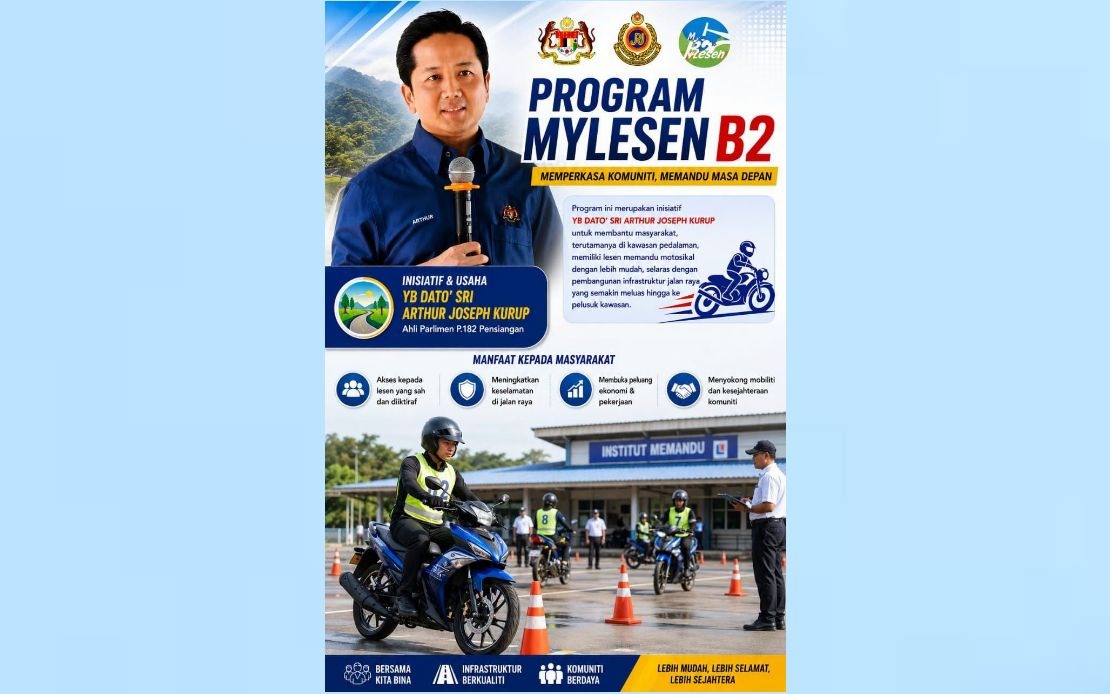
The Malaysian government's MyLesen B2 initiative has made a return to Pensiangan in Sabah, aimed at expanding access to motorcycle licensing among rural populations who would otherwise face significant logistical challenges in obtaining credentials through conventional channels. The programme represents a targeted effort to democratize road safety documentation across Malaysia's more dispersed communities, where geographic distance and limited transport infrastructure have historically created obstacles for residents seeking to regularize their riding status.
Pensiangan Member of Parliament Datuk Seri Arthur Joseph Kurup, who also serves as Minister of Natural Resources and Environmental Sustainability, framed the initiative as addressing a genuine accessibility gap within his constituency. By bringing licensing services directly to rural areas, the programme eliminates the need for prospective riders to undertake expensive and time-consuming journeys to driving schools located in major urban centres. This logistical barrier has long prevented many young people and working-age adults in East Malaysia from obtaining formal credentials, despite their regular use of motorcycles for transportation and livelihood purposes.
The underlying structure of MyLesen B2 maintains comprehensive safeguards despite its community-based delivery model. Participants remain subject to the same mandatory training courses and standardized examinations that apply across Malaysia's licensing framework. This approach ensures that convenience does not come at the expense of road safety standards. Rather, the programme combines accessibility with rigorous competency testing, allowing rural residents to demonstrate their knowledge of traffic regulations and riding techniques through properly supervised assessments.
Educational content represents a core component of the initiative's design. Beyond mechanical licensing requirements, the programme emphasizes participant understanding of road traffic laws and safe riding practices. This emphasis reflects evidence suggesting that formal education about traffic regulations significantly contributes to reducing accident rates and improving compliance among motorcyclists. Rural communities, which sometimes experience higher accident rates due to limited enforcement presence and varying road conditions, stand to benefit substantially from enhanced legal awareness and safety orientation.
Economic dimensions underpin the government's investment in this programme. Valid motorcycle licences unlock employment opportunities that might otherwise remain inaccessible to rural youth and adults. In many agricultural and resource-extraction communities across Sabah, motorcycle ownership serves as an essential tool for accessing work opportunities, attending training programmes, and participating in commerce. By removing bureaucratic barriers to licensing, the initiative creates pathways for economic participation that extend beyond immediate transportation concerns.
The long-term value proposition of the licence holds particular significance for programme participants. Unlike temporary documentation or conditional permits, MyLesen B2 credentials provide lifelong validity, subject only to ongoing compliance with regulatory requirements. This permanence means that residents who successfully complete the programme secure credentials that will serve them throughout their working lives and potentially support their families' economic mobility across generations. The stability of this arrangement distinguishes it from temporary measures or time-limited interventions.
Eligibility parameters reflect careful targeting of communities most likely to benefit from expanded access. The programme opens to residents aged between 16 and 63, with particular emphasis on individuals who have never previously held driving licences. This age range captures both young people entering the workforce and middle-aged adults who may have deferred licensing due to accessibility constraints. The focus on first-time licence holders suggests the programme aims to formalize existing riding practices rather than encouraging new motorcycle adoption.
Implementation logistics emphasize accessibility through multiple registration channels within the constituency. The Pensiangan Parliamentary Service Centre and the Sook State Assemblyman's Service Centre both provide registration documents, ensuring that residents can access programme information through locally trusted institutions rather than distant government offices. This distributed approach recognizes that government services remain more effective when delivered through established community touchpoints that residents already utilize for other administrative matters.
For Malaysian readers, particularly those in rural regions, the MyLesen B2 programme illustrates a broader government strategy of extending standardized administrative services into geographically dispersed communities. The initiative acknowledges that legitimate regulatory requirements should not inadvertently exclude citizens from underserved areas. As Malaysia continues developing its rural infrastructure and economic opportunities, ensuring that rural residents can access foundational credentials like driving licences becomes increasingly essential to inclusive economic participation and road safety outcomes across all regions.

