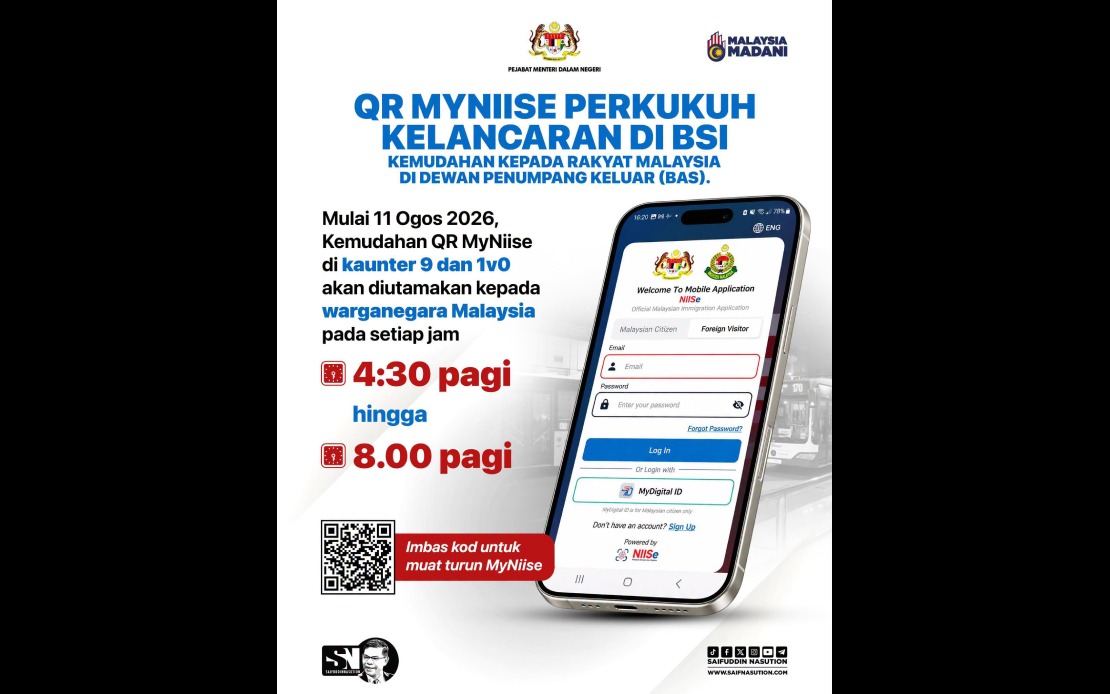
Malaysia is accelerating immigration processing for cross-border commuters with the rollout of dedicated fast-track lanes powered by the National Integrated Immigration System at Bangunan Sultan Iskandar. Home Minister Datuk Seri Saifuddin Nasution Ismail announced the initiative on August 11, positioning it as a response to the persistent congestion that plagues the morning departure rush to Singapore. The new arrangement funnels MyNIISe QR code users through counters 9 and 10 in the Bus Departure Hall, operational between 4.30 am and 8 am when traveller volume typically peaks.
The timing reflects a clear understanding of daily commuting patterns across the Johor Strait. Thousands of Malaysians cross into Singapore each morning for employment, with many departing as early as dawn to secure seats on interstate buses and arrive at workplaces by standard business hours. This pressure point has long created bottlenecks at immigration control, frustrating both travellers and officials managing the checkpoint. The MyNIISe initiative directly targets this vulnerability by allowing pre-screened digital submissions to bypass conventional queue congestion, theoretically shaving minutes off processing time during the busiest window.
MyNIISe represents one of the government's flagship modernisation projects, embedding digital-first border management into Malaysia's immigration infrastructure. The system is accessible through major application platforms—the Apple App Store, Google Play Store, and Huawei App Gallery—enabling broad smartphone penetration regardless of device ecosystem preference. This multi-platform availability is strategically important in Malaysia's mobile-first market, where device diversity remains common across income levels. By prioritising QR-based users, the government creates a tangible incentive for voluntary adoption of digital systems while maintaining parallel conventional channels for those unable or unwilling to use applications.
The priority lane arrangement carries implications beyond mere convenience. For daily commuters, shaving even five to ten minutes from border crossing times compounds across weeks and months, recovering productive time and reducing stress. For Singapore-bound workers already managing tight schedules, this incremental efficiency gain translates into meaningful quality-of-life improvements. The system also generates valuable data on cross-border movement patterns, allowing both Malaysian and ultimately Singaporean authorities to better forecast congestion and resource deployment at bilateral checkpoints.
From a transport integration perspective, the initiative sits within a broader Southeast Asian trend toward seamless mobility corridors. As the ASEAN Economic Community advances, member states increasingly recognise that friction at borders directly undermines competitiveness and workforce flexibility. Malaysia's investment in digital immigration systems positions it ahead of some peers while aligning with Singapore's own technological sophistication, potentially setting a template for bilateral cooperation that extends beyond the current pilot scheme.
The announcement also signals implicit confidence in the maturity of Malaysia's digital infrastructure and citizen preparedness for app-based governance. QR code adoption has accelerated dramatically post-pandemic, normalising digital credentials for transactions ranging from retail to health verification. Immigration represents a natural next frontier, though successful uptake hinges on user confidence in data privacy and system reliability. The government has not publicly detailed data protection protocols or cybersecurity standards underpinning MyNIISe, an omission that may temper enthusiastic adoption among security-conscious travellers, particularly those handling sensitive cross-border business information.
The geographic concentration of this facility at Bangunan Sultan Iskandar specifically targets the bus commuter demographic, the dominant mode of Singapore-bound transport for Malaysian workers. Coach operators and bus station management will likely benefit from reduced congestion, enabling faster turnarounds and improved scheduling predictability. However, the scheme's impact remains limited to this single checkpoint and mode, leaving unaddressed congestion at other Malaysia-Singapore crossing points serving private vehicles, motorcycles, and train passengers. Any comprehensive border modernisation strategy would eventually require harmonised systems across all entry points.
Home Minister Saifuddin Nasution's framing of the initiative emphasises user convenience and congestion relief rather than enforcement or security enhancement, a messaging choice that reflects political sensitivity around border control. Immigration officers have long balanced facilitation with security screening, and priority lanes inherently create questions about whether expedited processing maintains equivalent scrutiny. The government's public communications avoid this tension, instead stressing traveller experience and official commitment to removing bureaucratic friction.
Implementation success will depend heavily on sustained technology reliability and user education. MyNIISe uptake requires not only download enthusiasm but consistent, trouble-free operation across peak-hour network congestion. System outages during morning rush periods would rapidly erode confidence and revert users to conventional queues. Additionally, counter staff will require training ensuring that QR-based processing genuinely accelerates clearance rather than creating new bottlenecks through unfamiliar procedures. The relatively narrow operational window—4.30 am to 8 am—suggests a pilot approach, with potential for expansion pending performance metrics.
The announcement arrives as Malaysia continues calibrating its post-pandemic immigration posture, balancing reopening momentum with border security and revenue collection. Digital systems offer governments tools for modernising experience while simultaneously enhancing intelligence gathering and compliance monitoring. MyNIISe, therefore, serves multiple constituencies: the commuter seeking faster passage, the immigration officer managing throughput and security, and the government institution building a modern border framework aligned with regional standards and citizen expectations.
Successful implementation of this priority lane could accelerate broader MyNIISe adoption, demonstrating tangible government service improvements tied to digital engagement. As Southeast Asian economies deepen integration and cross-border mobility becomes routine for growing numbers of workers, efficient immigration processing transitions from convenience to competitive necessity. Malaysia's current initiative, though modest in immediate scope, positions the country within this broader evolution while directly benefiting the substantial community of daily Malaysia-Singapore commuters whose economic contributions justify infrastructure and process investment.

