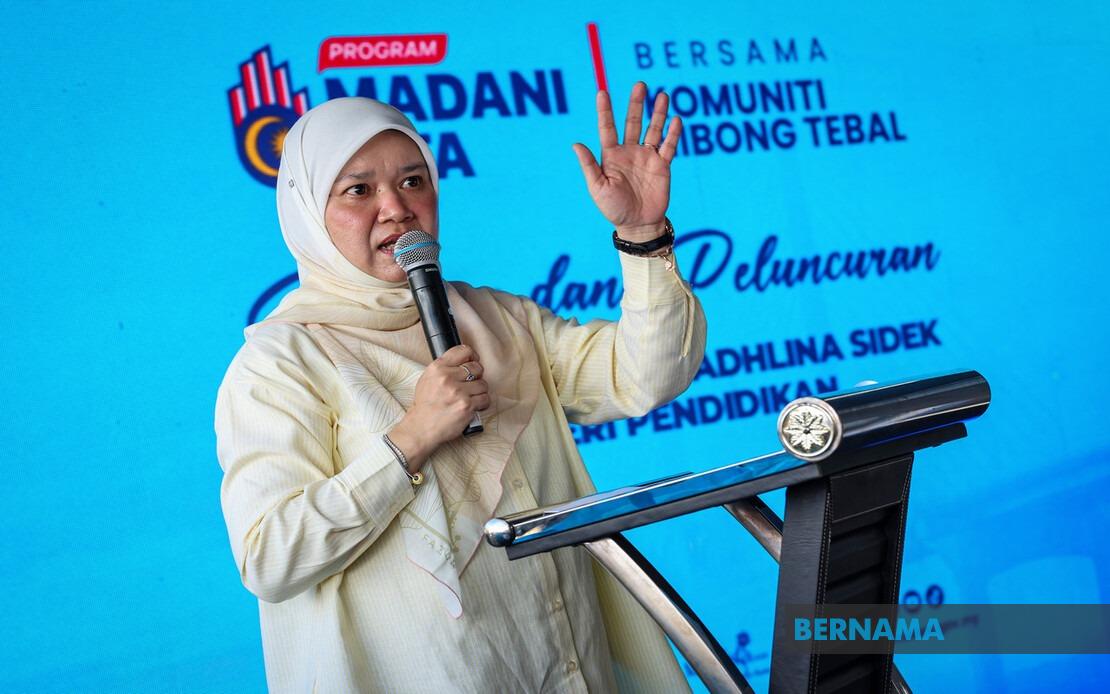
Education Minister Fadhlina Sidek has commended the NADI Mahir school uniform initiative as a practical solution to one of Malaysia's persistent household expenses, praising the programme's ability to distribute cost pressures across several payment cycles rather than requiring lump-sum expenditure at the start of each school term. Speaking during an official visit to Nibong Tebal, Sidek underscored how the instalment payment model responds to a tangible need among Malaysian families, particularly those managing tight monthly budgets where school fees, books, and uniforms compete for limited resources.
Beyond its direct consumer benefit, the NADI Mahir scheme demonstrates a deeper policy intent: channelling demand for essential goods through local micro-entrepreneurs rather than large commercial suppliers. The 120 tailors and seamstresses trained through the NADI Mahir Jahit skills programme now operate as independent business owners, collectively producing the uniforms distributed across the instalment network. This model creates a dual-benefit ecosystem where families gain affordable payment flexibility whilst trained artisans secure reliable income and expand their customer base through institutional partnerships.
The education minister drew particular attention to NADI's broader community engagement framework, of which the uniform scheme forms one component. The National Information Dissemination Centre operates multiple concurrent initiatives spanning academic support, digital skills, youth development, and entrepreneurship training. Sidek noted that these interconnected programmes reflect a holistic approach to addressing inequality and capability gaps across different demographic segments, rather than relying on isolated interventions.
Data from the NADI Tuisyen Rakyat tutoring programme reveals measurable educational impact, with over 42,000 students nationwide accessing subsidised tuition services. Within Sidek's own parliamentary constituency of Nibong Tebal, more than 73 students participated in the scheme, and notably, 65 outstanding examination results were recorded in the 2025 Sijil Pelajaran Malaysia assessment. These figures suggest that when tutoring removes cost barriers, academic achievement improves proportionally—an outcome with implications for education policymakers across Southeast Asia grappling with similar equity challenges.
Youth engagement extends beyond academics into competitive spheres through NADI E-Sukan, a digital gaming and esports platform designed to identify talent, build confidence, and foster teamwork among younger Malaysians. Nibong Tebal has demonstrated regional competitiveness in this space, securing the national NADI E-Sukan MADANI Mobile Legends title and placing as state runners-up in Penang. These results indicate that structured esports initiatives, when properly resourced and professionally administered, can function as legitimate platforms for youth development rather than merely entertainment channels.
The entrepreneurship pipeline extends into emerging technology domains through the 1 NADI 1 Prompt Engineer initiative, which introduces artificial intelligence and generative AI tools to aspiring technicians and business operators. Eleven participants in Nibong Tebal have already engaged with this programme, reflecting early adoption patterns as Malaysia positions itself within the global AI economy. Such training bridges the gap between policy announcements about digital transformation and practical skill acquisition at community level, where most citizens ultimately require hands-on competency to compete in evolving labour markets.
Fadhlina's endorsement carries particular weight given her dual role as both education minister and the elected representative for Nibong Tebal, allowing her to assess NADI's effectiveness from both systemic and constituency-level perspectives. Her public advocacy suggests the government views NADI less as a temporary pilot scheme and more as an institutionalised mechanism for delivering social services and community development through existing communication and information infrastructure. This positioning indicates longer-term commitment to scaling programmes if initial results prove sustainable.
The presence of Ministry of Communications officials and Malaysian Communications and Multimedia Commission representatives at the Nibong Tebal event underscores how multiple government entities now treat NADI as a strategic platform rather than an isolated education department concern. This cross-ministerial coordination suggests that digital service delivery, financial inclusion through instalment schemes, and skills training are increasingly understood as interconnected policy domains requiring collaborative execution rather than siloed implementation.
For Malaysian households, particularly those in lower-income brackets, the practical relief provided by uniform instalment payments may appear modest in isolation but compounds meaningfully across school expenses. When uniforms, textbooks, tuition, transport, and other educational costs can be staggered rather than front-loaded, household cash flow management becomes substantially less precarious. This financial architecture matters considerably in a middle-income country like Malaysia where disposable income inequality remains pronounced and education expenses constitute significant budget allocations for working-class families.
The NADI Mahir model also illustrates how skills training programmes can generate sustainable economic activity when connected to reliable demand sources. Rather than training seamstresses and tailors and hoping they secure independent clientele, the programme ensures trained entrepreneurs receive institutional orders through the school uniform supply chain. This guaranteed demand reduces business risk and increases survival rates for microenterprises—a structural advantage that many entrepreneurship support schemes overlook when emphasis falls primarily on training rather than market access.
Looking forward, the scalability question will determine whether NADI's Nibong Tebal success translates into national impact. Expanding the school uniform scheme to additional states, replicating the tutoring programme across underserving regions, and scaling esports infrastructure to smaller towns will require sustained funding and administrative capacity. Early indicators from Nibong Tebal suggest both community uptake and measurable outcomes exist, but translating localised success into nationwide coverage presents familiar challenges that Malaysian policymakers will navigate as NADI continues expanding its footprint across the country.

