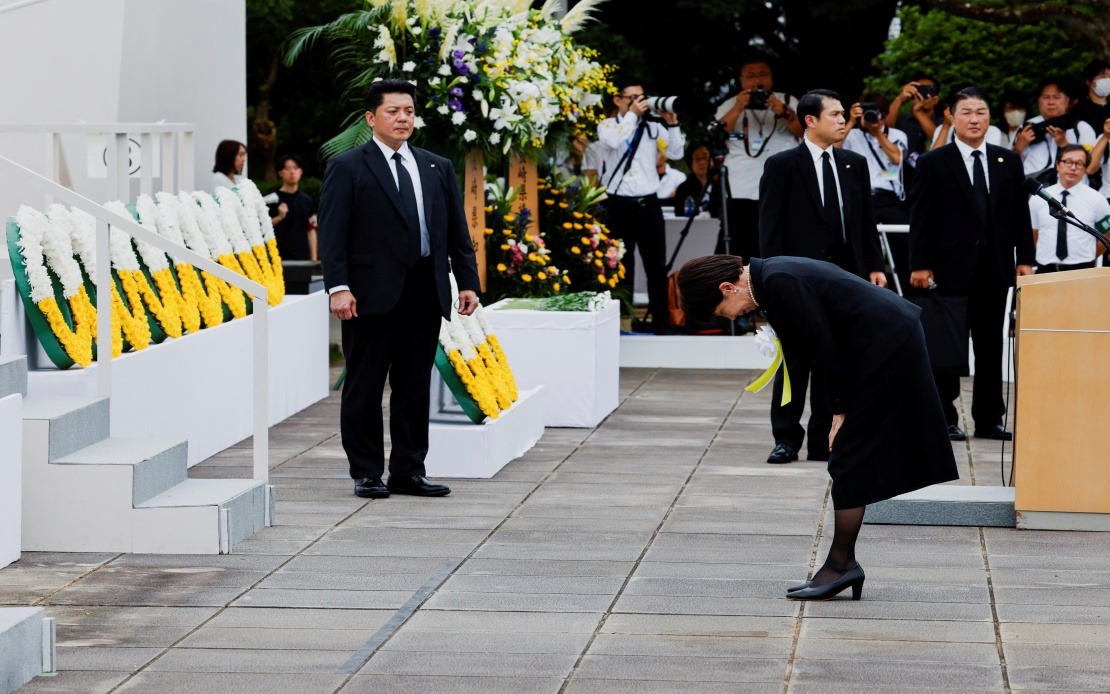
Japan's southwestern city of Nagasaki observed the 81st anniversary of the atomic bombing on Sunday with a solemn ceremony that underscored the enduring tension between nuclear disarmament and modern security concerns. The commemoration of the August 9, 1945 attack, which occurred just three days after Hiroshima fell victim to nuclear fire, arrives at a time when global powers are increasingly divided on how to manage nuclear weapons in an era of rising geopolitical instability. For Southeast Asian observers, the ceremony represents more than historical reflection—it signals the deepening philosophical divide over whether nuclear deterrence remains necessary or whether the world must pursue complete disarmament.
Mayor Shiro Suzuki was expected to use the platform to call upon world leaders to prioritize nuclear disarmament while making an unequivocal statement that human civilization cannot sustainably coexist with nuclear weapons. This message carries particular weight in a region where Japan's security arrangements, its historical pacifism, and emerging strategic anxieties create an increasingly complex calculus. The mayor's remarks come against the backdrop of intensifying regional tensions that have prompted some Japanese policymakers to question whether the nation's three nonnuclear principles—prohibiting the production, possession, or stationing of nuclear weapons—remain viable in contemporary security environments.
The moment of silence at 11.02 a.m. marked the precise instant when the "Fat Man" plutonium device was released from a US bomber and detonated over the city, forever marking Nagasaki as the last place on Earth to endure nuclear attack. The specificity of this timestamp reflects the permanent imprint the bombing left on the city's collective memory, with survivors and descendants continuing to mark the exact seconds that altered the course of human history. The fact that no other city has subsequently experienced nuclear bombardment speaks both to the catastrophic nature of the weapon and to an implicit global understanding that such devastation must not be repeated.
Prime Minister Sanae Takaichi's expected presence at the ceremony, alongside a statement from UN Secretary-General António Guterres, underscored the international dimensions of the annual remembrance. Yet Takaichi's participation occurs amid mounting controversy within Japan over whether the nation should reconsider its longstanding nuclear abstinence. Following similar remarks at Thursday's Hiroshima ceremony, Takaichi emphasized that Tokyo "is upholding" its nonnuclear policy, a carefully calibrated statement that simultaneously acknowledges growing domestic pressure to revisit this foundational principle.
The debate over Japan's nuclear posture reflects broader anxieties about regional security in Northeast Asia. China's expanding nuclear arsenal, North Korea's missile development, and Russia's military assertiveness have prompted some Japanese strategic thinkers to suggest that extended reliance on the US nuclear umbrella may prove insufficient for long-term security. Malaysia and other Southeast Asian nations watch this debate with keen interest, recognizing that any shift in Japanese nuclear policy could reshape the entire regional security architecture and potentially trigger proliferation cascades that would affect smaller, non-nuclear nations seeking to maintain strategic stability.
The May review conference of the Nuclear Non-Proliferation Treaty, typically convened every five years, concluded without consensus for the third consecutive occasion following its monthlong deliberation in New York. This failure represents a significant setback for global arms control efforts and reflects the widening fissures between nuclear-armed states and non-nuclear nations over burden-sharing and disarmament timelines. For developing nations in Southeast Asia that are party to the treaty, the breakdown signals that international mechanisms designed to prevent nuclear proliferation are increasingly ineffective and that security may increasingly depend on bilateral relationships rather than multilateral agreements.
The Nagasaki bombing claimed approximately 74,000 lives by the end of 1945, with countless others experiencing lifelong radiation-related health complications and psychological trauma. Japan's subsequent surrender on August 15 that year brought World War II to a close, but the nuclear devastation that preceded capitulation became the defining catastrophe that shaped postwar international relations and ultimately established the foundations for modern arms control frameworks. The human toll remains almost incomprehensible—a single weapon's instantaneous obliteration of an entire city continues to stand as humanity's bleakest technological achievement.
The hibakusha, or atomic bomb survivors, now average more than 86 years of age among those officially recognized by the government, creating an urgent imperative for historical transmission to younger generations. These witnesses to nuclear warfare are racing against time to ensure that the consequences of atomic weapons are not merely academic abstractions but visceral, emotionally comprehensible truths embedded in collective memory. Many hibakusha and their advocacy organizations have become vocal proponents of disarmament, viewing their personal suffering as evidence that nuclear weapons cannot be safely managed or controlled, regardless of what security theorists might argue.
For Malaysian readers and Southeast Asian observers, Nagasaki's annual commemoration offers several lessons relevant to regional security deliberations. First, it demonstrates that even a defeated nation recovering from catastrophic destruction ultimately accepted a nuclear-free identity for nearly eight decades, suggesting that non-nuclear status need not be strategically debilitating. Second, the current debate within Japan illustrates how geopolitical pressures can erode even deeply embedded national principles, a concern relevant to any nation seeking to maintain security without nuclear weapons in an increasingly contested environment. Third, the failure of international disarmament mechanisms to produce consensus outcomes indicates that Southeast Asian nations cannot rely solely on global frameworks for protection and must instead cultivate regional stability through dialogue and confidence-building measures.
The persistence of the nuclear deterrence debate despite Nagasaki's cautionary example reflects a fundamental disagreement about human nature and international security. One perspective holds that nuclear weapons, by making total war unthinkable, have paradoxically prevented great-power conflicts and thus deserve retention as permanent security guarantees. The opposing view maintains that the existence of these weapons perpetually courts existential catastrophe and that disarmament, however challenging, remains the only genuinely safe path forward. Japan's internal struggle between these frameworks, embodied in competing visions of national identity and security, will likely determine not only Tokyo's future trajectory but also the strategic environment that surrounds Southeast Asia for decades to come.

