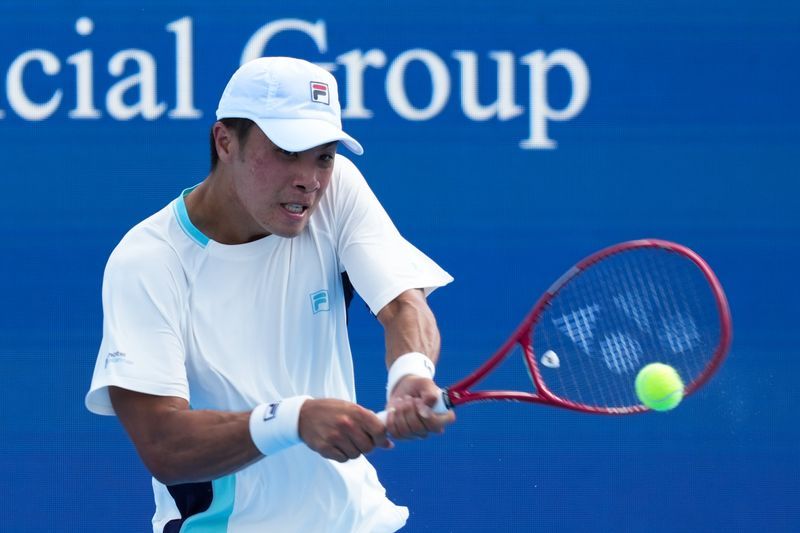
Brandon Nakashima showcased remarkable composure on Friday at the Cincinnati Open, rallying past sixth-seeded American Taylor Fritz 7-6(9) 4-6 6-3 to advance to the semi-finals of the Masters 1000 event. The 25-year-old's comeback victory—particularly from a break down in the deciding set—underscores a remarkable rise in form that has positioned him as one of the tournament's most compelling storylines heading into the U.S. Open.
The Cincinnati triumph represents a significant milestone in Nakashima's career trajectory. By reaching the semi-finals here, he has now secured consecutive appearances in the final four of back-to-back Masters 1000 tournaments, having made the same stage last week in Montreal. This consistency at the sport's elite level, especially across the demanding North American hard-court swing, demonstrates a maturity and mental fortitude that distinguishes his breakthrough moment from previous false starts.
The opening set proved to be a microcosm of the match's overall intensity. Both players demonstrated commanding service games, creating a stalemate that necessitated a tiebreak to separate them. The exchange was tightly contested, with multiple swings in momentum as Nakashima and Fritz traded mini-breaks. Ultimately, Nakashima seized the crucial moment when Fritz's concentration wavered, converting his fifth set point when the sixth seed sent a ball beyond the baseline.
Fritz responded with considerable intensity in the second set, shifting tactical approach by applying aggressive pressure on return of serve. His strategy yielded immediate dividends as he engineered an early break, then consolidated his advantage with an emphatic ace that forced a decider. At that juncture, the match appeared poised in Fritz's favor, particularly given Nakashima's pre-tournament record of just one victory in four meetings with his fellow American.
The decisive third set became the arena where Nakashima's mental resilience truly shone. Fritz capitalized on his opponent's accumulating unforced errors to break serve and reach 3-2, seemingly moving toward victory. However, the momentum shift that defines championship-caliber tennis came almost instantaneously. Facing 30-0 in the subsequent game, Nakashima clawed back from that deficit to convert his second break point of the match, restoring parity at 3-3 and fundamentally altering the psychological tenor of the encounter.
From that inflection point, Nakashima's confidence visibly crystallized. He proceeded to win the final three games consecutively, a run in which Fritz's unforced errors multiplied and his opponent's commanding presence on court became increasingly evident. The momentum transfer reflected both Nakashima's improving execution and Fritz's deteriorating composure—a pattern characteristic of matches between closely matched competitors where marginal psychological advantages become magnified.
This victory represents Nakashima's fourth top-10 scalp this season, an accomplishment that carries particular weight given his career arc. The 27th-seeded American has experienced the full spectrum of professional tennis—periods of promise followed by plateaus that tested his resolve. His current form suggests he has transcended those earlier limitations, developing the consistency and mental architecture necessary to compete with tennis's elite practitioners across extended tournaments.
The Cincinnati triumph also positions Nakashima favorably for the imminent U.S. Open, which commences later this month. Victories achieved on hard courts in North America carry especial relevance for preparing for the year's final Grand Slam, offering both tactical familiarity and psychological momentum. His demonstrated ability to recover from adversity—a hallmark of both the Fritz encounter and his broader recent performances—will prove invaluable when navigating the grueling draws typical of Grand Slam competition.
Nakashima's semi-final opponent will emerge from the match between Italian 10th seed Lorenzo Musetti and fellow American Frances Tiafoe. Regardless of the outcome of that contest, Nakashima's progression represents a continuation of his upward trajectory. His capacity to convert moments of adversity into catalysts for renewed focus, illustrated vividly against Fritz, suggests that his recent accomplishments may represent the foundation of sustained excellence rather than a temporary upswing in an otherwise inconsistent record.
The broader narrative of American tennis depth receives reinforcement through Nakashima's achievements. With multiple American men competing at the elite level—as evidenced by both Fritz and Tiafoe reaching deep into prestigious tournaments—the United States maintains a robust pipeline of competitive professionals. Nakashima's emergence as a reliable performer at Masters level provides further evidence of this productive ecosystem, though his ultimate impact will depend on his capacity to translate these mid-tier tournament successes into performances at the Grand Slam stage where sustained legacies are constructed.

