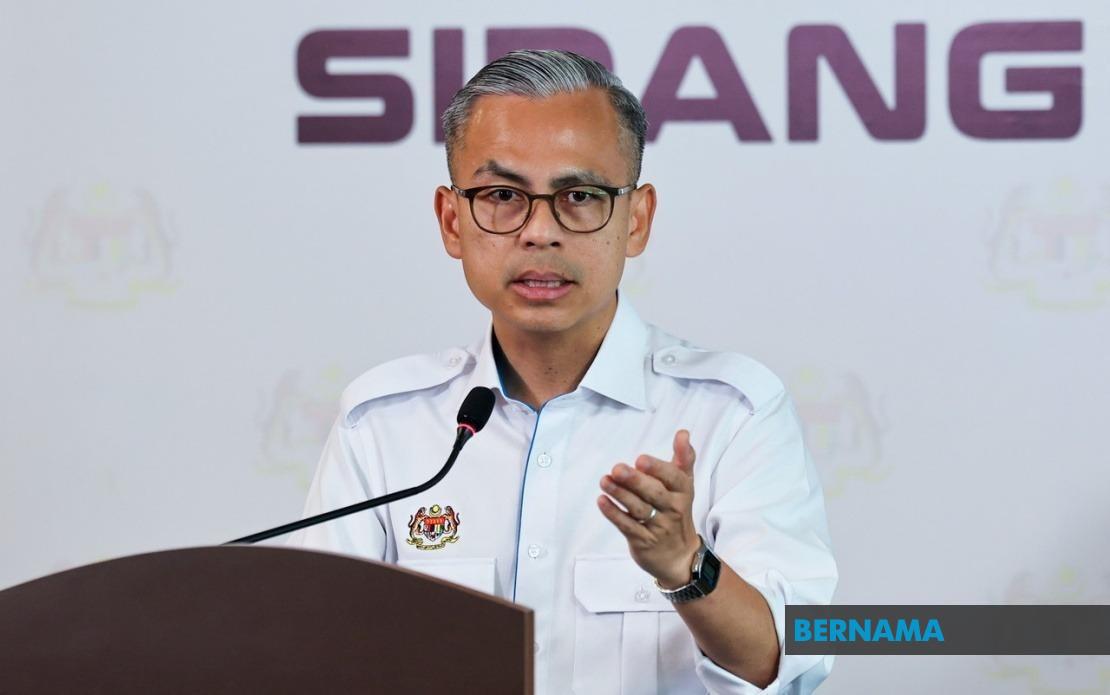
Communications Minister Datuk Seri Fahmi Fadzil announced today that preparations for the 2026 National Day parade at Dataran Putrajaya have reached near-completion, with organisers expecting to address remaining minor details during tomorrow's comprehensive dress rehearsal. Serving as chairman of the 2026 National Day and Malaysia Day Main Committee, Fahmi inspected proceedings at the venue and reported that most operational elements are aligned and ready for the nation's national celebration.
The minister identified spacing between parade contingents as the primary focus for refinement in coming hours. Currently, some military and civilian units are positioned further apart than intended, creating visual gaps in the procession that compromise the overall aesthetic and flow of the parade. Fahmi explained that tightening these intervals will enhance the parade's cohesion and orderly appearance, ensuring contingents move as a unified formation rather than as disconnected segments. This precision-based adjustment reflects the committee's commitment to delivering a polished national spectacle that represents Malaysian organisational standards.
Weather cooperation has significantly aided rehearsal execution, with stable atmospheric conditions allowing participants to complete their assignments without interruption or safety concerns. Beyond meteorological fortune, Fahmi commended the enthusiasm and dedication demonstrated by all involved parties, ranging from uniformed security personnel to school students from three states participating in the human graphics performance component. The scale of coordination required to synchronise thousands of individual participants, each following precise choreography, underscores the logistical complexity underlying what will appear seamless to the watching public.
Among this year's marquee attractions is the debut participation of the Johor Military Force, broadening the representation of regional armed services in Malaysia's premier national parade. Equally notable is the inclusion of a maritime asset—the Ibrahim-class boat designed by His Majesty Sultan Ibrahim, King of Malaysia—which will showcase naval innovation and royal patronage of advanced defence capabilities. These additions distinguish the 2026 celebration from previous editions and reflect evolving national priorities regarding military modernisation and inter-state cooperation.
A technical concern that has drawn public scrutiny involves the multi-tiered structure accommodating 1,500 student performers in the human graphics display. The structure's visible movement during rehearsal raised initial safety questions among observers, prompting Fahmi to provide detailed assurances. He confirmed that Putrajaya Corporation has conducted thorough structural assessments and determined that minor oscillation falls within engineered tolerance parameters designed to accommodate dancers' rhythmic movements without compromising integrity. The structure has successfully supported similar performances twice previously with no incidents, further validating its safety profile.
The perceived asymmetry in the structure's positioning also drew attention, with Fahmi attributing the misalignment to geometric factors beyond the parade committee's control. The parade route and adjacent Putrajaya Corporation building do not share the same architectural axis, constraining structural placement options. Additionally, reducing the human graphics contingent from 2,000 to 1,500 participants this year altered weight distribution calculations, further influencing optimal positioning. Despite these technical realities, Fahmi acknowledged that such visual irregularities could generate negative public perception and has directed the organising secretariat to explore technical refinements for future national day celebrations to eliminate such concerns entirely.
The transition to the 2026 parade represents Malaysia's growing sophistication in coordinating large-scale national events, particularly at Dataran Putrajaya, which has become the symbolic heart of federal governance and patriotic ceremonies. The venue's adoption as the permanent national day celebration site reflects government emphasis on centralised, high-visibility events that can be efficiently managed and widely broadcast to Malaysian audiences. This concentration of resources and coordination at a single location enables more ambitious production values than dispersed celebrations.
For Malaysian organisers and event management professionals, the 2026 parade serves as a live case study in contingency planning and adaptive problem-solving. The ability to identify spacing deficiencies in rehearsal, address structural positioning concerns, and manage participant morale across multiple states demonstrates institutional learning and continuous improvement methodology. Such operational discipline trickles down from federal-level decision-making to ground-level execution, creating organisational standards that extend beyond military and ceremonial contexts into broader Malaysian administrative culture.
The Southeast Asian region will also observe Malaysia's National Day arrangements closely, as regional nations frequently benchmark their own national celebrations against Malaysian precedents. The integration of technological elements like purpose-designed naval vessels and coordinated human graphics displays positions Malaysia as a regional leader in patriotic celebration aesthetics. This soft power dimension—projecting organised, sophisticated national pride—carries strategic implications for Malaysia's regional standing and public diplomacy.
Looking forward, tomorrow's full dress rehearsal will serve as the definitive stress-test for all systems, personnel, and contingencies. Any problems identified during this comprehensive run-through can still be rectified before the official 2026 National Day celebration. Fahmi's confidence in near-completion status suggests the organising committee has managed timelines effectively and allocated resources appropriately to meet anticipated milestones. The success of this parade will establish expectations and precedents for future national day ceremonies, making these final preparation weeks critical for establishing operational excellence that transcends individual celebrations.

