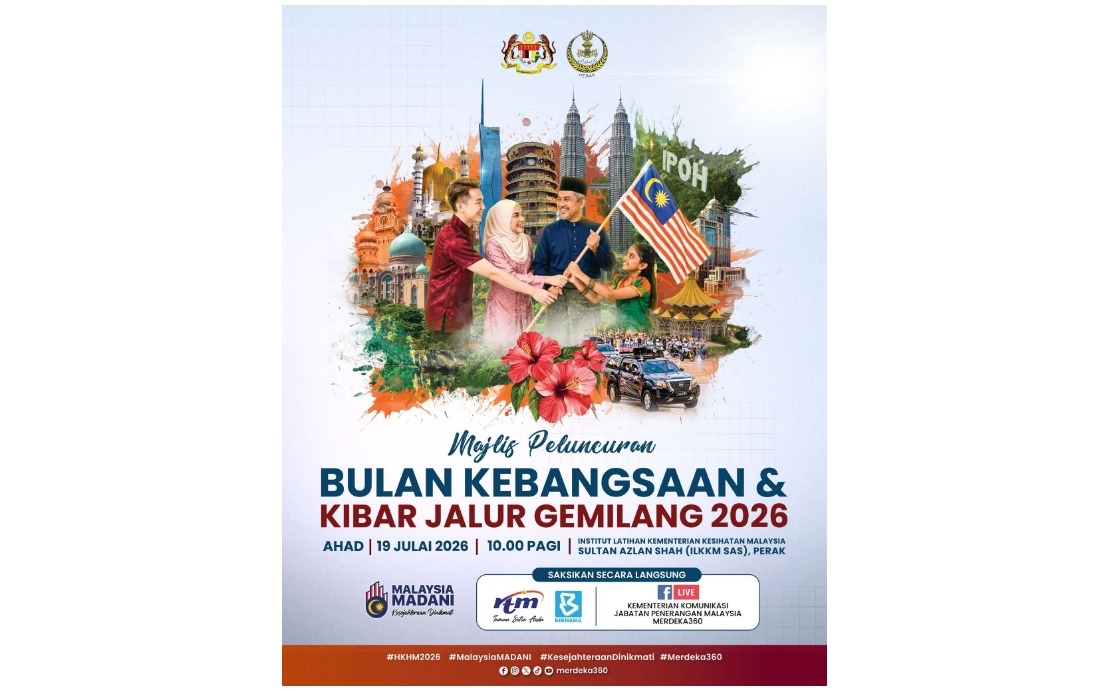
The countdown to Malaysia's 2026 National Month celebrations officially begins on July 19 when the government launches its annual Fly the Jalur Gemilang campaign at Institut Latihan Kementerian Kesihatan Malaysia Sultan Azlan Shah in Perak. Scheduled to commence at 10 am, this opening ceremony represents a pivotal moment in the nation's calendar of patriotic observances, setting the tone for activities spanning the next two months leading to both National Day and Malaysia Day celebrations.
The ceremonial launch will receive widespread broadcast coverage through multiple state and federal media channels, ensuring that Malaysians across the country can participate in the occasion. Radio Televisyen Malaysia, BERNAMA TV, and live streaming via the Merdeka360 Facebook platform alongside official government communications channels will carry the proceedings, reflecting the government's intention to make this year's campaign as inclusive and accessible as possible to the general population.
Central to this year's observances is the unifying theme "Malaysia MADANI: Kesejahteraan Dinikmati," which encapsulates the government's broader vision for national development. The phrase, translating to "Malaysia MADANI: Prosperity Enjoyed," underscores a deliberate philosophical shift in how the nation approaches its identity during these ceremonial periods. Rather than focusing solely on historical commemoration or abstract notions of patriotism, the theme explicitly connects national pride to tangible improvements in citizens' living standards and economic wellbeing.
This thematic approach reflects deeper principles grounded in the Malaysia MADANI framework, which government officials have consistently emphasised as foundational to contemporary policymaking. The framework's emphasis on justice, humanity, and public welfare provides the philosophical underpinning for the 2026 celebrations. By linking these values to the concept of shared prosperity, the government seeks to communicate that national development should benefit all Malaysians equitably, without exclusion based on geographic location, socioeconomic status, or demographic background.
The Merdeka360 platform has been established as the central repository for campaign materials, offering citizens access to official logos, patriotic musical compositions, and various promotional resources designed to facilitate grassroots participation. This digital-first approach recognises that contemporary civic engagement increasingly occurs through online channels, and making materials readily downloadable encourages widespread adoption among schools, community organisations, and private enterprises wishing to participate in the celebrations.
Communications Minister Datuk Seri Fahmi Fadzil has previously outlined the specific arrangements for the two major celebratory events bookending this campaign period. The principal National Day celebration on August 31 will take place at Dataran Putrajaya, though organisers have deliberately chosen to scale back the event to what officials characterise as a more modest yet vibrant format. This decision suggests a recalibration of priorities, possibly emphasising substance and community participation over grandiose spectacle, whilst Malaysia Day on September 16 will shift the national focus eastward to Sarawak, honouring the constitutional role that the two East Malaysian states play within the federation.
Beyond the flagship ceremonies, the government has choreographed seven complementary programmes and patriotic initiatives designed to saturate the calendar with meaningful activities throughout the two-month period. The Kembara Bahasa HKHM initiative targets linguistic appreciation and national cohesion through language, while the Quran Hour programme engages Malaysia's Muslim majority in spiritual reflection aligned with national values. Ambang Merdeka, Merdeka Countdown, and RIUH Merdeka appear designed as grassroots and community-level activations, allowing diverse segments of society to participate meaningfully in celebrations tailored to local contexts and preferences.
The National Statesmen Commemoration Ceremony rounds out this supporting programme suite, suggesting that the government views 2026 as an opportunity to reinforce continuity with Malaysia's political heritage whilst simultaneously projecting forward-looking aspirations. This dual orientation—simultaneously honouring the nation's founding figures and articulating contemporary values—represents a common challenge for post-colonial nations navigating between institutional tradition and modern governance imperatives.
For Malaysian audiences and regional observers, this campaign's emphasis on inclusive prosperity carries particular significance given the economic pressures many households face across Southeast Asia. By explicitly framing national celebration around shared economic wellbeing rather than nostalgic historical narrative, the government positions the Fly the Jalur Gemilang 2026 campaign as directly relevant to citizens' lived experiences. The success of this messaging will partly depend on whether economic indicators and tangible policy outcomes align with the aspirational rhetoric by the time these celebrations reach their climax in September.
The decision to commence the campaign in Perak, one of Malaysia's traditionally significant states both historically and economically, carries symbolic weight beyond mere logistical convenience. Perak's mining heritage and contemporary transition challenges mirror broader national economic transformation, making it a fitting location for launching a campaign centred on prosperous, inclusive development. The choice of a health ministry training institute as the venue further underscores the government's positioning of public welfare and human development as central to its MADANI vision.
For civil society organisations, educational institutions, and corporate entities, the availability of official campaign materials through Merdeka360 provides a framework within which to organise their own patriotic activities. This distributed model of celebration, rather than relying exclusively on government-organised events, has become increasingly important as Malaysian society has grown more complex and geographically dispersed. The platform effectively democratises participation, allowing communities from Perlis to Sabah to engage with the national narrative according to local preferences and capacities.
The regional context further enriches understanding of these celebrations. As Malaysia navigates shifting geopolitical dynamics and economic competition within Southeast Asia, reaffirming internal cohesion and shared national purpose carries strategic importance. Neighbouring countries facing their own integration challenges likely observe how Malaysia orchestrates these periodic recommitments to national identity, particularly when framed around inclusive prosperity rather than exclusionary nationalism.

