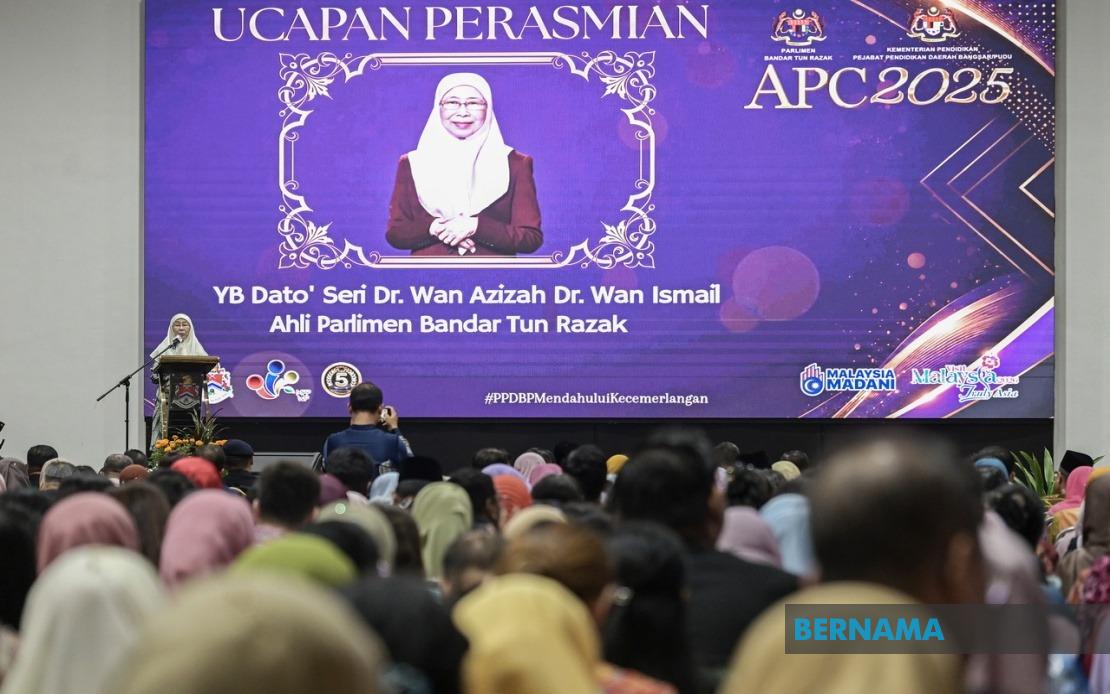
The true measure of a nation's progress extends far beyond the conventional yardsticks of economic expansion and technological achievement, Prime Minister's wife Datuk Seri Dr Wan Azizah Wan Ismail argued at a major educator recognition ceremony in Kuala Lumpur. Speaking at the 2025 Excellent Service Award presentation organised by the Bangsar/Pudu District Education Office, she reframed the national development narrative to centre on the cultivation of citizens possessing intellectual rigour, moral integrity, and genuine compassion for others. Her remarks come at a time when Malaysia continues to grapple with questions about social cohesion and ethical conduct across public and private sectors.
Dr Wan Azizah, who represents Bandar Tun Razak as Member of Parliament alongside her role as the Prime Minister's spouse, underscored the pivotal position teachers occupy in this character-building enterprise. Given that urban children spend the majority of their formative hours within school premises whilst their parents juggle professional commitments, educators have assumed an almost parental responsibility in transmitting values and shaping behavioural patterns. This observation resonates particularly with Malaysian parents navigating demanding work cultures, who increasingly rely on educational institutions to reinforce ethical frameworks and social responsibility.
The distinction she drew between knowledge transfer and holistic character development offers a significant counterweight to contemporary education discourse dominated by academic achievement metrics and standardised test scores. Rather than viewing schooling as a mechanism primarily for imparting factual content, Dr Wan Azizah positioned the education system as fundamentally concerned with cultivating individuals of elevated moral standing, refined courtesy, and hearts inclined toward the wellbeing of others. This conceptualisation aligns with broader Southeast Asian educational philosophies that historically emphasised virtue cultivation alongside intellectual development.
In addressing the contemporary challenge posed by artificial intelligence and the deluge of information characterising the digital age, Dr Wan Azizah identified values-based education and critical analytical thinking as essential counterbalances. As digital technologies proliferate across Malaysian society and misinformation spreads with unprecedented velocity, the ability to discern authentic information from fabrication has become a survival skill for citizens. Teachers, in this schema, function not merely as content deliverers but as guides helping young people navigate complex ethical and epistemic terrain, enabling them to construct informed judgements about truth claims they encounter online and offline.
The ceremony itself represented a substantial affirmation of educator contributions, with approximately one thousand attendees gathered at the Kuala Lumpur City Hall Training Institute to witness recognition accorded to seven hundred and forty-six teachers and school administrators drawn from one hundred and forty-three institutions across the Bangsar/Pudu district. This scale of recognition reflects official acknowledgement that educational excellence depends upon sustained commitment from classroom practitioners and administrative personnel working within complex institutional environments. The breadth of the award programme signals an institutional commitment to celebrating exemplary performance across the teaching profession rather than concentrating accolades on isolated high achievers.
Dr Wan Azizah expressed confidence that formal recognition of these educators' accomplishments would galvanise continued dedication to outstanding service delivery whilst simultaneously inspiring colleagues throughout the system to reinvigorate efforts toward strengthening Malaysia's broader educational agenda. The psychological impact of institutional recognition operates at multiple levels: it validates individual sacrifice, generates peer motivation through visible role-modelling, and publicly affirms social priorities regarding which professional contributions deserve celebration and emulation. Within Malaysian society, where public acknowledgement often carries significant cultural weight, such ceremonies function as more than ceremonial occasions.
The event's organisational context within the Bangsar/Pudu district specifically highlights regional approaches to educational excellence. This metropolitan area encompasses diverse school communities with varying resource bases and student demographics, requiring educators to demonstrate flexibility and contextual sensitivity in their practice. Recognition programmes structured at district rather than national levels can better capture locally-specific innovations and adaptations that contribute meaningfully to improved educational outcomes within particular communities. This granular approach to acknowledging excellence reflects understanding that sustainable educational improvement emerges through accumulation of dedicated practice across countless individual school sites.
The presence of senior government officials, including the Prime Minister's Political Secretary Datuk Azman Abidin and Kuala Lumpur Federal Territory Education Department director Megat Affandi Ismail, underscored the political importance attached to this gathering. Such high-level attendance signals administrative prioritisation of education and public appreciation for teaching professionals at moments when the profession occasionally faces criticism regarding student outcomes or institutional effectiveness. The positioning of education recognition events within official government calendars represents an opportunity to rebalance discourse around educational challenges by celebrating demonstrable achievements and acknowledging professional dedication.
For Malaysian policymakers and educational administrators, Dr Wan Azizah's address offers normative guidance regarding how to conceptualise educational mission during periods of rapid social and technological change. Rather than pursuing technological adoption or economic metrics as primary measures of educational success, her framework suggests that building social resilience through ethical citizenship ought to feature centrally within strategic planning. This positioning proves particularly relevant for Southeast Asian societies managing the tensions between economic competitiveness and social stability, between technological modernisation and maintenance of cultural values.
The emphasis on teachers' capacity to shape national character represents a significant attribution of both responsibility and agency to the teaching profession. Recognising teachers as architects of citizenship quality rather than mere instructional functionaries potentially elevates professional status and morale within a sector that has sometimes experienced deprofessionalisation through excessive standardisation and compliance-focused accountability frameworks. This reframing could encourage more reflective, intellectually engaged teaching practice focused on cultivating thinking citizens rather than producing conformist test-takers.
The broader implications for Malaysian society extend beyond pedagogical philosophy into questions about national identity and social direction. As the country navigates challenges ranging from income inequality to intercommunal relations, investing deliberately in ethical formation and critical thinking capacity among emerging generations represents a long-term strategy for building social capital and civic competence. The 2025 Excellent Service Award ceremony thus functions simultaneously as celebration of current achievement and investment in future national capacity.

