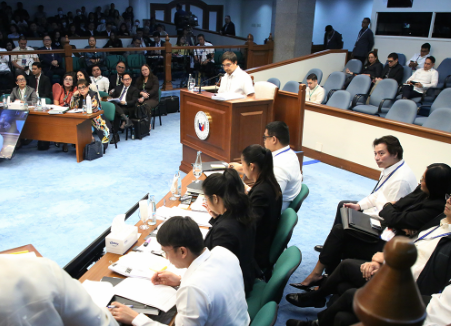
The Senate impeachment trial of Vice President Sara Duterte took a significant turn on Tuesday when Jeremy Lotoc, regional director of the National Bureau of Investigation, provided testimony that undermined the Vice President's position by characterizing her threats as credible and actionable. Speaking before the chamber's tribunal on the fifth day of proceedings, Lotoc asserted that Duterte not only possessed the capability to execute assassination threats she had made publicly against President Ferdinand Marcos, First Lady Liza Araneta-Marcos, and former House Speaker Martin Romualdez, but also demonstrated clear intent to do so. His remarks strengthened the prosecution's central argument that the Vice President's conduct constitutes grave threats and betrayal of public trust—offences for which she faces possible removal from office.
The NBI's investigation, which Lotoc previously oversaw through the Cybercrime Division before his current assignment, concluded that Duterte's statements were neither casual remarks nor politically motivated hyperbole but rather "serious, real and active" expressions of criminal intent. When Senate President Sherwin Gatchalian directly asked whether Duterte possessed the capacity to fulfill her threats, Lotoc responded with unequivocal certainty: "Definitely." The official proceeded to construct a layered argument about her capability, moving beyond the obvious point that her vice-presidential position granted her substantial power and influence. Instead, he widened the scope to encompass her political pedigree and family background, noting that her late father had previously served as president of the Philippines and that this familial connection to the nation's highest office provided additional machinery through which threats might be implemented.
Central to the prosecution's case is the contention that Duterte has admitted to conspiring with an unnamed individual to carry out revenge assassinations should she be killed. The NBI's evidence for this extraordinary claim rests almost entirely on statements Duterte herself made during a November 23, 2024 online press conference and a subsequent November 26 interview. During these public appearances, Duterte reiterated that she had spoken to someone specifically tasked with executing revenge killings in the event of her death. Lotoc testified that investigators interpreted these admissions as genuine confessions rather than rhetorical flourishes or political theatre. "We believe the Vice President was not kidding when she made those remarks," he stated, adding that the bureau's analytical framework treated her public pronouncements as evidence of actual conspiracy rather than inflammatory speech.
However, the evidentiary foundation supporting this explosive accusation proves remarkably thin upon closer examination. When pressed by senators on whether the NBI possessed independent verification of the alleged conspirator's identity or even existence, Lotoc acknowledged that investigators had located no corroborating evidence. The bureau's conclusion rested entirely upon Duterte's own statements and admissions, with no documentary evidence, witness testimony, or circumstantial corroboration. This limitation becomes particularly significant given that intelligence agencies theoretically possess far greater investigative capacity than the NBI. When questioned about this gap, Lotoc conceded that determining whether such a person actually existed was properly a matter for the intelligence services rather than his bureau, effectively ceding the most crucial factual question to another agency that has not presented findings to the court.
A critical frustration in the investigation, according to Lotoc's testimony, was Duterte's refusal to appear for questioning. The NBI desired to conduct a personal interview with the Vice President to explore whether she had genuinely engaged someone for purposes of assassination or whether her statements represented something less. Duterte declined to submit to such questioning, instead providing a written denial. Lotoc characterized this written response as substantively deficient, arguing that mere denial could not neutralize the fact that she had made the utterances in the first place or that she had publicly stated she had spoken to someone. The prosecution argues that this refusal to cooperate with investigators constitutes consciousness of guilt, while the defense maintains that the Vice President had no obligation to incriminate herself further through voluntary interrogation.
During redirect examination, private prosecutor Amado Virgil Ligutan emphasized a distinction that proved rhetorically valuable: Duterte has never genuinely retracted her core threats or denied making the inflammatory statements themselves. Instead, she has only denied hiring an assassin. This distinction matters substantially because it means the statements clearly remain part of the public record, indisputably made by the Vice President in her official capacity. Lotoc drew attention to her November 26 interview as particularly damning, noting that she reiterated rather than withdrew her earlier remarks, demonstrating that these were considered statements of genuine intent rather than momentary outbursts later regretted. The repetition of threats across multiple public forums strengthened the prosecution's argument that Duterte harboured sustained, calculated malice toward the President and his family rather than making isolated, heat-of-the-moment pronouncements.
The defense strategy during cross-examination focused heavily on technical and procedural deficiencies in the NBI's investigation and documentation. Defense counsel highlighted typographical errors and clerical mistakes in the bureau's official documents and reports. Lotoc, however, dismissed these imperfections as irrelevant to the substance of the findings, arguing that formatting errors in paperwork could not undermine the core investigative conclusions about Duterte's conduct and criminal intent. This exchange revealed a broader tension in the proceeding: whereas the defense sought to erode confidence in the prosecution's case through documentary criticism, the prosecution maintained that the evidentiary weight lay in the undisputed facts of what Duterte publicly stated and how repeatedly she made such statements.
A secondary strand of the Vice President's defence strategy involves her citation of "Operation Romanov," a purported plot against her life that she claims justified defensive measures and aggressive rhetoric. Lotoc's testimony directly undermined this narrative by revealing that NBI investigation traced the term "Romanov" back to a January 2024 rally speech by Davao City Mayor Sebastian "Baste" Duterte, the Vice President's brother, during which he directed hostile language at President Marcos and his family—not at the Vice President herself. This etymological finding suggested that the threat narrative Duterte invoked to justify her own threats did not actually support her position. Furthermore, the information that initially publicized "Operation Romanov" came from a vlogger named Princess Maui during Duterte's November 23 press conference, but when investigators sought to verify these claims through direct interview, Maui declined to appear and provide substantiation. Absent independent corroboration, Lotoc concluded that no validated threat against the Vice President could be confirmed through the bureau's inquiry.
The stalled investigation into alleged threats against Duterte reflects the broader asymmetry in the impeachment proceeding. Whereas the prosecution has presented official government investigators testifying about the Vice President's documented public statements, the defence has struggled to marshal comparable official evidence supporting its counter-claims. The Vice President's camp provided no actionable intelligence or cooperated with investigators in manner that might have allowed the NBI to validate alternative threat narratives. This investigative dead-end proved particularly damaging because it allowed prosecutors to argue that Duterte invoked phantom threats to justify rhetoric that was fundamentally unjustifiable.
As the trial enters its middle phases, Lotoc's testimony has substantially strengthened the prosecution's factual edifice. The undisputed nature of Duterte's statements, combined with the official investigative determination that they constitute grave threats, creates considerable pressure on the defence to demonstrate either that such statements do not constitute impeachable conduct or that they were justified by circumstances Duterte could reasonably cite. The defence's focus on documentary imperfections, as prosecution adviser Robert Ace Barbers noted, appeared to sidestep the substance of the core allegations. Senators watching the trial must ultimately weigh whether a vice-president's public threats of assassination, made repeatedly and never genuinely retracted, can be reconciled with the constitutional obligation to support and defend the presidency and the nation itself.
For Malaysian observers and regional analysts watching the Philippine impeachment proceeding, the trial illustrates the fragility of democratic institutions when political actors resort to extraordinary rhetoric and officials struggle to determine how to respond. The case raises questions about proportionality in constitutional remedies, the evidentiary standards appropriate for impeachment trials, and the broader health of Southeast Asian democracies where institutional checks on executive power face recurring stress. Duterte's trial continues to unfold amid intense domestic polarization and remains consequential not merely for Philippine politics but for broader regional stability and international perceptions of Southeast Asian governance.
The coming testimony will determine whether additional prosecution witnesses can strengthen the case beyond Lotoc's foundation of established statements and interpretive analysis. Conversely, the defence must demonstrate either factual inaccuracies in the prosecution narrative or present an alternative constitutional framework in which vice-presidential threats, however inflammatory, do not rise to impeachable conduct. The trial's outcome will carry implications for how the Philippine Senate, as a court of impeachment, interprets the constitutional threshold for removing sitting vice-presidents and whether political speech, however extreme, remains protected or crosses into the criminal and impeachable realm.

