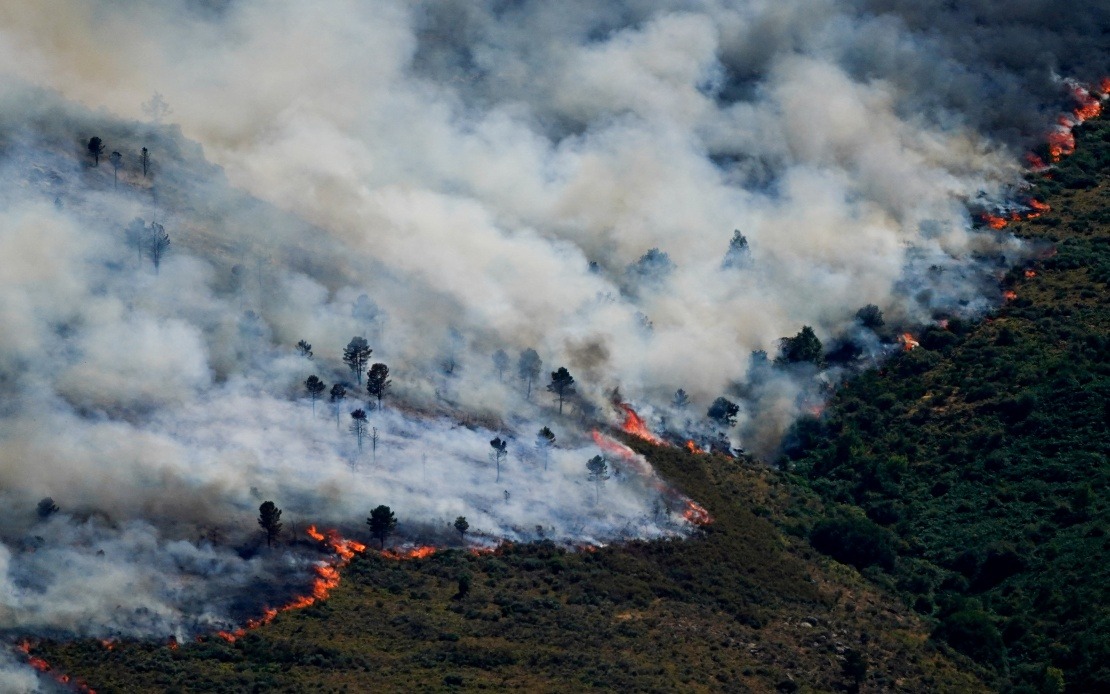
Spain confronted a catastrophic wildfire emergency over the weekend as blazes near the capital forced the evacuation of nearly 60,000 people from their homes, marking one of the most severe fire-related displacement events the country has experienced in recent years. The scale of the evacuation highlighted the destructive power of the uncontrolled fires spreading across multiple municipalities in the Madrid region and the adjoining province of Ávila, located northwest of the capital.
According to Francisco Martín Aguirre, the Spanish government's prefect for Madrid, the evacuation unfolded in two major zones with distinct impacts. The province of Ávila saw 30,000 residents flee their communities as flames advanced through rural and semi-rural areas. Simultaneously, an additional 29,488 people were displaced from communities surrounding Madrid itself, underscoring how the crisis extended across a broad geographic area rather than remaining confined to a single locality. These figures represented only those who successfully managed to leave ahead of the advancing fire fronts.
The human toll extended beyond those who escaped. The Interior Ministry reported that more than 28,000 additional residents found themselves unable to abandon their homes, effectively trapped by the fire's rapid spread and the operational challenges faced by emergency services attempting to maintain evacuation routes. Of these isolated populations, 20,262 individuals remained confined within the greater Madrid metropolitan area, while approximately 8,000 were stranded in Ávila. The predicament of these trapped residents underscored the fire's unpredictability and the difficulty of conducting large-scale evacuations when multiple fronts threatened simultaneously.
The severity of the situation compelled Prime Minister Pedro Sánchez's government to invoke emergency protocols on Friday, formally declaring a "state of emergency of national significance" covering both the Greater Madrid area and Ávila province. This declaration activated extraordinary governmental powers and mobilized national resources to combat the fires and manage the humanitarian crisis. The formal emergency status signaled to the international community and Spain's regional authorities the critical nature of the threat and the need for coordinated response at the highest levels of government.
Weather conditions played a crucial determining factor in the trajectory of the emergency. Following a night of calmer atmospheric conditions, Saturday morning brought improved weather that provided firefighting teams with a temporary advantage. The Interior Ministry's assessment that overnight conditions had become more favorable suggested that the intense heat and wind patterns that had accelerated fire spread had begun to moderate. Sánchez himself acknowledged this development during remarks delivered from the emergency services' command center, indicating that the improved weather offered a realistic possibility of containing the fires during the weekend period.
Yet the Prime Minister tempered any optimism by emphasizing that the situation remained fundamentally precarious. The apparent improvement in weather conditions did not erase the millions of cubic meters of flammable forest material already ignited or the unpredictability inherent in large-scale wildfire events. Sánchez reiterated that the government's paramount concern remained the preservation of human life, a priority that would continue to shape decision-making even as firefighting operations simultaneously worked to limit property damage and environmental degradation.
The Madrid wildfire crisis carries significant implications for neighboring regions, including those in Southeast Asia that face similar seasonal fire risks. Spain's experience demonstrates how modern infrastructure and early warning systems, while valuable, can be rapidly overwhelmed when multiple fire fronts develop simultaneously under adverse atmospheric conditions. The evacuation of nearly 60,000 people represented an enormous logistical undertaking requiring coordination across emergency services, local authorities, and regional governments. For Malaysia and other ASEAN nations prone to transboundary haze and seasonal fires, Spain's experience underscores the importance of robust inter-agency coordination, pre-positioned resources, and community preparedness protocols.
The concentration of so many residents in danger zones reflects broader patterns of urbanization and suburban expansion into fire-prone landscapes across Europe and globally. Communities that had developed in forested areas or on the urban-rural fringe suddenly found themselves in the direct path of an advancing fire front. This pattern mirrors trends in Southeast Asia, where rapid economic development has pushed residential and commercial development into zones historically dominated by vegetation, creating similar vulnerability profiles to those observed in Spain's crisis.
The timeline of events—with declarations of emergency on Friday and operational improvements by Saturday morning—illustrates the rapid escalation possible in major fire events. What begins as localized spot fires can quickly metastasize into regional crises affecting hundreds of thousands of people within hours. The Spanish government's decision to declare a national emergency before the crisis had fully stabilized demonstrated a precautionary approach that prevented the situation from deteriorating further.
As firefighting operations continued through the weekend, the focus shifted toward preventing new fire starts while containing existing blazes. The hundreds of firefighters and support personnel deployed to the Madrid and Ávila regions faced an exhausting battle against terrain and vegetation that fire exploits more efficiently than human resources can counter. Success would ultimately depend on sustained favorable weather, effective resource deployment, and the capacity of crews to establish containment lines faster than the fire could advance.
The displacement of nearly 60,000 people created secondary humanitarian challenges beyond immediate safety concerns. Evacuation centers required staffing, food supplies, medical services, and mental health support. Families separated during chaotic evacuations needed reunion services. Livestock left behind created welfare concerns. Infrastructure serving evacuated communities required monitoring and protection. These cascading effects would occupy Spanish authorities for weeks beyond the fire's containment, demonstrating how environmental crises impose costs that extend far beyond the immediate emergency period itself.

