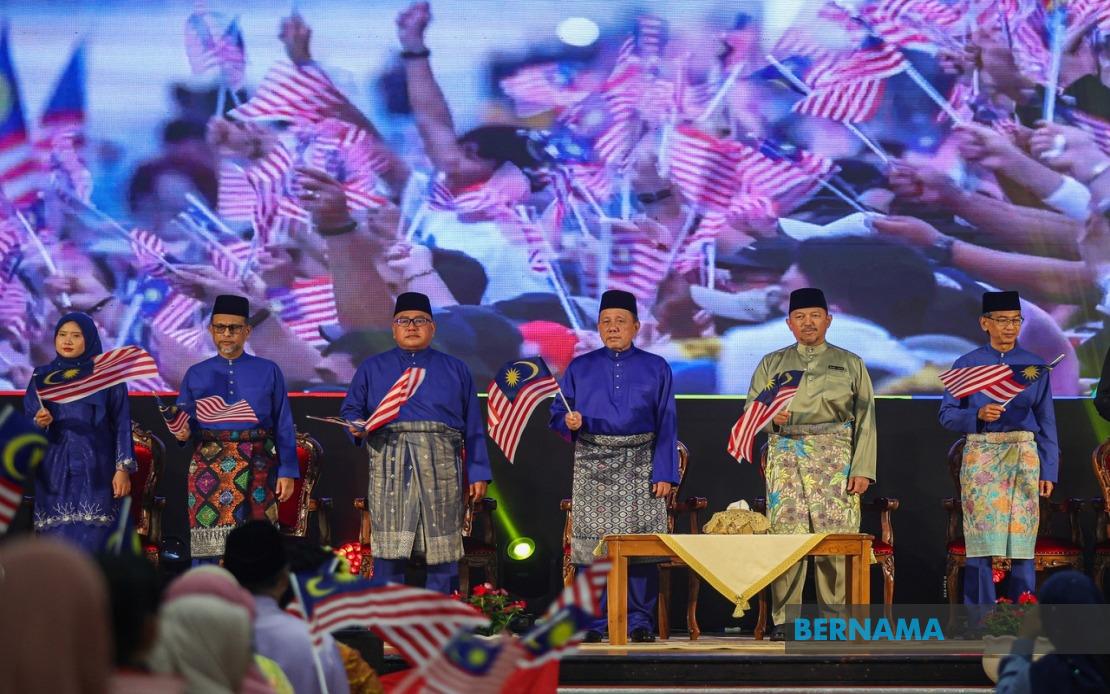
Negeri Sembilan Menteri Besar Datuk Ismail Lasim has mapped out an ambitious governance framework anchored on stability, progress and prosperity, positioning these three interconnected elements as essential foundations for delivering effective public services across the state. Speaking at the State-Level Public Servants Assembly and the launch of the Kibar Jalur Gemilang campaign in Seremban, Ismail articulated a vision extending beyond conventional indicators of political success, emphasising instead the need for institutional robustness and sustained confidence from both citizens and the investment community.
The emphasis on stability represents a deliberate strategic choice that diverges from measuring administrative performance purely through legislative arithmetic. Ismail stressed that a truly stable state requires more than a comfortable parliamentary majority; it demands reinforced constitutional institutions, streamlined governance processes and political predictability that reassures stakeholders of the administration's durability. This foundational pillar also encompasses safeguarding the Constitutional Monarchy and custodial traditions that Ismail identified as the regulatory umbrella beneath which all state initiatives operate. By framing stability in these institutional terms, the Juasseh assemblyman signalled recognition that investor confidence and public trust flow from predictable, transparent governance rather than transient political arrangements.
The progress component reflects an evolved understanding of development metrics beyond headline economic figures. Ismail cautioned against narrowly construing advancement as gross domestic product growth alone, advocating instead for a holistic measure encompassing employment creation, quality capital inflows and geographically balanced expansion. The state recorded a gross domestic product of RM55.8 billion in the preceding year, representing 2.6 per cent growth from RM54.3 billion, with the services and manufacturing sectors providing principal momentum. These figures underscore Negeri Sembilan's positioning within Malaysia's competitive economic landscape, though Ismail's insistence on equitable geographic distribution signals awareness of regional disparities that plague many Southeast Asian jurisdictions.
Particularly significant is Ismail's explicit commitment to incorporating rural and Felda settlement communities within the prosperity narrative. This represents a tacit acknowledgment that concentrating development within urban cores generates social tensions and political instability, a lesson increasingly relevant as Malaysian states confront rural unemployment and migration pressures. By pledging that rural localities advance in tandem with major urban centres, Ismail positioned agricultural and rural economic strengthening as integral to the administration's competitiveness strategy rather than supplementary welfare considerations.
The prosperity pillar functions as the visible manifestation of the first two elements, translating institutional stability and measured progress into tangible improvements in living standards. Ismail framed this as a collective enterprise requiring coordination between the newly constituted State Executive Council and the permanent public service apparatus. The diverse professional backgrounds and renewed energy within the Exco were presented as catalysts for enhanced administrative performance and strategic alignment. This emphasis on institutional harmonisation reflects understanding that state-level economic transformation depends upon seamless coordination between political leadership and professional bureaucracy, a relationship frequently fractious in Malaysian governance contexts.
Financial performance indicators reveal moderate optimism regarding revenue trajectories. Negeri Sembilan's state revenue reached RM522.4 million to date, with Ismail expressing confidence in achieving the RM1 billion target by 2030. While this target represents roughly a doubling of current collections over seven years—an annual growth rate approximating 11.5 per cent—it remains achievable should the services and manufacturing sectors sustain current momentum and agricultural diversification initiatives gain traction. The revenue target carries particular significance for a state of 1.2 million residents, as enhanced fiscal capacity enables investment in infrastructure, human capital development and social services that underpin broader prosperity objectives.
Ismail's framing of governance as a collective enterprise—inviting the public service, private sector and state residents to mobilise unified effort—represents an attempt to transcend the zero-sum political contestation characterising Malaysian state politics. By invoking shared citizenship and common interest in building a trusted government and respected public service, he sought to position the administration's agenda beyond partisan calculation. This rhetorical move carries particular resonance in Negeri Sembilan's political context, where recent electoral cycles have generated considerable uncertainty and administrative disruption.
The concurrent launch of the Kibar Jalur Gemilang campaign served a dual symbolic function, simultaneously mobilising nationalist sentiment and signalling the administration's commitment to fostering social cohesion. Ismail's call for government departments, local authorities, schools and business premises to display the national flag during National Day celebrations reflects recognition that institutional visual symbolism reinforces collective identity and administrative legitimacy. This approach acknowledges that effective governance combines substantive policy delivery with symbolic gestures that reinforce citizen attachment to state institutions.
For Malaysian observers and neighbouring Southeast Asian governments monitoring state-level developments, Negeri Sembilan's articulated framework offers insights into emerging governance priorities across the region. The emphasis on institutional stability over transient political dominance, balanced development spanning urban and rural economies, and inclusive prosperity suggesting concern for distributional equity collectively indicate evolving expectations regarding state administrative performance. Whether Ismail's administration can deliver measurable progress against these ambitious framings will determine not only Negeri Sembilan's trajectory but potentially influence governance approaches across other Malaysian states confronting comparable development challenges and fiscal constraints.

