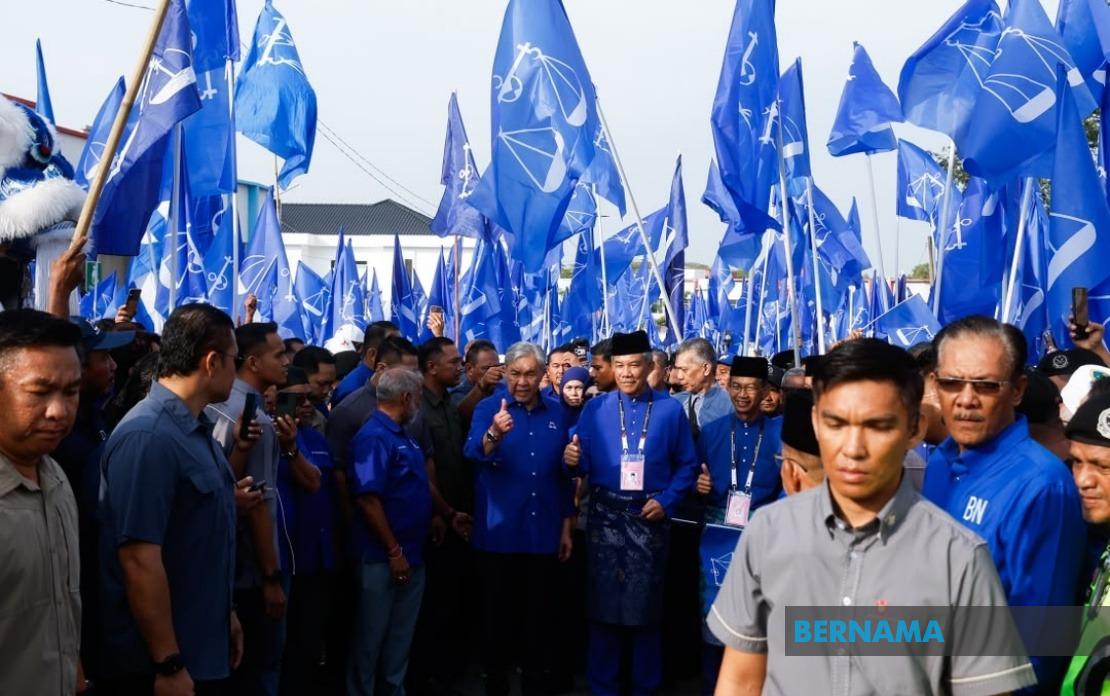
Barisan Nasional's top hierarchy signalled its commitment to the Negeri Sembilan state election by personally accompanying candidates through the nomination process on Thursday, with party chairman Datuk Seri Dr Ahmad Zahid Hamidi and his deputy Datuk Seri Mohamad Hasan arriving together at the Rembau nomination centre early in the morning. The choreographed show of unity—underscored by Ahmad Zahid's dual role as both BN chairman and UMNO president—reflected the coalition's desire to project organisational cohesion ahead of polling day scheduled for August 1.
Mohamad Hasan, who arrived at the Dewan Seri Rembau centre at 8.40 am, filed nomination papers to contest the Rantau seat, a constituency he has represented continuously since 2004. His two-decade tenure in the state seat demonstrates the stability that BN seeks to emphasise, particularly in constituencies where incumbents enjoy established voter networks and administrative experience. The decision to have Ahmad Zahid present alongside Mohamad at this moment underscored the importance both men assign to Negeri Sembilan in the broader calculations of peninsular politics.
The simultaneous opening of all eight nomination centres at 9 am and their closure precisely one hour later created a compressed timeframe that concentrated media attention and party activity into a single morning window. This standardised procedure, administered by the Election Commission, ensured that all candidates faced identical conditions and timelines, though the presence of high-ranking party figures at select locations meant differential levels of public and press exposure for various nominees.
Beyond Rembau, BN orchestrated its ground game through a hierarchical delegation structure. BN secretary-general Datuk Seri Dr Zambry Abd Kadir positioned himself at Port Dickson to support Datuk Mohd Faizal Ramli's bid for the Linggi seat, while UMNO vice-president Datuk Seri Johari Ghani accompanied Suhaimizan Bizar in Tampin's Gemencheh state seat contest. This distributed approach allowed senior figures to maintain visible presence across multiple constituencies simultaneously, amplifying the impression of comprehensive party mobilisation.
UMNO's secretary-general, Datuk Dr Asyraf Wajdi Dusuki, took personal charge of coordinating support for three BN candidates competing in Jempol parliamentary constituency—Datuk Mustapha Nagoor (Palong), Datuk Mohd Zaidy Abdul Kadir (Jeram Padang), and Chong Fui Ming (Bahau). The concentration of senior party machinery in this single parliamentary area suggested that BN considers Jempol a strategically significant battleground where multiple seats require intensive organisational backing.
Islamist opposition also mobilised its senior leadership, with PAS president Tan Sri Abdul Hadi Awang accompanying his party's nominee Mohd Fairuz Mohd Isa to the Serting nomination centre. PAS's decision to field candidates in Negeri Sembilan, despite the state being traditionally dominated by BN and DAP-aligned parties, reflects the Islamic party's ongoing efforts to expand its presence in non-Peninsular strongholds. The presence of Hadi himself underscored PAS's serious intent in these contests, despite facing structural disadvantages in a state where Malay-Muslim voters have historically preferred UMNO.
Partisan politics in Negeri Sembilan also encompasses smaller political entities seeking relevance and representation. Parti Orang Asli Malaysia (ASLI) president Rashid Ka personally supported his party's candidate Dayana Dal, competing for the Jeram Padang seat in Jempol. ASLI's participation highlights how even marginal parties leverage electoral contests to maintain organisational visibility and claim advocacy mandates around specific constituencies, though their realistic prospects of winning seats remain limited.
The election itself represents the culmination of a political process initiated when Negeri Sembilan's state assembly was officially dissolved on June 5 following the consent of Tuanku Muhriz Tuanku Munawir, the Yang Dipertuan Besar. This dissolution came after consultation with constitutional authorities and marked the formal beginning of the electoral cycle. The intervening period between dissolution and nomination day allowed parties approximately six weeks to finalise candidate selections, organisational preparations, and campaign groundwork.
Negeri Sembilan's electoral dynamics carry significance beyond the state's borders because the result influences calculations about BN's broader viability in peninsular politics and Malay-Muslim constituencies. A strong BN showing would vindicate the coalition's strategy of rehabilitating its brand following the 2022 federal election setback, while disappointing results could embolden opposition narratives about BN's declining relevance. For PAS, the contest represents an opportunity to demonstrate cross-regional appeal beyond its traditional strongholds in the north, though a poor showing might reinforce perceptions that Islamist politics has limited purchase in states where economic issues predominate.
Early voting has been scheduled for July 28, approximately three days before the main polling day, allowing security personnel, essential workers, and registered early voters to cast ballots at designated centres. This compressed electoral calendar—from nomination to polling within a fortnight—limits time for sustained campaign activities but intensifies the concentration of political messaging and candidate visibility. The speed also works to the advantage of better-resourced parties like BN, which can mobilise organisational infrastructure more rapidly than smaller opposition entities.
The visible presence of party leadership at nomination centres serves multiple strategic functions beyond the ceremonial. It signals inner-party stability and unity to both grassroots members and external observers, projects confidence about electoral prospects, generates local media coverage and social media amplification, and reinforces to candidates that their party hierarchy takes their individual contests seriously. For voters still deciding between candidates, the appearance of respected senior figures functions as an implicit endorsement that elevates the nominee's credibility and stature within the local political ecosystem.

