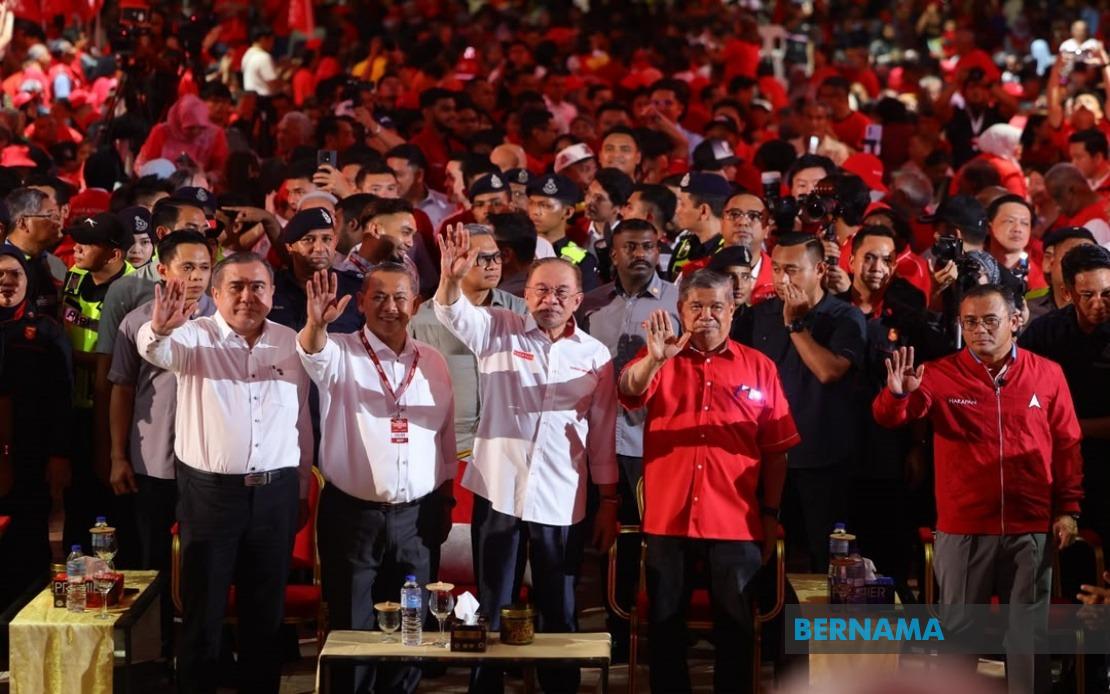
Pakatan Harapan (PH) is stepping up its campaign for the 16th Negeri Sembilan state election with a direct appeal to voters for renewed support, with state chairman Datuk Seri Aminuddin Harun making the case that continued coalition governance is essential for the state's trajectory. Speaking at a candidate announcement ceremony in Kuala Pilah on July 14, Aminuddin framed the election as a referendum on PH's track record rather than a contest against opponents, emphasizing that investor confidence and uninterrupted public programmes depend on electoral continuity.
The stability argument forms the backbone of PH's messaging strategy in Negeri Sembilan, with Aminuddin contending that political certainty translates directly into economic benefits for ordinary Malaysians. A fragmented or uncertain government, by contrast, risks disrupting the flow of development projects and welfare initiatives that require sustained planning and implementation. This approach resonates particularly in a state where economic performance has been relatively steady, providing PH with tangible achievements to cite when justifying its candidacy.
Among the concrete results Aminuddin highlighted was Negeri Sembilan's attraction of RM19.1 billion in investments since PH took control, suggesting that the business community views the state government's administration as predictable and business-friendly. This figure becomes a centrepiece of PH's election narrative because it speaks to concerns that matter to both voters and job seekers—economic dynamism and employment opportunities. In Southeast Asia's competitive economic landscape, where states vie for foreign direct investment, Negeri Sembilan's record positions it favourably against neighbouring jurisdictions, though questions about whether these investments have translated into broad-based job creation remain pertinent for campaign scrutiny.
The coalition has also leveraged improvements in Islamic funding collection as evidence of good governance, noting that zakat revenues have tripled from approximately RM80 million to nearly RM200 million during Aminuddin's tenure. This expansion of Islamic charitable collections reflects both stronger state finances and deeper institutional capacity, enabling the government to channel substantially more assistance to vulnerable populations. For Muslim-majority Malaysia, effective zakat management carries both spiritual and social significance, making this metric relevant to voters who view Islamic governance as integral to the state's character.
Welfare initiatives have become central to PH's electoral pitch in Negeri Sembilan, with the coalition emphasizing education support programmes and the distribution of free tablets to students. These initiatives address mounting parental concerns about educational access and technological preparedness, especially acute in post-pandemic contexts where digital literacy has become essential for academic success. By framing education as a government responsibility rather than leaving it to market forces, PH positions itself as addressing inequality, a traditional coalition strength that appeals to lower and middle-income households.
DAP secretary-general Anthony Loke's participation underscores the coalition's internal unity, a critical factor in a multi-party arrangement where component parties must subordinate individual ambitions to collective goals. Loke's characterization of the Negeri Sembilan election as PH's "second round" following losses in Johor reveals the coalition's strategic calculus—the state represents a crucial opportunity to restore momentum after setbacks elsewhere. His emphasis that Negeri Sembilan is "home ground" for PH attempts to leverage the coalition's existing organizational infrastructure and voter familiarity, assuming that prior electoral success can be replicated rather than eroded by broader political trends.
Loke's acknowledgment that PH "did not succeed" in Johor and that the result was "not in our favour" demonstrates a candid assessment of recent electoral headwinds. Rather than defending previous outcomes, the DAP leader reframes failure as a learning opportunity, suggesting that PH has identified specific weaknesses in its Johor campaign machinery that can be corrected in Negeri Sembilan. This approach attempts to transform defeat into motivation rather than allowing it to become a narrative of decline, though whether such messaging resonates with voters fatigued by coalition underperformance remains uncertain.
The coalition's commitment to respecting Negeri Sembilan's royal institutions and customary traditions, articulated through Loke's explicit pledges of loyalty to the Yang Dipertuan Besar and the Tunku Besar of Tampin, reflects sensitivity to the political sensitivities surrounding Malaysia's constitutional monarchy. This emphasis serves multiple purposes: it reassures traditional constituencies that PH respects established hierarchies, it inoculates the coalition against opposition claims of disrespect toward royalty, and it affirms that Malaysia's Westminster-derived system of constitutional monarchy remains non-negotiable even under progressive leadership. For DAP, historically the subject of opposition criticism regarding its secular orientation, such explicit affirmations are politically strategic.
The coordination among PH's component parties—represented by the presence of DAP secretary-general Loke, Amanah president Datuk Seri Mohamad Sabu, and other senior figures—signals that the coalition views Negeri Sembilan as sufficiently important to warrant high-level attention and unified campaign machinery. In Malaysian politics, where personality-based politics and intra-coalition tensions frequently undermine unity, such visible cohesion conveys strength to potential supporters. However, the very need to emphasize such unity suggests underlying vulnerabilities that the coalition must actively manage.
Amiduddin's status as the coalition's Menteri Besar candidate remains strategically important because voters often make state-level decisions based on confidence in the chief minister's competence and integrity. By consolidating all PH members behind Aminuddin as the "commander" for the election, the coalition eliminates potential fractures that could arise from competing claims to leadership. This clarity contrasts with situations in other states where unclear succession planning or factional disputes have weakened electoral performance.
The emphasis on continued cooperation between state and federal governments underscores a reality of Malaysian federalism: state governments depend significantly on federal funding and policy coordination for major projects. By highlighting this partnership, Aminuddin suggests that voting for PH Negeri Sembilan creates synergies with the federal administration that benefit residents through accelerated development. Conversely, if an opposition state government replaces PH, the implication runs, federal-state friction might impede progress.
For regional observers, the Negeri Sembilan election offers insights into PH's capacity to retain power after experiencing setbacks and internal tensions. The coalition's performance in this smaller, more manageable political theatre will likely influence its momentum heading toward future national electoral contests. If PH can consolidate its base and expand its appeal in Negeri Sembilan despite recent losses elsewhere, it demonstrates resilience and adaptability. Conversely, another significant loss would reinforce narratives of coalition decline and further strengthen opposition momentum.

