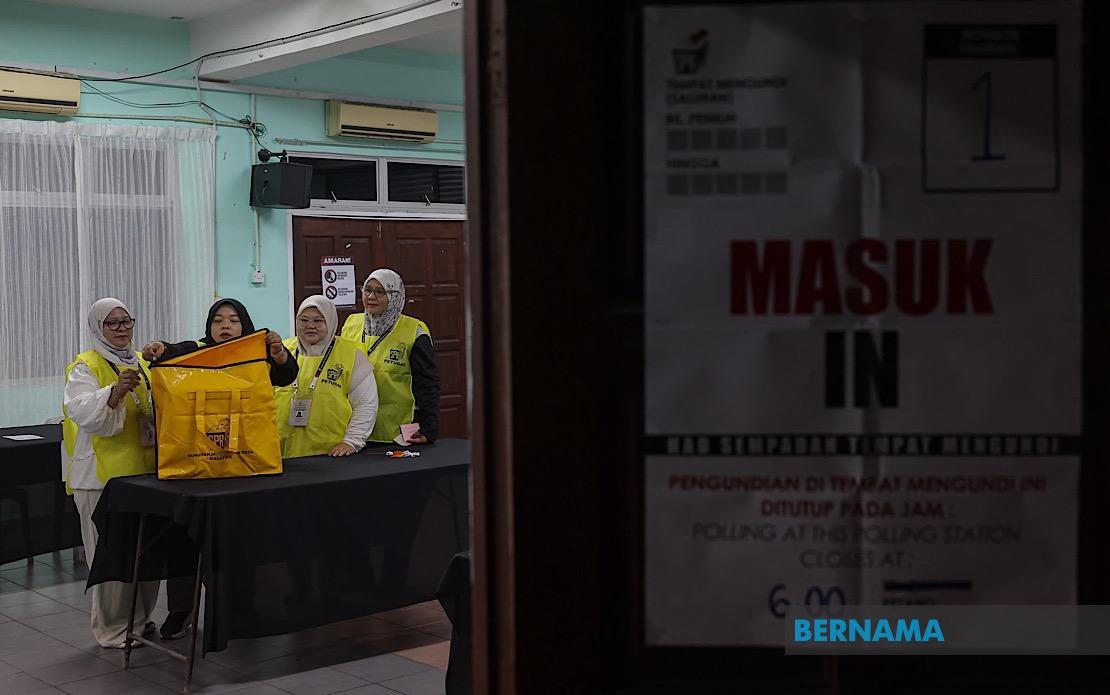
Voters across Negeri Sembilan stepped up to polling stations today to elect representatives who will shape the state's governance over the coming years. The 16th State Election represents a significant democratic moment for the state, following the dissolution of the Negeri Sembilan State Legislative Assembly on June 5th. A total of 859,760 registered voters, including 7,391 postal voters, were entitled to participate in today's election, which commenced at 8:00 am across 401 polling centers across the state, with voting scheduled to conclude at 6:00 pm.
The stakes are particularly high given the composition of parties contesting the 36 state assembly seats. Pakatan Harapan has fielded candidates in all 36 constituencies, the broadest coverage among established coalitions. Barisan Nasional brought 25 candidates to the contest, whilst Bersatu and Perikatan Nasional fielded 24 and 11 candidates respectively. Smaller players including Berjasa, the Orang Asli Malaysia Party, and the Socialist Party of Malaysia each nominated a single representative, with four additional independent candidates also competing. This diverse field underscores ongoing fragmentation within Malaysia's political landscape, a phenomenon that has intensified since the 2022 general election.
The electoral landscape has shifted considerably since voters last went to the polls in 2023. The previous state election saw Pakatan Harapan secure 17 of the 36 seats, Barisan Nasional win 14, and Perikatan Nasional capture 5. That outcome left the state without a decisive majority for any single coalition, raising questions about government stability and the potential for coalition realignments. Today's vote will reveal whether any coalition has strengthened its position, or whether continued fractionalisation persists. The 14-day campaign period preceding today's ballot tested party machinery and their respective appeals to voters in a state that has traditionally balanced competing interests and identities.
During the lead-up to today's election, early voting took place among military and police personnel and their spouses, with 91.06 percent turnout recorded among the 14,995 eligible early voters. That high participation rate among uniformed service members suggests sustained civic engagement and possibly indicates patterns that may be reflected in today's broader voting. The Election Commission has set a target voter turnout of between 72 and 75 percent, which would demonstrate continued public investment in state-level democratic participation at a time when some observers have expressed concerns about declining engagement in electoral politics.
Distribution of seats reveals a complex electoral picture across the state. Among the 36 contested positions, 22 state seats faced three-cornered contests, a reflection of the emergence of multiple viable candidates in many communities. A further 11 seats featured straight fights between two candidates, whilst two constituencies each witnessed four-cornered and five-cornered battles. This variation in contest configuration means that winning margins could be narrow in many constituencies, and the overall state outcome will depend significantly on how votes distribute across different geographic areas and demographic groups.
For Malaysian observers and regional watchers, today's election carries significance extending beyond Negeri Sembilan itself. State elections serve as testing grounds for national political strategies and provide early indicators of shifting voter sentiment. The performance of Pakatan Harapan, Barisan Nasional, and the various components of Perikatan Nasional will be closely scrutinised by analysts seeking to understand current political trajectories. The engagement of smaller parties and independent candidates also merits attention, as these challengers continue to nibble at the two-coalition dominance that characterised Malaysian politics until relatively recently.
Weather conditions posed a consideration for voters on polling day. The Malaysian Meteorological Department forecast clear conditions across most Negeri Sembilan districts during morning and early afternoon hours, specifically affecting Seremban, Jempol, Jelebu, Kuala Pilah, Tampin, Port Dickson, and Rembau. However, meteorological predictions indicated heavy rain and thunderstorms were likely across most districts during afternoon hours. Such weather patterns potentially influence voter turnout, particularly in constituencies where transportation infrastructure or voter accessibility might be affected by wet conditions.
The Election Commission anticipated that results would begin emerging around 10:00 pm following the close of polling, with comprehensive tallies expected before midnight. This timeline reflects the standardised counting procedures that have been refined across multiple electoral cycles. The speed of result determination has become increasingly important for market confidence and political stability, as extended uncertainty following elections can create unnecessary tension and speculation.
Negeri Sembilan's electoral composition and geographic distribution merit consideration when interpreting today's outcome. The state encompasses diverse districts with varying demographic profiles, from urban Port Dickson to the more rural Kuala Pilah and Jelebu constituencies. Success in state elections increasingly depends on parties' ability to construct coalition arrangements that reflect local sensitivities whilst maintaining coherence at the state level. The 2023 outcome, which produced no overwhelming mandate, suggested that Negeri Sembilan voters have become more discerning and less inclined toward decisive endorsements of any single political project.
The election also occurs within a broader context of constitutional governance and federalism in Malaysia. State elections, whilst administered under state authority, carry implications for federal government composition and the distribution of resources through intergovernmental arrangements. A state government aligned with the federal authority may experience more expeditious processing of development projects and funding allocations, whereas a state with an opposition-aligned government must navigate more complex negotiations with the federal centre. These considerations extend beyond abstract political theory and affect the lived experience of Negeri Sembilan residents in accessing public services and seeing community development priorities addressed.
Beyond today's voting, the immediate challenge will be government formation. If no single coalition commands an outright majority of 19 seats, successful formation of government will require coalition-building among winning parties and potentially negotiations with independent candidates. Such scenarios have become increasingly common across Malaysian state legislatures, introducing both flexibility and unpredictability into governance. The coming weeks will reveal not only who voters prefer, but also how successful different political combinations prove in translating electoral support into functional governing arrangements.

