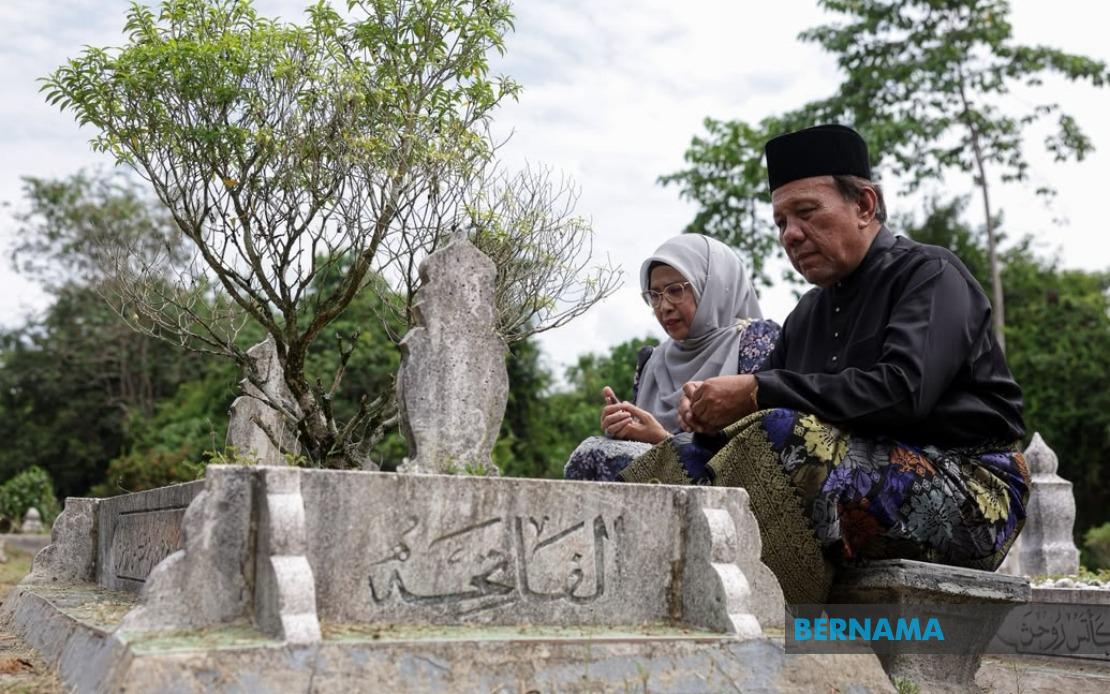
Datuk Ismail Lasim wasted little time in fulfilling a personal duty following his swearing-in as Negeri Sembilan's new Menteri Besar. Within hours of taking the oath before the Yang di-Pertuan Besar of Negeri Sembilan, Tuanku Muhriz Tuanku Munawir, at Istana Besar Seri Menanti, the newly installed chief minister travelled to Kuala Pilah to pay respects at the Tebing Tinggi Muslim cemetery, accompanied by his wife Datin Noraishah Othman.
The gesture reflected a moment of quiet reflection after a significant political achievement. Ismail, who secured the Juasseh state seat in yesterday's election, represents the culmination of electoral efforts that have reshaped Negeri Sembilan's political landscape. His immediate visit to his family's burial site underscores the personal dimensions often overlooked in political transitions, revealing how individuals balance public duty with private devotion during pivotal moments in their careers.
Ismail's parents, both now deceased, shaped his life trajectory long before he entered the corridors of power. His father, the late Lasim Yaman, lived to the age of 97 before passing on March 5, 2020, while his mother, the late Bedah Othman, preceded him in death on September 16, 2014. The timing of his cemetery visit—occurring immediately after assuming the state's highest executive office—suggests a deliberate act of acknowledgment, perhaps honouring those who contributed to his upbringing and values during formative years.
The political backdrop to Ismail's elevation carries significance beyond personal advancement. Yesterday's 16th Negeri Sembilan state election delivered a decisive outcome that fundamentally altered the state's governing coalition. Barisan Nasional emerged as the dominant force, capturing 18 out of the contested seats, while Perikatan Nasional secured seven seats. This distribution provides the two coalitions with a commanding two-thirds majority in the state assembly, effectively granting them substantial legislative power and insulating the government from immediate challenges to its mandate.
For Malaysian political observers, the outcome represents a validation of Barisan Nasional's continued relevance in state-level politics, particularly in Negeri Sembilan, which has traditionally been a coalition stronghold. The margin of victory affords Ismail a comfortable working majority as he assumes leadership during what are likely to be challenging economic times. A two-thirds majority typically enables more ambitious policy initiatives, constitutional amendments if necessary, and a stronger position when negotiating with the federal government on resource allocation and development priorities.
The new Menteri Besar faces an immediate agenda encompassing economic recovery, state infrastructure development, and addressing the grievances of constituents affected by recent national political volatility. Negeri Sembilan, positioned centrally in the Klang Valley economic corridor, holds strategic importance for regional development and connectivity initiatives. Ismail's government will likely prioritize enhancing transportation links, supporting small and medium-sized enterprises within his jurisdiction, and ensuring that state resources are deployed effectively to improve living standards across urban and rural areas.
Barisan Nasional's strong showing in Negeri Sembilan also signals broader patterns within Malaysia's political system. The coalition has worked methodically to rebuild its standing following the tumultuous 2018 election, which saw its historic defeat after more than six decades of uninterrupted rule at the federal level. State-level victories like Negeri Sembilan's represent incremental progress toward the coalition's longer-term objective of reasserting dominance in Malaysian politics, though the path remains contested and subject to shifting voter preferences.
The symbolic act of visiting ancestral graves also carries cultural resonance in Malaysian context. In Islamic tradition, paying respects to deceased family members is considered an act of piety and familial duty. For a public figure like Ismail, undertaking this ritual immediately after assuming high office demonstrates that despite the demands of his new position, personal and spiritual obligations remain paramount. This balance resonates with Malaysian voters who value leaders displaying strong family and religious commitment alongside their professional responsibilities.
Looking forward, Ismail's tenure will be scrutinized by both Barisan Nasional's national leadership and the broader Malaysian public. The performance of state governments significantly influences federal-level perception and can either strengthen or weaken coalitions heading into future national elections. Negeri Sembilan's economy, particularly its manufacturing and services sectors, will require attention, alongside addressing urban development pressures in areas increasingly integrated with the Klang Valley's sprawl.
The two-thirds majority that Barisan Nasional and Perikatan Nasional have secured creates a stable legislative environment, at least in the immediate term. This stability allows Ismail to focus on governance rather than managing precarious majorities or navigating constant defection threats. However, such large majorities also invite scrutiny regarding accountability and responsiveness to constituent concerns, as there are fewer checks from an opposition capable of generating legislative pressure.
Ismail's background, prior to becoming Menteri Besar, will influence the direction of his administration. His early actions, including the cemetery visit, suggest a leader mindful of tradition and personal values. How these private convictions translate into public policy—particularly regarding education, welfare, religious affairs, and economic development—will determine his effectiveness and popularity during what promises to be a demanding tenure.

