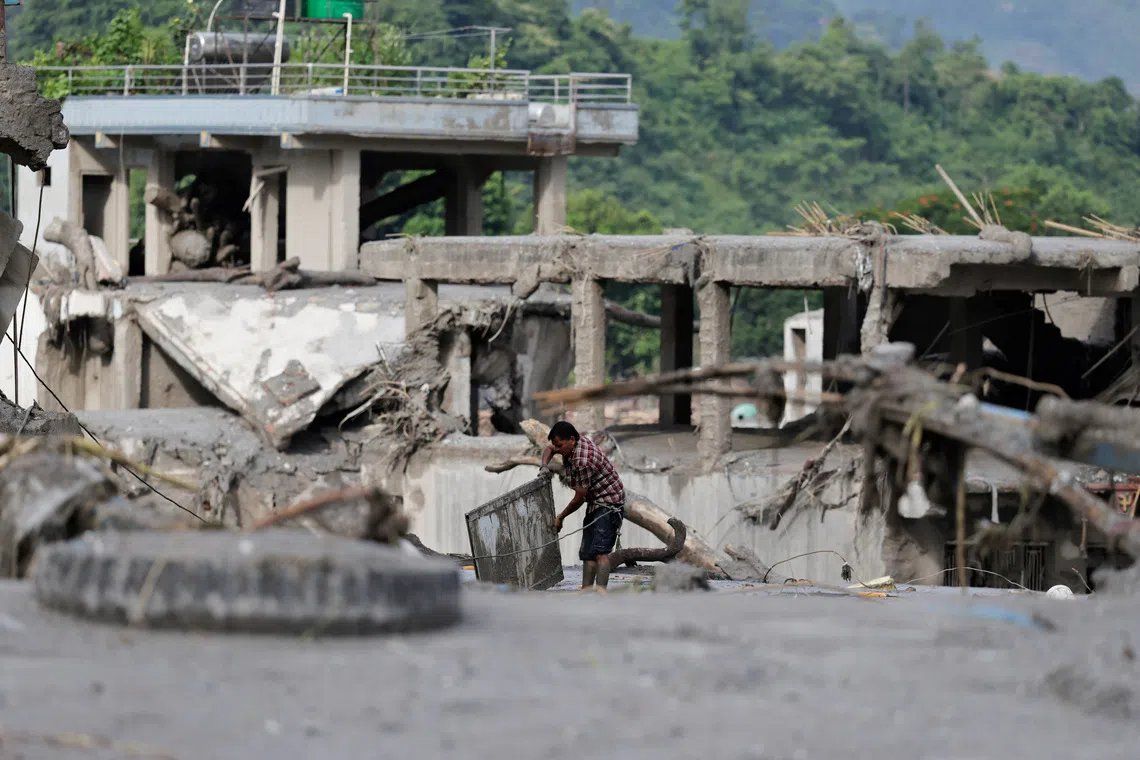
Disaster officials across Nepal and China escalated public safety alerts on Thursday as a new and potentially more severe flooding threat looms over the Himalayan border regions already devastated by Wednesday's catastrophic collapse of a major glacier. The secondary hazard stems from two rapidly filling lakes created when the glacier failure ejected massive quantities of rock, ice, and debris into mountain river systems, effectively damming waterways and trapping enormous volumes of liquid. With search and rescue teams still scouring the debris-strewn valleys for over a thousand missing persons in the aftermath of an event that has claimed at least 362 lives across Nepal and China's Tibet, authorities now face the harrowing prospect of engineered natural dams suddenly giving way.
The geological sequence that triggered the initial disaster created conditions for these follow-on risks. When the glacier disintegrated on Wednesday, the resulting torrent of stone and ice poured downslope into river channels, and rather than flowing freely to lower elevations, substantial portions of this debris accumulated and compacted, effectively forming temporary dams. Nepal's disaster management authority detected that the debris blockage on the Nepali side of the border has already begun impounding water as upstream flows continue. This accumulation process has already created hazardous conditions, with the stored water gradually building pressure against the unstable debris barrier.
In a striking display of cross-border cooperation amid the crisis, both governments formally alerted populations in potentially affected areas about the secondary flood hazard. Nepal's disaster authority issued an explicit notice urging residents, rescue personnel, and even those engaged in ongoing search operations to relocate to elevated ground and away from riverbanks. The message, distributed across the border region, reflected the seriousness with which officials view the risk of sudden catastrophic release. The authority's language was notably cautious, requesting that "all concerned" exercise "special caution" and remain in "safe places," terminology that underscores the unpredictability of the threat.
The Chinese assessment presented even more alarming quantifications of the impending danger. According to Beijing's water resources ministry, approximately 3 million cubic meters of water—a volume equivalent to roughly 1,200 Olympic-sized swimming pools—is expected to accumulate in the dammed lake on the Chinese side over the next seventy-two hours. This inflow projection places the existing dam structure under mounting stress, with authorities calculating that peak water pressure will likely occur around September 1. The scenario described by Chinese hydrologists amounts to a potential catastrophic failure of a natural barrier holding back a massive volume of water, with obvious implications for downstream communities.
Meteorological conditions threaten to amplify the crisis further. Chinese state media cited forecasts predicting significant rainfall across the region during the coming week, a development that would accelerate water accumulation in both lakes and increase the likelihood of dam failure. Zhu Jinfeng, a researcher at the water resources ministry's hydrology department, conveyed the intensifying nature of the threat to state broadcaster CCTV, stating that "the volume of water is continuing to increase, and so is the risk." His assessment captures the dynamic and worsening character of the hazard—these are not static dangers but rather conditions that deteriorate as time passes and precipitation adds to the burden on the debris barriers.
The operational implications for rescue workers proved immediate and concrete. Rescue teams already operating in the region, who have been working around the clock to locate survivors, received instructions to vacate the most exposed positions along riverbeds and valleys. Pawan Koirala, leading a thirteen-member rescue team, described the decision to withdraw from the river zone: "We are here for rescue and don't want to be near the danger zone." This conversation reflects the tragic calculus facing rescue operations—the need to maintain search efforts balanced against the imperative to preserve the lives of rescuers themselves. The withdrawal of teams from prime search locations inevitably compromises the ability to locate remaining missing persons, compounding the human toll of the original disaster.
For Malaysia and Southeast Asia more broadly, this unfolding emergency holds sobering reminders about climate vulnerabilities across the region's mountain ecosystems. The Himalayas remain relatively distant from most Southeast Asian nations, yet the mechanisms driving this disaster—glacier destabilization, extreme hydrological events, and cascading secondary hazards—apply across the region's extensive mountainous terrain. Communities throughout the Andes, Rockies, and Central Asian ranges face similar risks from unstable glacial lakes, a phenomenon that has accelerated as global temperatures rise. The Nepal-China incident demonstrates how climate-driven changes in mountain hydrology can generate not merely one catastrophic event but sequences of disasters, each potentially overshadowing the destruction of its predecessor.
The scale of the initial death toll and missing persons already positions this as a major regional disaster, yet the secondary threat could multiply the human and economic costs exponentially. A sudden release of 3 million cubic meters of water moving downslope would create a catastrophic flood wave capable of obliterating settlements, infrastructure, and agricultural land across a wide swath of territory. The initial glacier collapse itself appears to have been triggered by some combination of factors—likely including unusual thermal conditions in the upper atmosphere, though authorities have not yet issued comprehensive scientific assessments. The prospect of secondary failures in engineered-by-nature dams raises the uncomfortable possibility that this week's disaster is merely the opening chapter of a months-long crisis affecting the region.
International humanitarian and disaster response organizations are undoubtedly monitoring the situation closely, recognizing that if either the Nepali or Chinese lake experiences failure, rescue operations would likely shift entirely toward emergency response to the secondary flood rather than continued search efforts for survivors of the initial event. The psychological and operational pivot required—from searching for individuals to managing mass displacement and preventing further casualties—represents a dramatic escalation in crisis scope. Both Nepal and China have demonstrated capacity to mobilize resources and coordinate responses, yet the speed and scale of water movement from a catastrophic dam failure would likely outpace even well-organized evacuation efforts in lower-elevation valleys.

