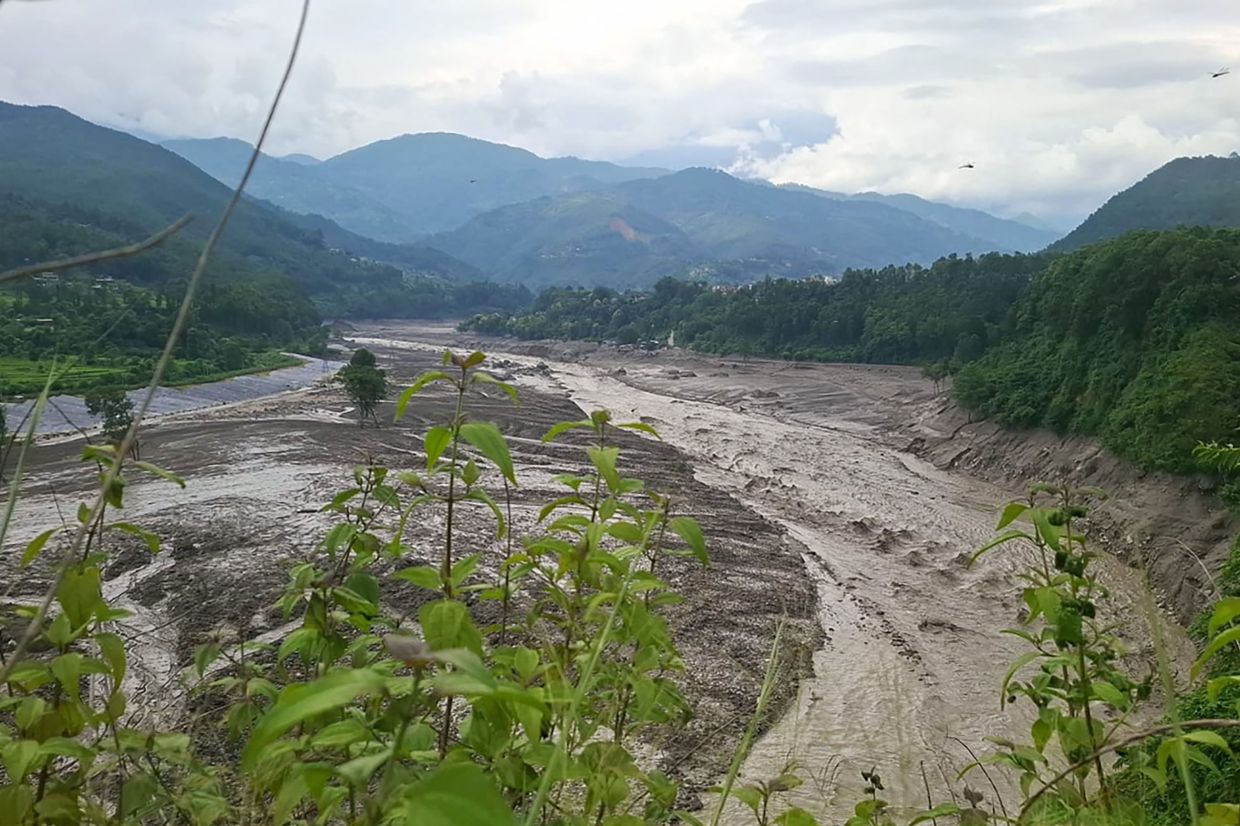
A devastating cascade of natural disasters unfolded across Nepal on Wednesday morning when a massive glacier avalanche dislodged ice and rock debris into the Lhende Khola River, triggering a destructive wall of floodwater that swept through multiple districts with catastrophic force. The resulting flash floods have claimed at least 22 lives, with hundreds of people—tourists, construction workers, pilgrims and local residents—still unaccounted for across affected areas. The incident has prompted urgent international cooperation, with India and China both mobilising substantial search and rescue resources to locate survivors in one of the region's deadliest natural disasters in recent memory.
The Bhotekoshi River, which channelled the initial surge of floodwater around 9 am local time, carved a path of destruction through communities in Nuwakot and surrounding districts in the northern Himalayan foothills. Multiple multistorey buildings, commercial vehicles, and entire sections of villages were engulfed and buried beneath tonnes of mud and debris. Beyond the immediate loss of life and property, the floods have damaged critical infrastructure including roads, bridges, and several hydropower projects that are essential to Nepal's energy sector and regional connectivity. Officials have subsequently issued warnings across multiple districts, advising residents to evacuate from the banks of the Bhotekoshi, Trishuli, and Narayani rivers as water levels remained dangerously elevated.
Malaysian nationals have been directly affected by the catastrophe. Malaysia's Foreign Ministry confirmed that its embassy in Kathmandu received reports from travel agencies indicating that 11 Malaysians were believed to be stranded in the Rasuwa district, one of the most severely impacted zones. This number forms part of a broader casualty list that reveals the international scope of the disaster—384 tourists and other nationals are currently reported missing, including 291 individuals from India, the United States, the United Kingdom, and Malaysia. The composition of the missing reflects the region's significance as a destination for religious pilgrimage and international tourism, particularly during the summer season when Mount Kailash attracts devotees from across the world.
The majority of those unaccounted for are believed to be pilgrims travelling to Mount Kailash in the Tibetan autonomous region of China, a site venerated in Hindu, Buddhist, and other spiritual traditions. Many were part of organised groups traversing the Nepal-Tibet border regions when the disaster struck, and the remote nature of these routes has complicated rescue coordination. South Korean government officials confirmed that nationals employed in construction work on a hydropower facility in the region were among the missing, underlining how the disaster has swept up workers engaged in development projects across multiple sectors.
Recognising the magnitude of the crisis, Nepal's government has appealed directly to both China and India for assistance. Sasmit Pokharel, spokesperson for the Nepali government, stated that the nation has requested urgent support from both neighbouring powers for coordinated rescue operations. China has responded with large-scale search and rescue operations concentrated in the Gyirong area on the Tibetan border, with state media reporting that Chinese President Xi Jinping has personally directed authorities to intensify rescue efforts and evacuate residents from high-risk zones. Indian Prime Minister Narendra Modi has also committed substantial assistance, speaking directly with Nepal's Prime Minister Balendra Shah to offer humanitarian aid and coordinate relief operations across the border.
Climate scientists and disaster specialists have traced the root cause of Wednesday's calamity to accelerating glacial instability in the Himalayan region. Researchers at the Kathmandu-based International Centre for Integrated Mountain Development determined that an avalanche of ice and rock from a glacier on the Nepal side of the border dislodged material that temporarily blocked the Lhende Khola River, a tributary of the Bhotekoshi. The sudden release of impounded water created an exceptionally powerful surge of floodwater that swept downstream with devastating velocity. This represents a recurring pattern of vulnerability—the same river system experienced severe flooding just fourteen months earlier in August of the previous year, when glacial melt from Tibet triggered similar events.
Climate change has fundamentally altered the hazard profile of the Himalayan region, making such catastrophic events increasingly frequent and unpredictable. The Hindu Kush Himalaya zone, which spans Nepal and extends through India and adjacent countries, is warming at a pace significantly faster than the global average due to human-induced climate change. Research conducted by institutions in Kathmandu this year documented that glaciers across the Hindu Kush Himalaya are melting at an accelerating rate, with ice loss rates having doubled since the year 2000. This acceleration is directly attributable to rising global temperatures and anthropogenic climate forcing, creating a feedback loop where melting ice exposes darker surfaces that absorb more solar radiation, thereby accelerating further melting.
Saswata Sanyal, a disaster risk reduction specialist at the climate research institute, characterised the recurring nature of such events as symptomatic of systemic environmental change. He noted that the Lhende Khola has flooded twice within fourteen months, each time triggered by ice and rock avalanches that cascade from glaciers destabilised by warming temperatures. Sanyal emphasised that in the context of a rapidly warming Himalaya, early warning systems and disaster preparedness have become the foundational strategy for adaptation and risk mitigation. The challenge confronting regional governments and international agencies is not merely responding to individual disasters but developing robust systems to predict and prepare for increasingly frequent and severe events.
The pattern of extreme weather and geomorphological hazards across the Himalayan region has intensified markedly in recent years. Beyond flash floods and avalanches, the region now experiences more frequent and intense heat waves, concentrated rainfall events, and landslides triggered by soil destabilisation. Glacial retreat has fundamentally altered river regimes, creating both immediate hazards from accelerated melt and longer-term challenges to water security for hundreds of millions of people dependent on Himalayan water sources across South and Southeast Asia. For Malaysian readers, the presence of eleven nationals in the affected zone underscores how climate-driven disasters in distant mountain regions can have direct and immediate consequences for citizens, while also illustrating the interconnected nature of global environmental change and humanitarian crisis.

