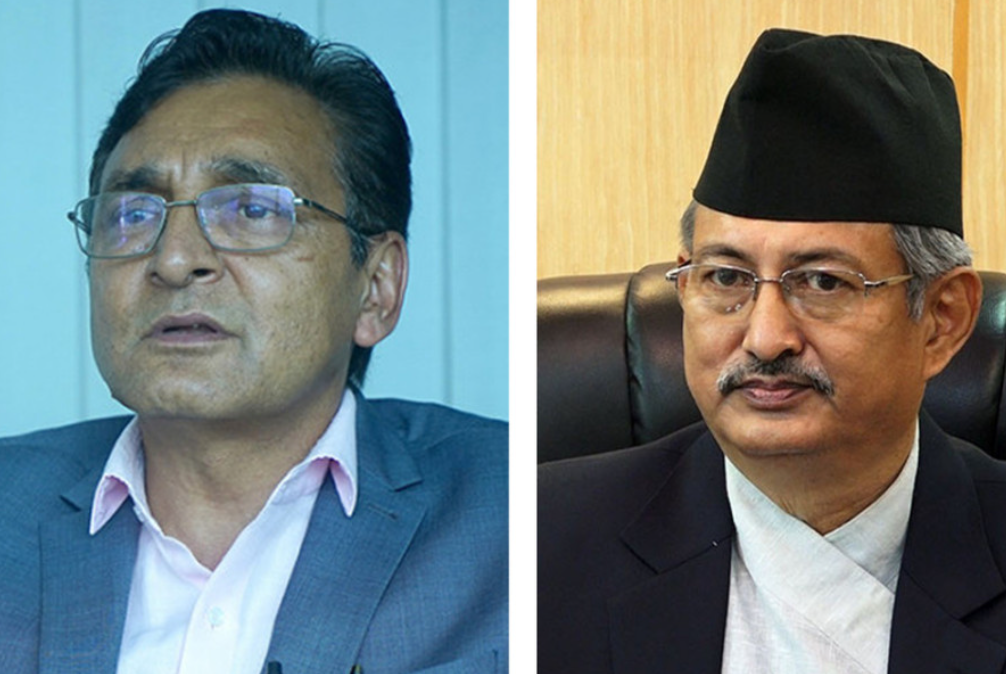
A Kathmandu district court has delivered guilty verdicts against two high-ranking former government officials who masterminded a scheme to forge official documents and enable Nepali nationals to fraudulently claim asylum as Bhutanese refugees destined for the United States. The rulings, announced late Tuesday and confirmed by court documentation and legal representatives on Wednesday, represent a significant moment in Nepal's anti-corruption efforts following months of public pressure over systemic graft. Former Deputy Prime Minister and Energy Minister Top Bahadur Rayamajhi received a four-year sentence for charges encompassing crimes against the state, fraud, and participation in organised criminal activity. Former Home Minister Bal Krishna Khand, who faces lesser direct involvement charges, drew a two-year prison term as an accomplice to the broader conspiracy.
Rayamajhi currently remains in police custody while facing his conviction, whereas Khand secured bail prior to sentencing and continues to operate outside detention. Both officials have previously issued categorical denials regarding their participation in the fraud scheme. Dharma Raj Regmi, representing Rayamajhi's interests, contended that his client bore no responsibility for refugee policy formulation and immediately signalled intentions to challenge the conviction through the appellate process. Similarly, Khand's legal counsel Pankaj Karna declared plans to pursue an appeal, suggesting the case will likely proceed through higher judicial levels before final resolution.
The scope of the conspiracy extended far beyond the two former ministers. Alongside Rayamajhi and Khand, fourteen additional defendants received convictions, including a former senior administrator within Nepal's home ministry apparatus and a prominent ex-leader of the Bhutanese refugee community in Nepal. These co-conspirators received sentences ranging up to four years, indicating their varying degrees of culpability within the broader fraud network. The involvement of a high-ranking bureaucrat within the home ministry underscores how the scheme penetrated institutional structures responsible for refugee processing and documentation verification.
The precise scale of the fraud remains unclear at present. Investigators have not yet confirmed whether any Nepali nationals actually successfully entered the United States under false Bhutanese refugee credentials through this conspiracy. The scam itself came to light in 2023, by which point both Rayamajhi and Khand had already departed their respective government positions. This timing raises questions about how long the fraudulent scheme operated undetected and whether authorities initially lacked the political will to pursue high-level officials while they remained in power.
Understanding the context of the refugee situation proves essential for grasping both the motivation behind the fraud and its broader regional significance. Since the early 1990s, approximately 120,000 ethnic Nepalis have fled Bhutan, seeking refuge across the southern border. These individuals cited insufficient political freedoms and ethnic discrimination within Bhutan's majority Buddhist society, a kingdom with a total population beneath 800,000 inhabitants. Their exodus represents one of South Asia's most persistent displacement crises, yet the underlying political causes remain unresolved between Thimphu and Kathmandu.
Third-country resettlement emerged as the primary solution after Nepal and Bhutan failed to negotiate any sustainable repatriation framework. Through international coordination efforts, nearly 113,000 Bhutanese refugees have gained permanent resettlement across multiple Western nations. The United States alone has accepted approximately 100,000 refugees from this population, making it by far the largest recipient. Canada, Australia, and other developed nations have also participated in accepting smaller numbers. Yet several thousand Bhutanese-origin Nepalis remain confined to camps scattered across eastern Nepal, where they continue to languish while expressing hopes of eventual return to Bhutan—a prospect that appears increasingly distant given political developments in the kingdom.
The guilty verdicts arrive at a particularly symbolic moment in Nepal's political trajectory. In September of the previous year, Nepal witnessed sustained youth-led anti-corruption demonstrations that claimed seventy-six lives and destabilised the ruling government. The intensity of public anger over endemic corruption directly prompted governmental collapse and triggered broader institutional reckoning. This groundswell of popular frustration against official malfeasance forced the political establishment to address charges of systematic graft that had previously operated with relative impunity.
The new political dispensation taking office represents a departure from traditional power structures. In March elections, Nepali voters overwhelmingly endorsed a government led by Balendra Shah, a former rap musician who rebranded himself as a political reformer and now serves as prime minister at age thirty-six. Shah explicitly campaigned on an anti-corruption platform targeting alleged wrongdoing by prior administrations, framing his leadership as generational change resistant to establishment patterns. The refugee fraud convictions constitute concrete evidence that his administration is pursuing promised investigations and prosecutions of former officials, thereby establishing credibility for his reform agenda.
For Malaysia and other Southeast Asian nations, Nepal's prosecution efforts contain relevant lessons regarding institutional accountability. The conviction demonstrates that even former ministers of substantial rank face legal consequences when evidence of corruption emerges, potentially raising performance standards across the region. The scheme's reliance on forged documentation and bureaucratic complicity reflects vulnerabilities common to developing-nation administrative systems throughout Asia. Additionally, the case underscores how refugee administration systems remain susceptible to manipulation when internal controls lack rigor and oversight proves insufficient.
The refugee fraud also illustrates how genuine humanitarian crises can be exploited for illicit profit and personal advantage. Authentic Bhutanese refugees fleeing legitimate persecution became the inadvertent cover for a corruption scheme that potentially undermined the credibility of legitimate asylum claims. This dynamic damages both refugee receiving countries' confidence in documentation integrity and international cooperation on humanitarian protection. For the broader community of displaced Bhutanese Nepalis still awaiting resolution of their status, the fraud represents a setback that complicates perceptions of Nepal's refugee administration legitimacy.
Appeal proceedings will likely extend the case across multiple years as the judicial system processes challenges to the convictions and sentences. Higher courts may either uphold, modify, or overturn the verdicts depending on evidentiary assessments and legal arguments presented. The cases against the fourteen co-conspirators will simultaneously advance through the system, potentially revealing additional details about the conspiracy's operational mechanics and extent. Each development carries potential implications for broader political perceptions regarding whether Nepal's new government genuinely pursues accountability or merely conducts performative prosecutions to satisfy public demands.

