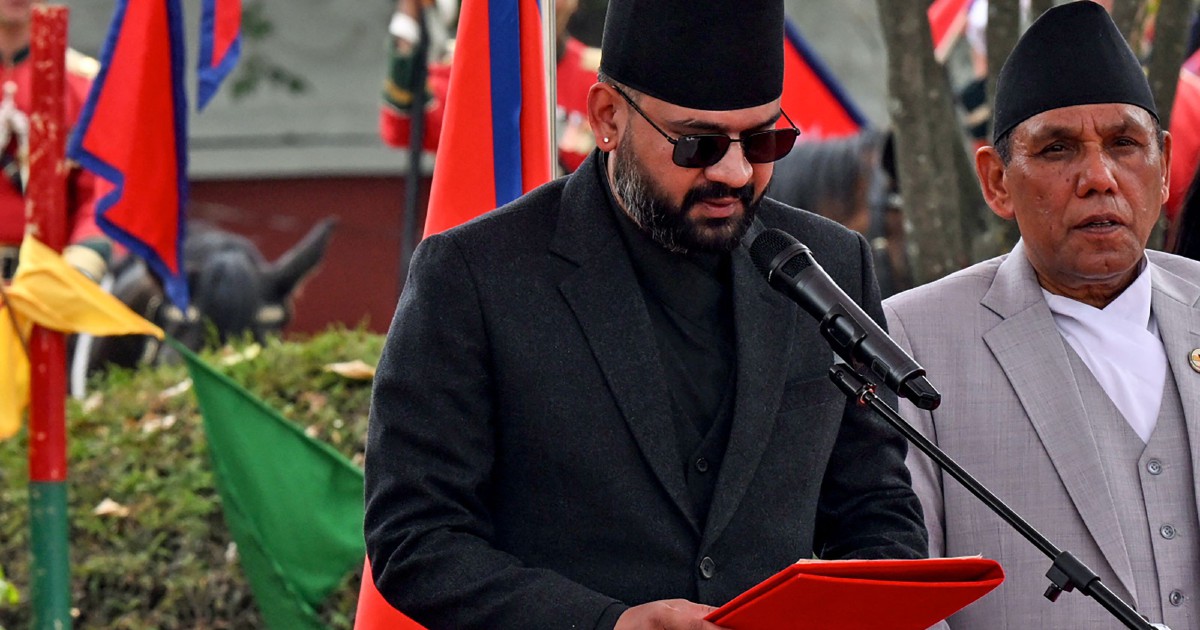
Nepal's Prime Minister Balendra Shah will be permitted to retain his characteristic dark sunglasses during parliamentary proceedings, an official confirmed on Tuesday, settling a question that had emerged when the parliament speaker previously discouraged the practice. The decision reflects an accommodation of medical needs within the legislature's dress code expectations, recognizing that what might ordinarily be considered informal attire serves a therapeutic purpose for the government's chief executive.
The matter gained public attention when Nepal's parliament speaker had advised against Shah wearing sunglasses in the chamber, as this departed from conventional parliamentary decorum observed across most legislatures worldwide. Such dress codes typically emphasize formal presentation and are intended to maintain the dignity and solemnity of legislative proceedings. The speaker's guidance appeared to follow standard practices in which legislators are expected to maintain a particular standard of appearance during official sessions.
However, Shah's medical requirement for the eyewear altered the equation significantly. Medical practitioners have long recognized that certain conditions—including photosensitivity, ocular inflammation, or post-operative eye complications—necessitate protection from ambient light even in controlled indoor environments. The sunglasses thus function as a medical device rather than a fashion accessory, placing the matter squarely within grounds for reasonable accommodation. This medical dimension transformed what might have appeared as a mere stylistic preference into a health accommodation issue.
The resolution demonstrates pragmatic flexibility within institutional frameworks, particularly when medical necessity intersects with procedural norms. Many parliaments globally have evolved to recognize that rigid adherence to dress codes can conflict with legitimate health requirements of their members. By permitting Shah to maintain his signature eyewear, Nepal's parliament has aligned itself with an increasingly accommodating approach that balances institutional dignity with individual health needs.
For Malaysian observers, this development carries particular relevance given regional legislative traditions. Southeast Asian parliaments have similarly navigated questions about dress codes, decorum standards, and the accommodation of members' diverse health circumstances. The principle established in Nepal—that medical necessity can supersede standard procedural expectations—provides a useful precedent for how democratic institutions can remain both dignified and humane.
The public nature of this exemption also reflects broader conversations about transparency and the appropriate scope of parliamentary accommodations. By publicly confirming the medical basis for Shah's exception rather than handling the matter quietly, Nepal's authorities acknowledged that such decisions warrant open discussion and understanding. This transparency helps citizens comprehend that exceptions to parliamentary norms rest on substantive grounds rather than mere privilege or favoritism.
Institutional dress codes carry symbolic weight in democratic societies, representing concepts of equality, formality, and shared commitment to procedural standards. Yet these same institutions recognize that their primary function transcends mere appearance, focusing instead on substantive legislative work and representation. The tension between maintaining standards and accommodating genuine needs has become increasingly evident across parliaments worldwide, as lawmakers seek to preserve institutional character while accepting that diverse bodies inevitably encompass diverse health requirements.
Shah's situation also illuminates how legislative bodies adapt their practices in response to individual circumstances while maintaining overall institutional coherence. Rather than establishing a blanket exception that might undermine dress code standards, the medical exemption remains particular to circumstances supporting it. This targeted approach allows parliaments to demonstrate flexibility without abandoning the dress code concept entirely.
The decision ultimately reflects a mature institutional response to a nuanced problem. By examining the substantive medical justification and granting appropriate accommodation, Nepal's parliament has modeled how democratic chambers can honor both procedural traditions and the human realities of their members. For the Prime Minister, this resolves a distraction that could have otherwise dominated parliamentary discussion; for the institution, it demonstrates that maintaining dignity need not require inflexibility in the face of legitimate medical need.

