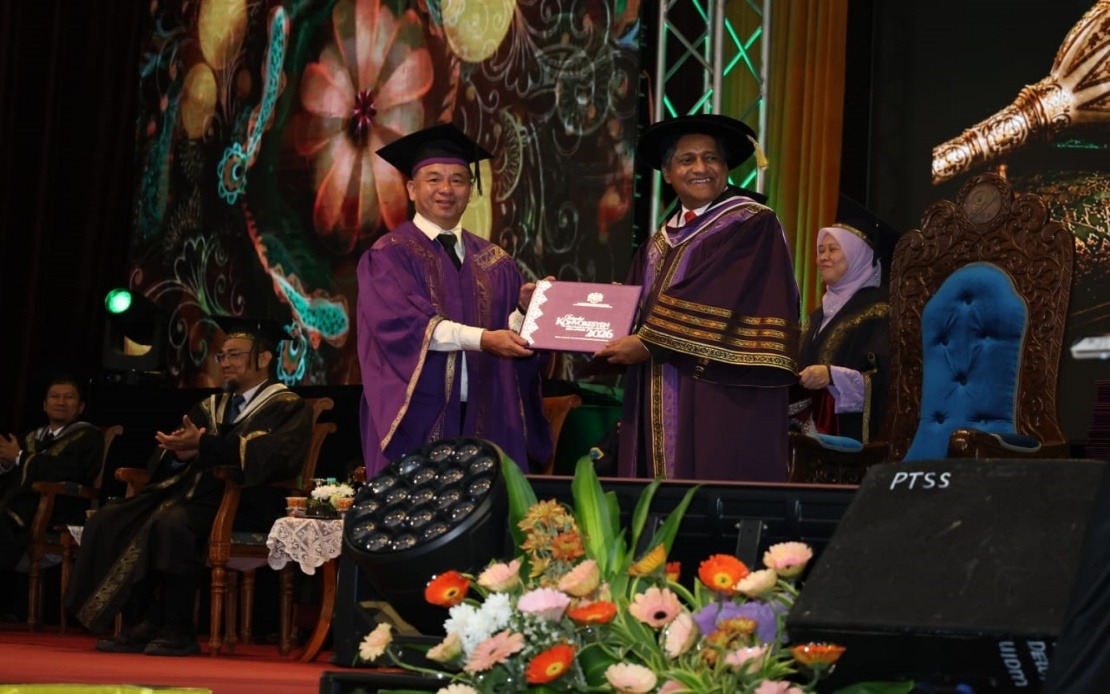
Heng Meng Lai has shattered the notion that educational pursuits belong exclusively to the young, stepping onto the convocation stage at Seberang Perai Polytechnic as the institution's oldest ever graduate at the age of 57. His achievement in completing the Diploma in Electrical and Electronic Engineering represents far more than a personal milestone—it underscores a transformative reality about Malaysia's evolving approach to skills development and the democratisation of learning opportunities across generations.
The journey that brought Heng to this moment spans nearly half a century, marked by postponed ambitions and competing life priorities. After his father's death when he was merely nine years old, his family's circumstances shifted dramatically. His mother became the household's sole provider, working long hours in a sewing factory to support seven children. These formative experiences of hardship and economic struggle, rather than crushing his educational aspirations, instead crystallised them into a driving force that persisted through decades of employment and responsibility.
Heng's career trajectory reveals a man methodically building expertise through practical experience. He spent years working as a storekeeper before progressing to a supervisory role on the production line at an electronics manufacturing facility. This frontline exposure to the technical operations of electrical and electronic systems gradually awakened a deeper curiosity about the field. Rather than remaining satisfied with procedural knowledge acquired through routine work, he recognised that formal qualification would unlock new dimensions of understanding and career progression.
The decision to enrol at Seberang Perai Polytechnic represented the culmination of a long-deferred dream, yet it also presented genuine uncertainties. Heng would find himself in lecture halls and laboratories alongside classmates young enough to be his grandchildren, navigating curricula designed for students at a fundamentally different life stage. The potential for feeling displaced or marginalised was real, yet his recounting of his polytechnic experience paints a strikingly different picture than such concerns might suggest.
According to Heng's own reflections, the academic staff at the institution provided patient, consistent mentorship that actively combated any sense of alienation. Rather than treating his age as an impediment or curiosity, lecturers offered targeted guidance to help him bridge the gap between his prior work experience and the formal theoretical frameworks being taught. This institutional support proved crucial—it transformed what could have been an isolating experience into one marked by belonging and academic encouragement.
The significance of Heng's achievement resonates particularly within Malaysia's broader policy framework around human capital development. At a time when the nation faces urgent needs for skilled workers in technical fields and when demographic shifts create pressures on the traditional school-age workforce pipeline, stories like Heng's demonstrate that talent and capability exist across all age groups. His proven ability to master complex engineering concepts at 57 suggests that the pool of potential skilled workers extends far beyond the conventional boundaries that many employers and educational planners typically assume.
For Seberang Perai Polytechnic, Heng's graduation carries symbolic weight. Director Mohd Ruzi Hamzah positioned the achievement as validation of the institution's commitment to accessibility and inclusivity, noting that the polytechnic system remains dedicated to serving diverse population segments regardless of age or socioeconomic background. This framing aligns with Malaysia's broader policy push toward lifelong learning—a concept that extends beyond a catchy phrase to encompass genuine structural changes in how educational access is conceptualised and delivered.
The practical implications of Heng's qualification extend beyond personal fulfilment. His stated intention to return to the electronics sector to apply his newly formalised knowledge suggests that employers in technical industries may benefit substantially from engaging workers who combine years of hands-on experience with fresh, contemporary theoretical training. This combination often produces professionals who can identify practical problems more readily than fresh graduates while possessing up-to-date technical knowledge.
Heng's explicit plan to pursue a Bachelor's degree following completion of his diploma demonstrates that his educational appetite has merely been whetted rather than satisfied. This progression trajectory mirrors the pathways increasingly available through Malaysia's polytechnic-to-university bridge programmes, though it remains a relatively underutilised avenue for mature-age learners. His determination to continue ascending the qualification ladder at an age when many professionals consider their formal learning complete signals that educational ambition need not diminish with age.
The broader Southeast Asian context amplifies the relevance of Heng's story. Across the region, nations grapple with skills shortages in technical fields while simultaneously facing rapid technological change that renders existing worker expertise periodically obsolete. Malaysia's polytechnic system, having expanded dramatically in recent decades, continues experimenting with pedagogical approaches and admission pathways that might better serve non-traditional learners. Heng's positive experience suggests these institutions possess both the capability and the will to accommodate older students effectively.
Beyond the employment and economic dimensions, Heng's achievement speaks to questions of dignity and social inclusion. His childhood experiences of economic precarity and educational deprivation could easily have calcified into resignation. Instead, he maintained what might be termed an educational hope—a sustained belief that circumstances could change and that qualification remained attainable. For other Malaysians from similarly constrained backgrounds who abandoned formal schooling decades ago, Heng's example offers tangible proof that institutional support systems exist to facilitate their return to learning.
The convocation ceremony in which Heng received his diploma represented a moment of personal transformation, yet it also constituted a subtle institutional statement. By prominently acknowledging its oldest-ever graduate, Seberang Perai Polytechnic positioned itself as genuinely committed to lifelong learning principles rather than merely paying rhetorical lip service to the concept. This positioning carries increasing importance as Malaysia competes regionally for positioning as a centre of excellence in skills development and technical education.
As Heng proceeds toward his next educational objective, his trajectory offers Malaysian policymakers, educators, and employers a potent reminder. The assumption that educational benefits accrue primarily to the young reflects an increasingly outdated understanding of workforce development. A 57-year-old man with decades of practical experience, combined with contemporary formal qualification and demonstrable motivation, represents precisely the category of human capital that knowledge-intensive economies require. Heng's achievement suggests that rather than viewing age as a barrier to educational participation, Malaysia's institutional framework should actively cultivate the untapped potential represented by mature-age learners.

