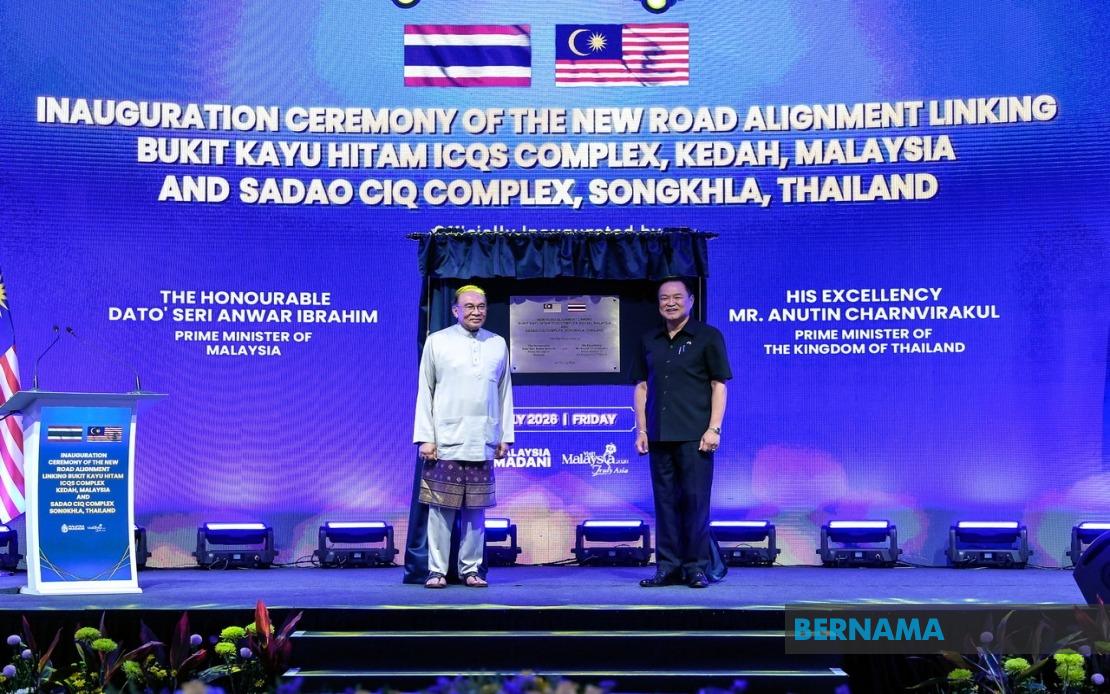
Prime Minister Datuk Seri Anwar Ibrahim has unveiled an ambitious infrastructure project designed to transform cross-border economic dynamics between Malaysia and Thailand. At a ceremony in Bukit Kayu Hitam today, he officially launched a new road alignment connecting the Bukit Kayu Hitam Immigration, Customs, Quarantine and Security Complex in Kedah with the Sadao Customs, Immigration and Quarantine Complex in southern Thailand. The bilateral initiative, jointly inaugurated with Thailand's Prime Minister Anutin Charnvirakul, represents a significant step in deepening institutional cooperation between the two nations and signals renewed political commitment to leveraging geographic proximity for mutual prosperity.
The infrastructure development is positioned as more than a routine border enhancement. Anwar characterised the alignment as a historic turning point in Malaysia-Thailand relations, one that transcends conventional diplomatic engagement and ventures into concrete, tangible development. The project underpins both governments' recognition that the northern Malaysian states and southern Thai provinces remain economically underdeveloped relative to their respective countries' urban cores, and that strategic border improvements can redirect investment and commercial activity toward these peripheral regions. By facilitating smoother movement of goods and people, the new road aims to reduce friction costs associated with cross-border transactions, thereby making the region more competitive for both domestic and foreign investors.
Beyond the physical infrastructure itself, Anwar outlined a broader strategic vision encompassing the creation of a special economic border zone spanning northern Peninsular Malaysia and southern Thailand. This concept extends to Perlis, Kedah, Kelantan, Perak and Penang on the Malaysian side, offering development opportunities that currently remain constrained by inadequate connectivity and bureaucratic inefficiencies. The Prime Minister acknowledged that establishing such a zone is neither swift nor straightforward, requiring sustained high-level political will and institutional coordination. The announcement suggests both governments are willing to undertake the legislative, administrative and regulatory harmonisation necessary to enable preferential trading arrangements and investment frameworks unique to the border region.
Trade expansion figures prominently in both countries' calculations. Malaysia and Thailand have committed to achieving bilateral trade worth USD30 billion by 2027, up from current levels. Anwar indicated that enhanced border infrastructure and reduced clearance times will be instrumental in closing this gap. For Malaysian exporters, particularly those in agriculture, manufacturing and processed goods, faster customs processing directly translates to lower transaction costs and improved competitiveness in Thai markets. Conversely, Thai producers gain more efficient access to Malaysian ports and onward regional distribution networks. This mutually beneficial dynamic makes the investment economically rational for both sides and suggests the trade target is achievable if complementary policy measures are implemented.
A critical component of the initiative involves expedited resolution of longstanding bilateral irritants. Anwar emphasised that both nations have agreed to accelerate the settlement of disputes spanning customs procedures, immigration protocols, fisheries management and trade regulations. These issues, some rooted in decades of negotiation, have historically impeded seamless commercial interaction. The apparent breakthrough in addressing these matters swiftly—Anwar noted that several long-standing issues were substantially resolved during recent high-level discussions—signals a qualitative shift in bilateral problem-solving methodology. Rather than allowing bureaucratic inertia and diplomatic caution to perpetuate inefficiencies, the two governments appear committed to identifying pragmatic solutions that prioritise the interests of traders and business communities operating across the border.
The political symbolism of the border launch itself warrants examination. Anwar's explicit appreciation for Anutin's willingness to visit the Bukit Kayu Hitam border area underscores an often-overlooked dimension of bilateral relations: the tendency for senior leaders to concentrate on capital cities and major urban centres while neglecting peripheral communities. By conducting the project launch at the border itself rather than in Kuala Lumpur or Bangkok, both prime ministers signalled tangible commitment to the welfare of communities traditionally marginalised in national economic narratives. For residents of Kedah, Perlis and adjacent Thai provinces, such high-level attention validates their concerns and suggests future policy decisions may increasingly account for border-region development.
For Malaysian readers, particularly those in northern states, the initiative carries concrete implications. Enhanced cross-border connectivity reduces time and costs associated with trade with Thailand, benefiting exporters and consumers alike. Investment in border infrastructure typically generates employment in construction, logistics and service sectors. Additionally, the proposed special economic zone framework may eventually offer preferential tax treatments, streamlined business registration and enhanced infrastructure investment in participating regions. Tourism flows could also intensify as border crossing becomes more efficient. However, these benefits will depend on effective implementation and complementary investments in domestic infrastructure within Malaysia's border districts.
The broader Southeast Asian context adds another dimension to this development. Malaysia and Thailand are significant regional trading partners, and their successful border cooperation models can serve as templates for other ASEAN nations. The success or failure of the Bukit Kayu Hitam-Sadao initiative will influence perceptions about the feasibility of similar projects elsewhere in the region—for instance, between Malaysia and Indonesia, or Thailand and Laos. If the project delivers measurable economic gains, it strengthens the case for regional governments to prioritise border infrastructure investment as a development strategy. Conversely, implementation challenges would underscore the complexity of cross-border coordination even between relatively stable, cooperative neighbours.
The fisheries component of the bilateral agenda merits particular attention. The Malaysia-Thailand maritime boundary has historically generated tensions related to fishing rights and resource access. By explicitly including fisheries in the framework for expedited issue resolution, both governments acknowledge this sector's importance to coastal communities and its potential to generate renewed disputes if left unmanaged. Harmonising fisheries regulations and enforcement mechanisms across the border could benefit small-scale fishers while reducing enforcement costs for both nations.
Anwar's framing of the initiative as part of his government's broader economic ambitions is strategically significant. Northern Malaysia has historically lagged southern and western regions in per-capita income and development metrics. Positioning border development as a cornerstone of northern economic revitalisation allows the government to articulate a compelling narrative of inclusive growth. For Anwar's political coalition, which relies substantially on support from northern constituencies, tangible border-region development yields electoral dividends while addressing genuine economic disparities.
The successful launch represents only an initial phase. Realising the full potential of the road alignment and special economic zone concept will require sustained political commitment, substantial public investment and effective inter-agency coordination. Both governments will need to navigate complex questions regarding labour mobility, environmental standards, intellectual property protection and dispute resolution mechanisms within the proposed zone. The coming months will reveal whether today's ceremony marks genuine institutional transformation or remains primarily ceremonial in character. For the traders and residents of Malaysia's northern border areas, the ultimate measure of success will be whether improved border infrastructure translates into tangible livelihood improvements and sustainable economic growth.

