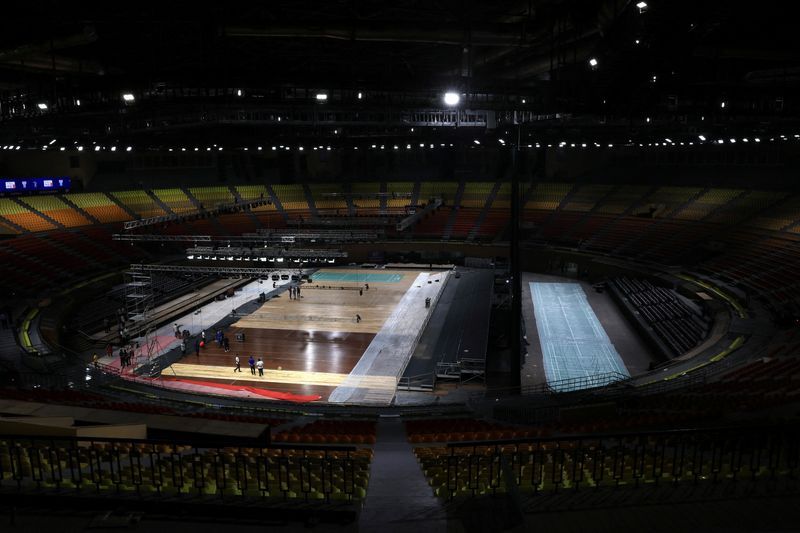
The Badminton World Federation's showpiece event arrives in New Delhi next week with an unconventional security measure in place: a team of trained specialists whose sole job is to reproduce the alarm calls of langur monkeys. This quirky addition to the event's workforce reflects a persistent urban challenge that has plagued major sporting competitions and government facilities across India's capital—the management of rhesus monkey populations that routinely invade buildings, disrupt proceedings, and occasionally pose risks to spectators and staff.
The city's monkey problem is neither new nor trivial. Rhesus macaques have become a perennial headache in Delhi, frequently breaching security at office buildings, courts, and public spaces where they snatch food, scare visitors, and occasionally turn aggressive. Their sheer numbers and boldness have made them a fixture of urban life that organisers of international events must now explicitly plan for. The langur, a larger primate distinguished by its black face and grey body, has emerged as an effective natural deterrent. These primates compete with rhesus monkeys for territory and resources, and their presence alone is often sufficient to drive smaller monkey populations away. This biological reality has given rise to a small but recognised profession: langur mimics who can reproduce the vocal signatures that signal danger to the city's rhesus populations.
Zafar, one such practitioner, represents the third generation of his family to work in this field. During a recent visit to the Indira Gandhi Indoor Stadium, he demonstrated his hooting technique to journalists, explaining the mechanics of his craft. According to Zafar, the work is not about harming animals but creating an acoustic environment hostile enough to discourage them from entering particular spaces. He has previously served in government offices across India, where his services have helped maintain animal-free working environments without resorting to culling or cruel confinement. His presence at the World Championships reflects organisers' determination to prevent a recurrence of earlier embarrassments.
That determination stems directly from the Indian Open badminton tournament held at the same venue earlier this year, when a rhesus monkey was spotted moving freely through the spectator gallery. The incident proved deeply embarrassing for the Badminton Association of India, which faced criticism for failing to manage basic venue security. For a nation preparing to host the 2030 Commonwealth Games and actively bidding to stage the 2036 Olympics, such breaches carry symbolic weight beyond the immediate disruption. International sporting bodies and potential host nations for future events scrutinise how venues handle logistical challenges, and wildlife management failures suggest inadequate overall planning.
The monkey problem, however significant, represents only one dimension of the wildlife challenge facing event organisers. Delhi's pigeon population has also become a source of recurring frustration. During the Indian Open, the court itself required sanitisation after birds fouled the playing surface, and matches were interrupted twice as a result. Players lodged complaints about hygiene standards, and the spectacle of stoppages created an unprofessional impression that particularly concerned officials tasked with showcasing India's capacity to host premier international competitions.
Addressing the pigeon issue required a different technological approach. Stadium management has applied non-toxic gel, typically used to prevent birds from roosting on railway infrastructure, across the roof and ventilation ducts of the facility. This method deters pigeons from settling in the stadium without harming them, aligning with India's broader animal welfare considerations. The gel creates an uncomfortable surface that encourages birds to nest elsewhere, effectively creating an invisible barrier that functions around the clock without human intervention.
Sanjay Mishra, secretary general of the Badminton Association of India, publicly acknowledged the earlier shortcomings while emphasising the scale of improvements undertaken since the Indian Open. His statement that all issues have been addressed carries the weight of India's international reputation on the line. The Badminton World Federation has apparently signed off on current arrangements, an endorsement that provides some assurance regarding venue standards. The sports ministry's involvement in facility upgrades signals that the government views successful hosting of the World Championships as a test case for future major events.
For Malaysian readers and broader Southeast Asian audiences, the Indian experience offers relevant perspective on the intersection of urban wildlife management and international event hosting. Across the region, cities hosting major sporting competitions face similar pressures to present infrastructure that meets global standards while managing localised environmental challenges. The solutions emerging from New Delhi—combining traditional ecological knowledge with modern pest management technology—illustrate how developing economies can address such issues without importing wholesale international solutions that may prove culturally inappropriate or economically inefficient.
The deployment of langur mimics also underscores how international competition standards sometimes require adaptation to local contexts. Rather than constructing elaborate enclosures or implementing intrusive security measures, organisers have opted for a solution rooted in animal behaviour and local expertise. This pragmatic approach resonates with Southeast Asian event management practices that increasingly emphasise working with rather than against local ecological realities. Malaysia's own experiences hosting major sporting events provide useful comparative reference points for understanding how different regions balance operational necessity with environmental sensitivity.
Looking beyond the immediate World Championships, India's comprehensive response to venue management challenges reflects broader institutional learning about hosting international events. Each successive tournament provides feedback that shapes future planning, and the investments in pigeon management and monkey deterrence represent institutional memory being converted into concrete improvements. For stakeholders in other Southeast Asian nations considering bids for future Olympics or Commonwealth Games, the New Delhi model demonstrates that credible hosting requires addressing not just athletic facilities but the full ecosystem of venue management, including dimensions that might initially seem peripheral but ultimately affect international perception.

