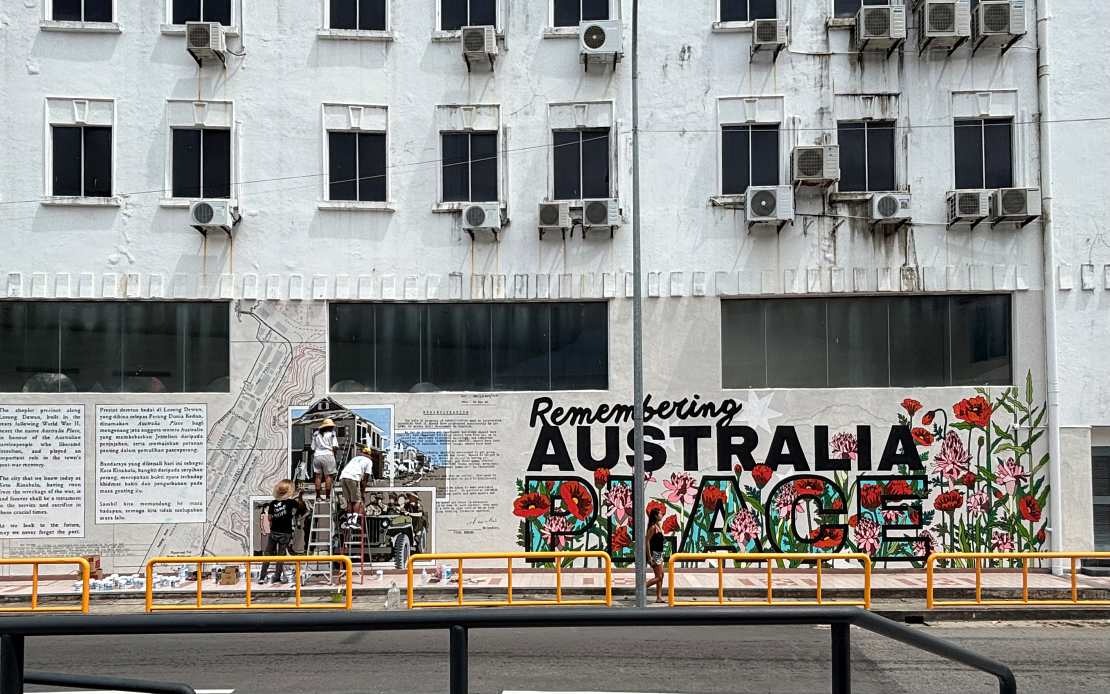
A carefully designed public mural has breathed fresh artistic life into a Kota Kinabalu landmark long known as 'Australia Place', transforming the informal designation into a formal celebration of the historical ties binding Sabah and Australia. The unveiling on Friday of the 'Remembering Australia Place' mural at the Wisma Intiutama building represents more than a simple public art installation—it serves as a tangible recognition of relationships forged through shared wartime experience, educational exchange, and sustained bilateral cooperation spanning multiple generations.
The timing of the mural's reveal carries particular significance, arriving on the eve of Sandakan Day, the annual commemoration observed by both nations honouring the soldiers and civilians who endured the devastating Sandakan Death Marches during World War II. This historical backdrop transforms the artwork into something far deeper than aesthetic decoration, anchoring contemporary ties to a past marked by extraordinary sacrifice and resilience. For Kota Kinabalu, a city where Australian cultural presence has long been woven into the social fabric, the mural represents an official acknowledgement of what residents have long understood intuitively—that Australian-Sabahan connections run profoundly deep through multiple dimensions of community life.
Danielle Heinecke, Australia's High Commissioner to Malaysia, framed the mural as emblematic of a partnership characterised by decades of cultural and community exchange. Her statement emphasised how the artwork captures the experiences of individuals whose personal journeys have intertwined the nations' destinies, creating bonds that transcend formal diplomatic channels. This observation reflects a broader reality often overlooked in traditional bilateral relationships: that genuine partnership develops through countless personal connections, professional collaborations, and family ties rather than through government proclamations alone. For Malaysian readers, particularly those in Sabah, this perspective reinforces how international relationships are ultimately human endeavours grounded in mutual respect and shared values.
The artistic conception and execution by Pillars of Sabah, a local community arts organisation, invested the project with authenticity and local resonance. Rather than commissioning external artists unfamiliar with Sabahan contexts and sensibilities, the decision to work with community-based creators ensured the mural would genuinely reflect the lived experiences and cultural understanding of those it depicts. This methodological choice becomes instructive for public art initiatives elsewhere in Malaysia, suggesting that meaningful cultural commemorations benefit from rooting artistic expression in community knowledge and creative expertise.
Jared Abdul Rahman, co-founder of Pillars of Sabah, embodies the very relationship the mural celebrates. Born to a Sabahan father and Tasmanian mother who met during the father's studies under the Colombo Plan scholarship scheme, Jared's personal biography encapsulates how bilateral relationships manifest at the individual level. His background represents a specific historical moment when Malaysian students pursued higher education in Australia through formal government programs, generating lasting personal and professional networks. These educational flows, often overlooked in policy discussions, constitute crucial infrastructure for maintaining long-term diplomatic and cultural goodwill, establishing lifelong associations that persist regardless of political fluctuations.
The collaborative aspect of the mural's creation merits particular attention. By engaging students and teachers from Sekolah Menengah Kebangsaan Sanzac and encouraging intergenerational participation from across the Kota Kinabalu community, the project transformed art-making into a pedagogical exercise. Younger Sabahans gained concrete understanding of historical connections to Australia while contributing meaningfully to a permanent public work. This generational transmission of historical memory proves essential in maintaining continuity of bilateral relationships, ensuring that contemporary young people internalise the shared history underpinning Sabah-Australia ties rather than treating such connections as abstract or irrelevant to their present circumstances.
Sandakan Day itself deserves deeper consideration for Malaysian audiences. The annual observance commemorates the 2,434 prisoners of war who perished during the Sandakan Death Marches in 1945, one of World War II's most harrowing episodes. Yet the day also honours Sabahans who, at tremendous personal risk, provided assistance to these prisoners and facilitated escape attempts. This dual commemoration positions Sabahans not merely as witnesses to historical tragedy but as active participants in resistance and humanitarian action. The mural thus becomes a vehicle for asserting Sabahan agency and moral courage during wartime, counteracting narratives that might otherwise centre Australian or European perspectives exclusively.
For contemporary Malaysian-Australian relations, the mural embodies diplomatic values extending well beyond ceremonial courtesy. Australia constitutes a significant destination for Malaysian students pursuing tertiary education, with Sabahans historically well-represented among these educational migrants. Trade flows, tourism patterns, and professional networks have created substantive economic interdependencies. Cultural connections through media, sport, and academic collaboration run consistently strong. The mural's celebration of these multifaceted linkages implicitly advocates for prioritising such people-to-people connections even when formal diplomatic relations experience periodic strain or when regional geopolitical tensions create complications.
The specific location of 'Australia Place' within Kota Kinabalu's urban geography reflects historical patterns of community settlement and commercial development. Colonial-era and post-colonial urban planning in Sabah frequently resulted in ethnic and national communities establishing informal geographic clusters, with particular streets or districts becoming associated with specific national or cultural identities. The 'Australia Place' designation emerged organically from these patterns, representing decades of accumulated Australian presence in the form of businesses, educational institutions, and residential communities. Formalising this designation through public art grants official sanction to what was previously merely customary recognition.
The mural's artistic approach, emphasising shared values of friendship, resilience, and cooperation, offers instructive lessons for how bilateral relationships might be publicly represented. Rather than focusing narrowly on official achievements or diplomatic victories, the artwork prioritises human connection and mutual support. This framing aligns with contemporary understanding that sustainable international partnerships depend fundamentally on genuine goodwill and perceived reciprocal benefit rather than on power asymmetries or transactional calculations. For Malaysians observing regional dynamics, such artistic expression of partnership values carries subtle but significant diplomatic weight.
Looking forward, the mural establishes a precedent for how Sabah might commemorate its distinctive international relationships through public art. The state maintains significant connections to multiple nations through historical accident, migration patterns, and contemporary commerce. Similar artistic initiatives could celebrate and reinforce relationships with other partners, creating a more complex and nuanced public understanding of Sabah's place within broader regional and global networks. This approach transforms public space into educational and commemorative resources that bypass traditional media and reach diverse audiences through aesthetic experience.
The presence of Mayor Datuk Seri Sabin Samitah and various parliamentarians at the unveiling ceremony underscored official endorsement of the artistic tribute. Such political participation signals that celebrating international friendship remains a legitimate and valued municipal function, worthy of attention from elected representatives. This institutional support proves crucial for sustaining public art initiatives and ensuring they achieve permanence rather than remaining temporary installations subject to removal or neglect. For Kota Kinabalu, the mural thus becomes an anchoring cultural fixture likely to persist across political administrations and shifting budgetary priorities.

