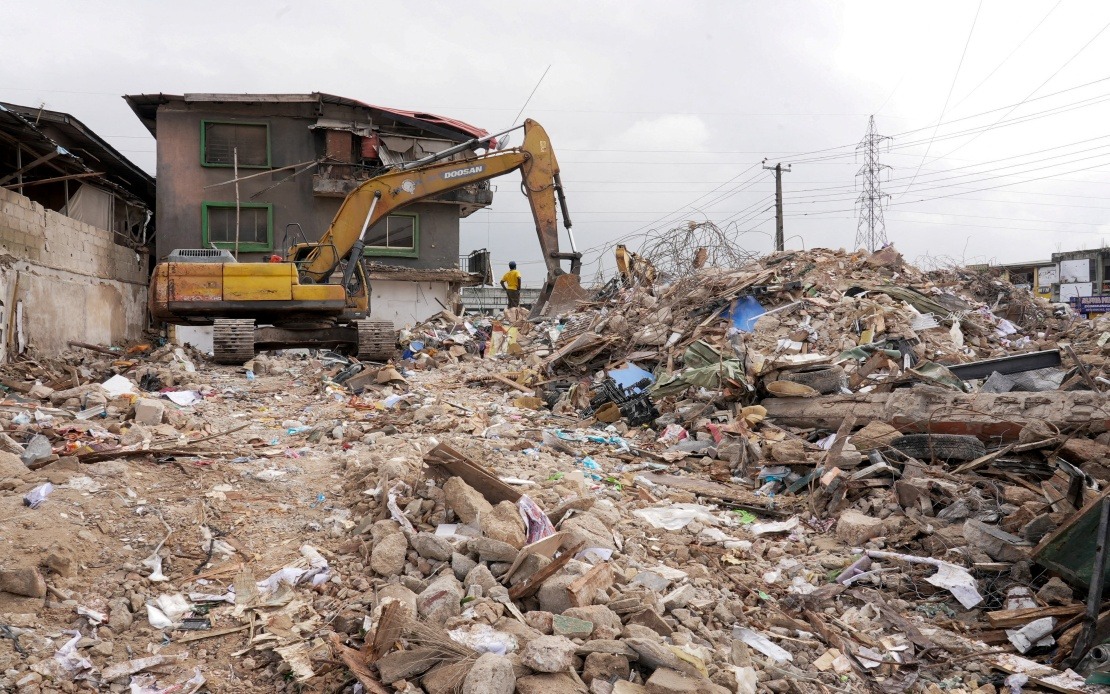
Nine people have been confirmed dead and 27 others rescued following the collapse of a three-story shopping complex in Alakija, a rapidly developing satellite community situated along the busy Lagos-Badagry Expressway in Nigeria's southwestern Lagos state. Authorities concluded rescue operations on Friday morning after multi-agency teams worked continuously to extract survivors from the debris. The fatalities represent a grim reminder of Nigeria's ongoing struggle with building safety standards, a concern that extends across West Africa and carries lessons for rapidly urbanizing regions across the continent.
The shopping complex gave way unexpectedly on Thursday morning, prompting emergency services to mobilize immediately. Olufemi Oke-Osanyintolu, permanent secretary of the Lagos State Emergency Management Agency, confirmed that rescue personnel operated ceaselessly to locate and pull trapped victims from underneath the collapsed structure. The coordinated response involved multiple agencies working in tandem to access the wreckage and safely remove survivors before nightfall.
Among the rescued individuals, medical personnel documented injuries ranging from minor wounds to severe trauma. All 27 survivors were transported to medical facilities for treatment and observation. The injured included shop operators conducting normal commerce when the structure failed, as well as customers and residents from the surrounding neighbourhood who found themselves trapped when the building gave way without warning.
Initial assessments suggest that most victims were occupying the complex during standard business hours. Shop owners had opened their establishments and were engaged in routine commercial activity when the collapse occurred. The suddenness of the incident meant that many people had little opportunity to escape before becoming trapped beneath tonnes of concrete and steel.
The China Civil Engineering Construction Corporation, which maintains operations in the area as part of a broader railway infrastructure project, contributed personnel and equipment to the rescue efforts. Their involvement underscores how major construction enterprises in the region maintain standing relationships with local authorities and can be mobilized swiftly during emergencies. The corporation's technical expertise and heavy machinery proved valuable in accelerating the extraction process.
Authorities have launched a formal investigation into the structural failure, though preliminary findings have not yet been disclosed. The cause of the collapse remains uncertain at this stage, with engineers and officials likely conducting forensic assessments of the remaining structure to determine what combination of factors led to the disaster. This investigative process typically takes weeks or months to complete.
Building collapses have become a recurring tragedy across Nigeria, reflecting systemic challenges in construction oversight and enforcement. Infrastructure experts consistently identify three primary culprits: deteriorating structures that have exceeded their design lifespan without adequate maintenance, widespread disregard for established building codes and safety regulations, and the widespread use of substandard materials to reduce construction costs. These factors interact to create particularly hazardous conditions in rapidly developing areas where demand for commercial and residential space outpaces regulatory capacity.
The incident in Alakija highlights vulnerabilities in enforcement mechanisms across Lagos and other major Nigerian cities experiencing rapid urbanization. Developers frequently cut corners to maximize profits, while inspection regimes lack sufficient funding, personnel, and political will to ensure compliance. The gap between regulations on paper and their practical implementation remains dangerously wide, leaving occupants of buildings—whether shoppers, workers, or residents—exposed to preventable risks.
For Malaysia and other Southeast Asian nations experiencing similar growth trajectories, the Lagos collapse serves as a cautionary case study. While Malaysia has implemented relatively robust building codes and maintains stronger enforcement through bodies like the Construction Industry Development Board, the pressures facing rapidly urbanizing regions—cost pressures, population growth, competing development priorities—can erode safety standards if vigilance is relaxed. The incident underscores why continuous investment in inspection capacity, building material certification, and penalties for non-compliance remains essential even in jurisdictions with established regulatory frameworks.
The rescue operation itself demonstrated both the capacity of emergency responders to mobilize effectively and the fundamental tragedy that such mobilization addresses: a preventable disaster. That 27 people were rescued suggests competent emergency services, yet nine deaths represent a human cost that would likely be avoided entirely had construction standards been properly maintained and enforced from the outset. The distinction between what occurred—a reactive rescue operation—and what should occur—proactive prevention through rigorous regulation—remains at the heart of building safety discussions across the developing world.

