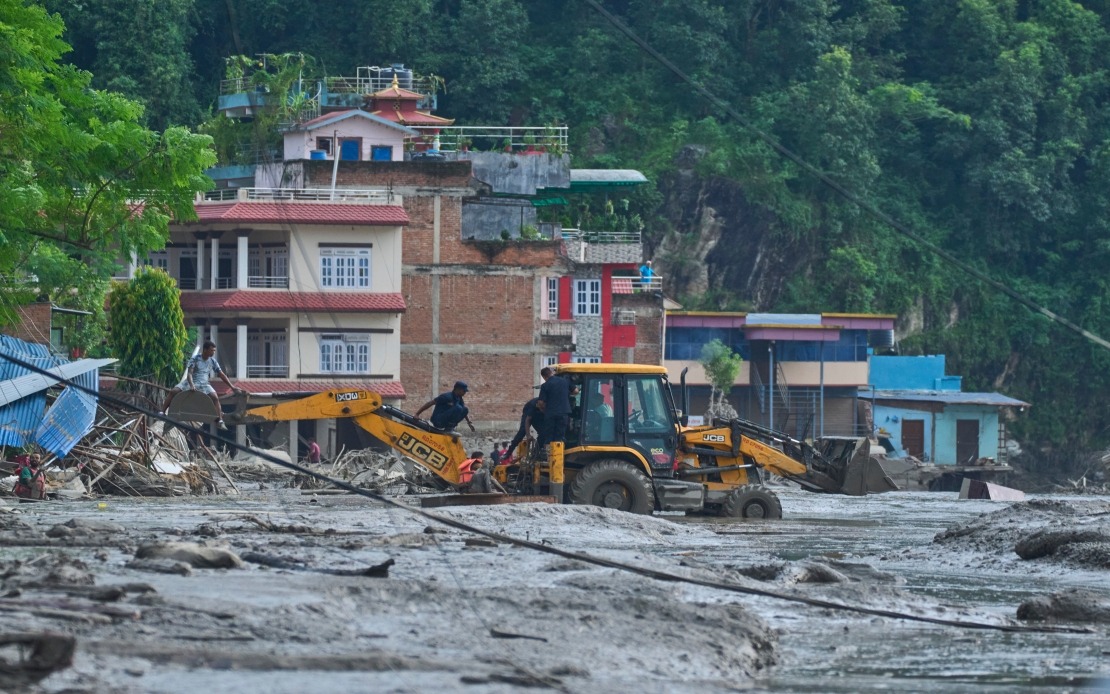
Nine South Korean nationals have disappeared in the aftermath of catastrophic flooding that struck Nepal's Rasuwa district on Wednesday, prompting an urgent diplomatic and humanitarian response from Seoul. The workers—six employed by industrial giant Doosan Enerbility Co. and three by state-controlled Korea South-East Power Co.—were engaged in constructing a hydropower facility when the disaster overwhelmed the region. South Korea's foreign ministry announced Thursday that an interagency team would depart immediately for Nepal to coordinate with local authorities and accelerate search operations.
The scale of the disaster extends far beyond the nine missing South Koreans. Torrential flooding unleashed near the Nepal-Tibet frontier has claimed over 160 lives and left hundreds unaccounted for, predominantly international workers scattered across the affected zones. The tragedy underscores the vulnerability of large-scale infrastructure projects operating in geographically challenging terrain, particularly across the Himalayan region where weather patterns remain unpredictable and rescue logistics extraordinarily complex.
Among the missing South Koreans' colleagues, circumstances proved considerably more fortunate. Ten other Doosan employees who had become trapped in the inundated areas were located and confirmed alive, though extraction from the zone remained underway. The broader workforce of approximately 200 foreign employees engaged in the hydropower construction initiative managed to evacuate the premises as conditions deteriorated, demonstrating the critical importance of emergency preparedness protocols at international development sites.
Seoul's governmental response has been characterised by decisive action and senior-level engagement. President Lee Jae Myung issued direct instructions to mobilise all available state resources toward locating and recovering the missing citizens. The emergency response delegation, assembled from the foreign ministry alongside police and fire service specialists, was scheduled to arrive in Kathmandu on Thursday to establish coordination with Nepalese government institutions and regional rescue authorities.
Foreign Minister Cho Hyun chaired an emergency crisis meeting on Wednesday evening, outlining Seoul's multifaceted approach to the emergency. Beyond search and rescue operations, South Korea's diplomatic strategy encompasses provision of psychological and practical support to families of the unaccounted workers, continued monitoring of South Korean nationals remaining in Nepal, and prevention of additional casualties. Cho emphasised that his ministry would engage directly with Nepal's foreign minister to secure cooperative framework and accelerate joint response mechanisms.
The private sector has mobilised in parallel with governmental efforts. Both Doosan Enerbility and Korea South-East Power established dedicated crisis response teams and initiated deployment of field operations units toward the disaster zone. This dual-track approach—combining state resources with corporate logistics capacity—represents standard protocol for South Korean responses to overseas worker emergencies, reflecting a developed nation's institutional maturity in managing international crises.
For Southeast Asian observers, the Nepal flooding tragedy carries particular relevance. The region hosts numerous hydropower and infrastructure initiatives involving multinational workforces, many employing engineers and technicians from throughout Asia. The disaster illustrates how natural hazards can strike with devastating suddenness at construction sites in mountainous terrain, overwhelming even well-resourced operators. Malaysia and other regional countries with nationals working on Himalayan infrastructure projects face similar risk profiles requiring strengthened safety protocols and emergency preparedness frameworks.
The hydropower sector across Nepal and the wider Himalayan zone operates under inherent environmental challenges. Monsoon-driven precipitation patterns, alpine topography, and remote location compound difficulties for both construction operations and emergency response. The proximity of the Rasuwa district incident to the Nepal-Tibet border introduced additional logistical complications for rescue coordination. These structural vulnerabilities underscore why international development organisations increasingly emphasise pre-disaster risk assessment and community-level resilience planning in mountainous regions vulnerable to flash flooding.
For South Korean society, the incident reflects ongoing tensions around the human cost of overseas resource extraction and infrastructure development. While such projects generate significant economic benefits and employment, they simultaneously expose workers to environmental hazards sometimes inadequately mitigated through existing safety frameworks. The psychological impact upon families of the nine missing workers represents a secondary humanitarian dimension, with government support proving essential during prolonged search operations characterised by uncertainty and limited communication.
Nepal's government has faced mounting international pressure to accelerate rescue efforts and provide transparent casualty accounting. The concentration of foreign workers among the missing and deceased has elevated diplomatic attention, with multiple nations dispatching their own assessment teams and demanding updates on recovery progress. This geopolitical dimension—whereby natural disasters become focal points for bilateral engagement—characterises contemporary international development relationships across Asia.
The search operation's success will depend substantially upon coordination quality between South Korean specialists and Nepalese ground-level authorities. Rapid response teams must navigate damaged infrastructure, unstable terrain, and potential aftereffects from the initial flooding event. Communication challenges, supply chain disruptions, and weather-dependent helicopter access to remote areas typically constrain rescue timelines in Himalayan environments. South Korean officials acknowledged these operational constraints while maintaining commitment to exhausting all available recovery methodologies.

