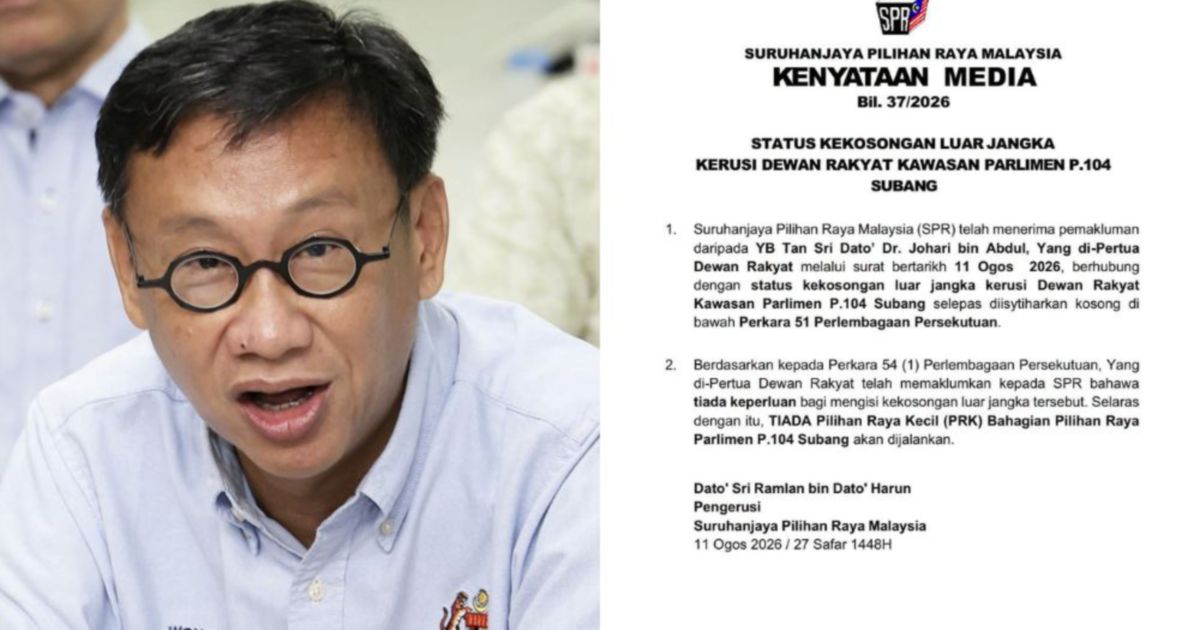
Malaysia's Election Commission has formally confirmed that no by-election will be conducted for the Subang parliamentary seat in the wake of Wong Chen's resignation as its Member of Parliament representing the People's Justice Party (PKR). The decision marks a significant development in the political landscape of the Klang Valley region and raises important questions about parliamentary representation and electoral procedures in Malaysia.
Wong Chen, who has served as the Member of Parliament for Subang since 2013, announced his departure from parliamentary duties, triggering immediate speculation about the timeline and likelihood of a by-election. The Election Commission's announcement, however, has closed the door on such speculation, at least for the immediate future. The constitutional and procedural grounds for this determination underscore the complexity of Malaysia's electoral law framework and the specific circumstances that must be met for a by-election to be triggered.
Under Malaysia's Federal Constitution, not all parliamentary vacancies automatically necessitate a by-election. The circumstances surrounding the vacancy, the timing relative to the general election, and various procedural requirements all factor into the Election Commission's determination. In Subang's case, these factors evidently aligned to support the decision against holding a by-election at this juncture. This outcome reflects the technical but consequential nature of electoral administration, where legal interpretations can significantly impact political opportunities.
The Subang constituency, one of Malaysia's prominent urban parliamentary seats located in the heart of Selangor's commercial and residential hub, has been a closely watched political battleground. Wong Chen's tenure represented a notable chapter in the area's political history, having successfully retained the seat through multiple election cycles. His constituency encompasses diverse communities including professionals, business owners, and long-established residential areas, making it a microcosm of broader Malaysian demographic and political trends.
PKR, as the ruling party in the Selangor state government and a key component of the federal coalition, would ordinarily view the loss of a parliamentary seat through by-election as a strategic vulnerability. However, the absence of a mandatory by-election provides the party with continuity without facing the electoral risk that any contest would entail. This development illustrates how procedural rules can substantially alter political outcomes and strategic calculations for ruling coalitions.
Wong Chen's decision to step down comes after serving multiple terms and maintaining a presence as one of the more visible urban representatives within PKR. His resignation, whether motivated by personal circumstances, strategic considerations, or other factors, demonstrates the fluid nature of parliamentary representation in Malaysian politics. The timing and circumstances surrounding such resignations often carry deeper political significance beyond the surface announcement.
The Election Commission's role as the neutral arbiter of electoral matters places it in a position requiring careful interpretation of constitutional provisions and established precedents. The commission's confirmation that no by-election will occur reflects its assessment of applicable law and procedure, though such determinations occasionally generate debate among constitutional scholars and political observers regarding their appropriateness.
From a broader Malaysian perspective, this decision has implications for how parliamentary representation is managed and sustained. Citizens of Subang will continue to be represented without the immediate prospect of selecting a new MP through direct voting. This raises considerations about democratic accountability and the mechanisms through which voter preferences are incorporated into parliamentary composition, particularly in urban constituencies where electoral engagement tends to be higher.
The absence of a by-election also carries financial implications, sparing the government the considerable expense associated with conducting a parliamentary contest. The cost of administering by-elections, involving voter registration verification, polling day operations, and extensive security arrangements, represents a substantial public expenditure. This economic dimension adds a practical layer to the Election Commission's determination.
Looking forward, the Subang seat's future composition will likely be determined through the next general election cycle, whenever that occurs. This means that the constituency will return to the standard electoral calendar, with any change in representation contingent upon the outcome of the broader parliamentary contest. Such timing can significantly influence political dynamics, as constituencies awaiting representation changes may experience different levels of political attention and development focus compared to constituencies with representation actively contested.
For the Selangor government and PKR's broader political standing, the situation represents both a relief in avoiding an unpredictable by-election contest and a continuation of existing arrangements without fresh democratic validation. The party will need to ensure that the Subang constituency remains politically engaged and supportive through the election cycle ahead, maintaining the constituency linkages that have traditionally characterised Wong Chen's tenure.
The Election Commission's decision underscores how Malaysia's electoral framework, despite its democratic foundations, contains technical provisions that can significantly shape political outcomes and opportunities. While such procedural mechanisms serve important constitutional purposes, they also highlight the importance of understanding Malaysia's electoral architecture and the various routes through which parliamentary seats can change representation.
Ultimately, Subang's political future will be determined by voters when the next general election is called, at which point the full electoral process will engage the constituency and its diverse population in selecting their next Member of Parliament. Until then, the constituency operates under the current arrangement, reflecting Malaysia's constitutional provisions and the Election Commission's authoritative interpretation of electoral law.

