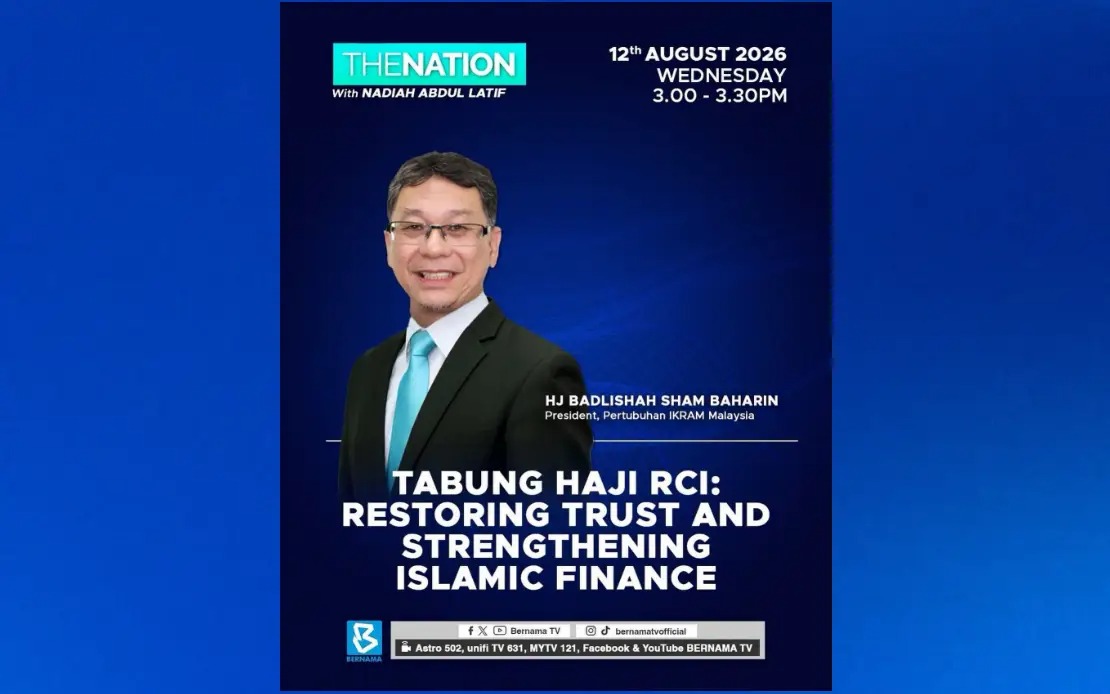
Pertubuhan IKRAM Malaysia has weighed into the contentious debate over Tabung Haji's troubled investment history, arguing against the establishment of another Royal Commission of Inquiry and instead throwing its support behind existing enforcement mechanisms already examining the fund's operations. The organisation's president Badlishah Sham Baharin made the position clear following media reports that both government and opposition lawmakers were pushing for an expanded probe covering the period from 2021 onwards, beyond what the recently released RCI report documented for 2014 to 2020.
The push for a new RCI reflects growing political pressure to comprehensively examine what has emerged as one of Malaysia's most significant public investment failures. However, Badlishah Sham contends that establishing multiple commissions of inquiry risks eroding public confidence in the process itself. He argues that RCIs should be reserved exclusively for the most serious matters of national concern, and that their overuse effectively diminishes their credibility and investigative weight. Instead, he advocates for channelling complaints and concerns through established law enforcement channels, particularly the Malaysian Anti-Corruption Commission, which already maintains jurisdiction over the fund.
The Finance Minister II Datuk Seri Amir Hamzah Azizan provided Parliament with a stark accounting of Tabung Haji's investment debacle during last week's special Dewan Rakyat session. His presentation revealed that the fund's 14 problematic investments generated combined losses approaching RM13 billion, a figure that encompasses both direct government bailouts and lingering impairment losses. The breakdown is particularly revealing: RM10.2 billion flowed from the federal government through an emergency rescue package administered via Urusharta Jamaah Sdn Bhd in 2018, while a further RM2.6 billion in impairment charges accumulated between 2018 and 2025 as troubled investments continued their downward trajectory.
Among these failed ventures, the Al-Rawda hotel investment stands out as the largest single loss, illustrating the scale and complexity of decisions that went wrong at Tabung Haji. Between 2015 and 2017, the fund committed to lease four hotels serving the pilgrimage cities of Makkah and Madinah, disbursing approximately 1.4 billion Saudi riyals—roughly RM1.5 billion—to an intermediary as upfront payment for the arrangement. The investment appeared designed to capture revenue from Malaysian pilgrims seeking accommodation during the hajj season. However, the arrangement collapsed when Al-Rawda ceased rental payments from the first quarter of 2019 onwards, leaving Tabung Haji with minimal recovery prospects and forcing an accounting recognition of the full RM1 billion loss in 2024.
While opposing a new RCI, Badlishah Sham has advocated for a pragmatic alternative mechanism to prevent future disasters. He supports the establishment of a multi-agency task force specifically tasked with identifying investments carrying elevated loss risks and implementing preventive measures to ensure comparable scandals do not recur. His emphasis on rigorous due diligence before any investment proceeds reflects a recognition that Tabung Haji's collapse stemmed partly from inadequate vetting procedures. He underscores the importance of investigating investment opportunities from the grassroots level, ensuring that proposed ventures comply with established ethical standards and procedural safeguards rather than proceeding on the basis of optimistic projections or connected intermediaries.
The RCI report itself, released on 29 July, documented extensive governance failings spanning the 2014–2020 period and proposed 25 specific recommendations for institutional reform. Progress on implementation has been measurable, with Tabung Haji reportedly adopting three-quarters of these recommendations by 30 July, suggesting the organisation is attempting substantive change. However, the fact that the existing RCI's mandate concluded at 2020 has created a temporal gap that opposition and government lawmakers alike view as problematic, particularly given that impairment losses continued accumulating through 2025.
The debate also exposed fractures in parliamentary conduct during last week's special sitting. Several opposition MPs staged a walkout rather than participate in the proceedings, a tactic that Badlishah Sham characterized as failing the basic responsibilities of elected office. With approximately 10 million Malaysian Muslims holding deposits in Tabung Haji, he argued that MPs from all parties bear an obligation to scrutinise management decisions and voice concerns on behalf of depositors, regardless of partisan disagreements with the government. His criticism highlights the tension between parliamentary opposition and parliamentary duty, particularly when national institutions managing public savings face credibility crises.
Badlishah Sham's observation about MPs subsequently debating the matter on social media platforms rather than within the chamber reflects broader concerns about the quality of public discourse surrounding Tabung Haji's predicament. The investment failures have shaken confidence in an institution that traditionally enjoyed strong community trust, particularly among the Muslim majority. Restoring that trust requires sustained transparency and evidence that governance structures have been fundamentally strengthened, not merely subjected to another inquiry whose findings might languish for years.
For Malaysia's broader Islamic finance sector, the Tabung Haji crisis carries sobering implications. The fund operates at the intersection of religious obligation, public policy and investment management, and its failures have exposed vulnerabilities in institutional oversight mechanisms that were intended to protect beneficiaries. Badlishah Sham's advocacy for stronger due diligence procedures and multi-agency coordination reflects recognition that Islamic financial institutions require governance frameworks appropriate to their unique obligations and stakeholder base. The ongoing MACC investigations will likely determine whether individual officers face accountability, but institutional reform—the focus of the RCI recommendations—remains critical for public confidence.
The question of whether current investigations suffice or whether a new RCI is warranted will likely persist in political discourse through the coming months. Badlishah Sham's position carries weight within Malaysia's Islamic civil society, yet his argument for limiting RCIs faces counterargument that a complete accounting of the 2021–2025 investment period is essential for full transparency. The resolution may depend less on formal investigative mechanisms and more on whether Tabung Haji's board can demonstrate genuine structural change, ethical investment standards, and genuine accountability—measures that the public will scrutinise regardless of which official body oversees them.

