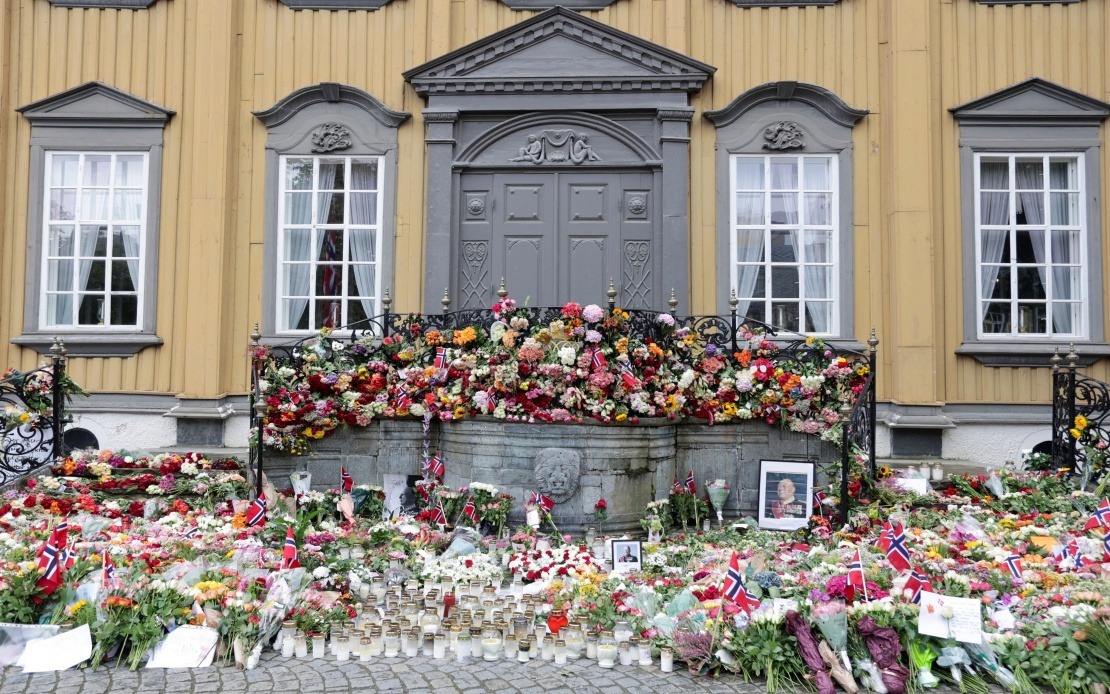
Norway came to a standstill on Sunday as the nation mourned King Harald V, the constitutional monarch whose death on Friday at the age of 89 marked the end of a significant era for the Scandinavian kingdom. Across the country, religious services were conducted in cathedrals and churches to allow citizens and residents to pay their final respects to the late sovereign, who had reigned since 1991. The Norwegian Royal House confirmed that the formal state funeral will be held on September 9, providing the nation with a structured timeframe to conduct solemn commemorations and prepare for the ceremonial proceedings that traditionally accompany the passing of a reigning monarch.
The scale of public grief witnessed during the memorial services underscored the deep affection Norwegians held for their late king. Tens of thousands of people gathered at places of worship throughout the country, creating scenes of collective mourning that reflected the personal connection many Norwegians felt toward Harald V. Beyond the churches, the Royal Palace in Oslo became a focal point for the nation's remembrance, with citizens laying tributes of flowers, candles, and handwritten cards at the palace gates. These spontaneous displays of mourning demonstrated how the monarchy remains woven into the fabric of Norwegian national identity, transcending its ceremonial role to embody shared values and historical continuity.
Under Norway's established constitutional rules governing royal succession, the transition of power occurred immediately and without complication. Harald V's eldest son, who is 53 years old, assumed the throne automatically upon his father's death, adopting the regnal name Haakon VIII. This seamless transfer of authority reflects the stability that constitutional monarchy provides, ensuring that the nation's leadership remains uninterrupted during periods of dynastic transition. The new king's assumption of the throne represents the continuation of a lineage that has governed Norway for more than a century, maintaining institutional continuity while also signifying a generational shift in the nation's leadership.
The circumstances surrounding King Harald V's death and the subsequent succession carry implications for other constitutional monarchies in the region and beyond. For Malaysia, which maintains its own unique system of rotating constitutional monarchy through the Conference of Rulers, the Norwegian succession demonstrates how hereditary monarchies in modern democracies manage the transfer of power with institutional stability. The immediate and orderly nature of the succession in Norway, conducted without constitutional controversy or political disruption, illustrates how well-established democratic frameworks and clear succession laws can facilitate peaceful transitions even during moments of national grief.
King Harald V's reign, spanning three decades, witnessed significant transformations in Norwegian society and Norway's international standing. Having ascended to the throne during a period when Norway was consolidating its identity as a sovereign nation outside the European Union, he provided steadfast leadership through economic prosperity driven by North Sea oil revenues and navigated the country's complex relationships with its Scandinavian neighbours and broader European context. His long tenure allowed for the establishment of deep institutional relationships and international diplomatic networks that will now pass to his successor.
The new King Haakon VIII faces the responsibility of maintaining these established relationships while potentially introducing his own approach to the monarchy's role in contemporary Norwegian society. At 53, he represents a generation that has grown up in post-Cold War Europe and witnessed the digital revolution and globalization's profound impacts on traditional institutions. His accession comes at a time when constitutional monarchies worldwide are actively reassessing their relevance and adapting their functions to meet modern expectations regarding transparency, engagement with civil society, and relevance to younger generations.
The timing of the succession also occurs amid broader discussions within European democracies about the future of hereditary institutions and their compatibility with contemporary democratic values. Norway, with its strong egalitarian traditions and robust democratic institutions, has long maintained a different relationship with its monarchy compared to some other European nations. The peaceful and dignified manner in which the country has processed the death of its late king and the accession of his successor may serve as a model for how modern constitutional monarchies can command respect and popular support through institutional propriety rather than ceremonial grandeur alone.
For the broader Southeast Asian context, the Norwegian succession provides a comparative lens through which to examine systems of hereditary leadership. While the structures differ significantly from Malaysia's unique elective monarchy system or the absolute monarchies found elsewhere in the region, the principles underlying orderly succession and constitutional restraint on executive power remain universally relevant. The clarity and predictability that characterize the Norwegian transition stand in contrast to succession challenges that have confronted other nations, highlighting the stabilizing effects of unambiguous constitutional frameworks.
As Norway prepares for the September 9 funeral, the nation faces a period of collective reflection on its recent past and shared future. The state funeral will serve not only as a formal acknowledgment of King Harald V's passing but also as a ceremonial affirmation of the monarchy's continuing role in Norwegian national life and democratic governance. The proceedings will likely draw international dignitaries and royal figures from across Europe and beyond, reinforcing Norway's position within the broader community of constitutional monarchies and democratic nations. For Norwegians themselves, the funeral represents an opportunity to honour their late sovereign's contributions to the nation while simultaneously embracing the new reign and the possibilities it portends for the kingdom's future direction.

