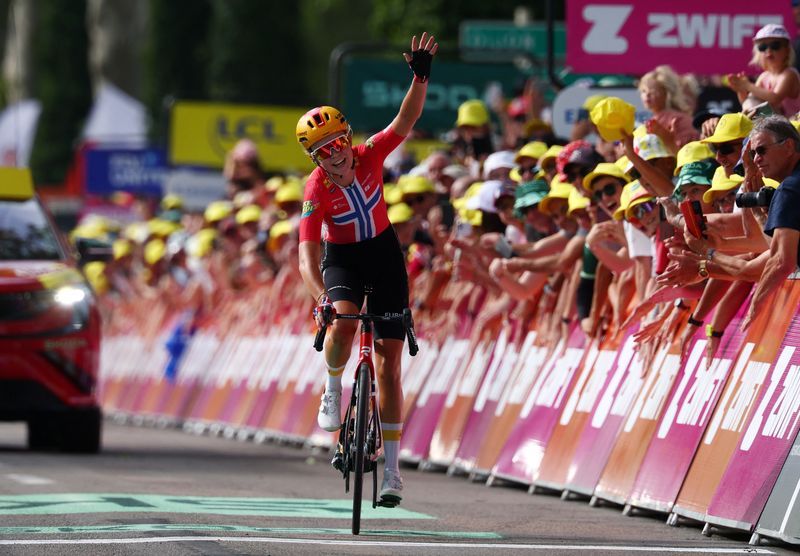
Sigrid Haugset of Norway etched her name into cycling history on Monday when she powered to a solitary stage victory at the Tour de France Femmes, breaking through a significant barrier for her nation and simultaneously claiming the race's coveted yellow jersey. The 27-year-old Uno-X Mobility rider's breakthrough moment marks a watershed for Norwegian women's cycling, as she becomes the first from her country to achieve either a stage win or overall leadership at the prestigious event. Her triumph displaced Dutchwoman Lorena Wiebes from the top position, fundamentally reshaping the competitive landscape of the race just days into its progression.
The stage witnessed a dramatic battle between Haugset and Belgium's Lotte Kopecky, who mounted a sustained chase across mountainous terrain in a bid to reel in the Norwegian leader. Despite Kopecky's determined efforts, she crossed the finish line in Poligny more than eighty seconds behind Haugset, while Netherlands rider Marianne Vos completed the podium in third place. The climbing phases proved decisive, as Haugset's superior mountain strength allowed her to construct an advantage that her rivals simply could not overcome, even as exhaustion visibly took its toll during the final kilometres.
Haugset's overall advantage following the 156.5-kilometre stage stands at two minutes and twenty-two seconds over Kimberly Le Court of Mauritius, providing her with a substantial cushion as the race continues through increasingly challenging terrain. This commanding lead reflects not merely the strength she demonstrated on Monday, but also the depth of tactical acumen she displayed when managing pressure from multiple challengers simultaneously. The gap suggests that barring significant mechanical misfortune or a dramatic collapse in form, she has positioned herself as a genuine contender for the final victory in Paris.
The emotional weight of her achievement was evident in Haugset's immediate reaction, one reflecting both disbelief and profound gratitude for the historic nature of her accomplishment. She spoke of the psychological battle she fought against her own doubts and fatigue, noting that she contemplated settling for second place before remembering the supporters back home in Norway who had motivated her pursuit. This introspective moment reveals the mental fortitude required to sustain a solo attack over extended distance against world-class opposition, a quality that separates champions from merely talented competitors.
The stage itself was marked by considerable drama unfolding during the steeper sections. As the peloton tackled the category one climb to Col de la Faucille for the first time in the race, multiple riders found themselves on the tarmac following a significant crash. Among those affected were Magdeleine Vallieres, the reigning world champion, and Demi Vollering, a former Tour de France winner. The incident could have proven decisive had injuries prevented swift recovery, but all affected riders remounted promptly and the main field managed to avoid further chaos during the gruelling 11.4-kilometre ascent.
Haugset's move to establish a decisive gap came during the subsequent climb to Col de la Savine, where she accelerated away from the main bunch with the kind of authority that immediately signalled her superiority on the day. Kopecky responded with typical Belgian aggression, launching her chase during the intermediate section of the stage, but found the Norwegian persistently beyond her reach. The tactical interplay between these two climbers showcased the calibre of women's professional cycling, where positioning, timing, and mental resilience often prove as important as raw power output.
As the race transitioned from Swiss territory into France proper, Wiebes, then wearing the yellow jersey, began losing touch with the breakaway battle unfolding ahead. She sat nearly thirteen minutes behind Haugset with merely twenty kilometres remaining, a deficit that would ultimately prove insurmountable and underscore how thoroughly the stage dynamics had shifted. Both Le Court and Vollering, positioned second and third respectively before the stage began, remained trapped within the secondary chase group rather than able to support their leaders or make independent gains.
The closing kilometres transformed into a gripping psychological duel between Haugset and Kopecky, with the gap fluctuating as the Norwegian's legs began signalling surrender while the Belgian pressed relentlessly forward. With ten kilometres remaining, Kopecky had reduced the arrears to merely ten seconds, suggesting a climactic finish might be imminent. However, Haugset found reserves from deep within when the pressure mounted most intensely, discovering a second wind that allowed her to surge again and establish breathing room once more with three kilometres left to navigate.
Haugset's composure throughout the final approach deserves particular emphasis, as she neither panicked when Kopecky drew perilously close nor allowed frustration to cloud her tactical judgment. Rather, she responded with measured acceleration that demonstrated both superior fitness and superior mental control in the moment when races are truly decided. Her refusal to celebrate prematurely or relax her grip on the pedals even as the finish line appeared speaks to the professional standards that have become hallmarks of elite women's cycling.
The physical and emotional toll of the exertion left Haugset quite literally unable to raise her arms from the handlebars as she crossed the line, a visceral illustration of the complete physical commitment required to win stage races against world-class opposition. She recounted with characteristic humour that her boyfriend would disapprove of her inability to properly celebrate, unable to gesture in triumph due to complete muscular exhaustion. This humanising moment, while lighthearted, underscores the intensity of professional women's cycling and the genuine physical sacrifice competitors make in pursuit of historic achievements.
For Malaysian and Southeast Asian cycling enthusiasts, Haugset's breakthrough carries broader significance about the globalisation and increasing competitiveness of women's professional cycling. The sport continues to develop talented athletes from nations previously considered peripheral to the traditional cycling powers, though the dominance of Northern European riders at this year's Tour de France Femmes suggests that geographic advantages including climate, cycling culture, and institutional investment remain substantial advantages. The race has become notably more competitive internationally, with Le Court's presence near the podium providing representation beyond the traditional cycling nations.
Haugset's journey to this historic moment reflects trends throughout women's professional cycling, where investment, media attention, and career pathways have improved dramatically over the past decade. Her sponsorship by Uno-X Mobility, a Scandinavian team, illustrates how regional companies increasingly provide professional opportunities for female cyclists, building sustainable programmes capable of developing world-class talent. The presence of such teams at the Tour de France Femmes represents a sea change from merely years past when women's cycling operated in comparative obscurity.
The immediate implications of Haugset's victory extend beyond the historic record books into the practical dynamics of the remaining stages. Her two-minute advantage provides real security heading into the mountain stages that remain, though cycling's unpredictability means nothing should be taken as certain. Le Court, Kopecky, and other ambitious rivals will certainly pursue opportunities to attack and narrow the margin, setting the stage for compelling racing through the concluding kilometres of this increasingly significant event.

