Johor's leadership has completed a significant restructuring of its State Executive Council, with Menteri Besar Datuk Onn Hafiz Ghazi emphasizing that the changes represent a deliberate modernization of the administration rather than a dismissal of past achievements. The reshuffle, which took formal effect at a ceremony held at Istana Bukit Serene in Johor Bahru on July 18, marks the beginning of the council's new five-year term and reflects an evolving approach to state governance across the 2022-2026 administration cycle.
The restructuring sees a mixed composition of continuity and fresh perspectives, with six sitting assemblymen retaining their executive portfolios while four newly appointed members join the state government's highest administrative body. This balance suggests a deliberate strategy to preserve institutional knowledge and experience while injecting new energy and ideas into decision-making processes. All ten officials were formally sworn in before the Regent of Johor, Tunku Mahkota Ismail, in a ceremony that underscored the constitutional and ceremonial gravity of their appointments.
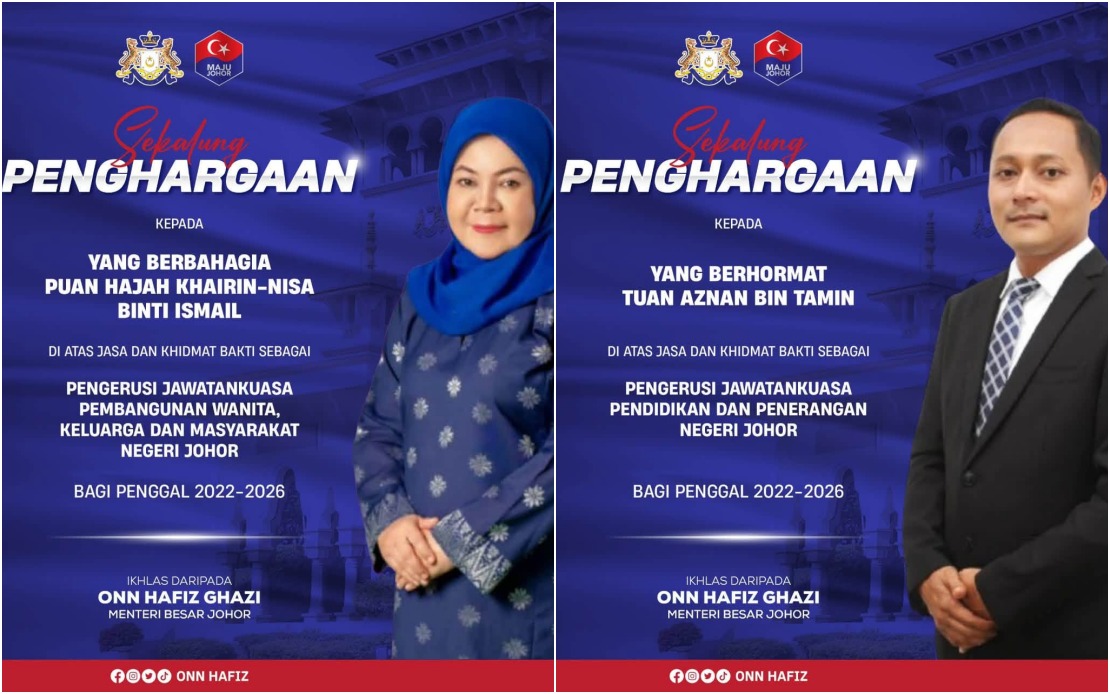
Onn Hafiz took particular care to recognize the four departing executives—Datuk Zahari Sarip, K. Raven Kumar, Aznan Tamin, and Khairin-Nisa Ismail—whose terms have concluded. Through a statement posted on social media, the Menteri Besar acknowledged their collective sacrifice, dedication, and intellectual contributions to state affairs during their period of service. This public recognition serves an important political function, ensuring that outgoing officials do not feel sidelined or devalued, which can be crucial for maintaining party cohesion and preventing internal grievances that might undermine future governance.
The Menteri Besar framed the reshuffle within a broader narrative of administrative renewal, positioning it as a natural and necessary component of effective governance. He argued that such transitions are not indicators of failure or underperformance but rather essential mechanisms through which state governments adapt to evolving circumstances, emerging challenges, and changing public expectations. This messaging is particularly significant in Malaysian politics, where cabinet changes can sometimes trigger speculation about internal power struggles or dissatisfaction with individual performance.
Onn Hafiz emphasized that the responsibility of steering Johor toward greater prosperity transcends any individual position within the executive hierarchy. His statement that "experience, wisdom and passion for service will continue to be strengths in our collective efforts" suggests a commitment to institutional continuity despite personnel changes. This reflects a more mature approach to leadership transitions, acknowledging that the state's development trajectory depends on sustained institutional capacity rather than the tenure of specific individuals.
The timing and composition of this reshuffle carry implications for Johor's development agenda moving forward. The state, as Malaysia's second-largest economy and home to major industrial and port facilities, faces complex governance challenges ranging from urban planning and environmental management to balancing rapid industrialization with livability concerns. The introduction of four new executives suggests that the leadership believes fresh perspectives are needed to address emerging issues or to implement new policy directions that may require different expertise or approaches than what the previous lineup offered.
For observers tracking Malaysian state-level politics, this reshuffle illustrates how Barisan Nasional-led administrations manage transitions within their power structures. Unlike the more dramatic reshuffles that have occasionally characterized Pakatan Harapan-governed states, the Johor transition appears methodical and designed to minimize disruption. The retention of six sitting members provides stability while the addition of four new faces allows for strategic realignment without wholesale institutional upheaval.
The public acknowledgment of the departing executives' contributions also serves to preserve their political standing for potential future roles, whether within state government, within their political party, or in federal positions. In Malaysian politics, such graceful transitions can influence how individuals are perceived by party leadership and voters alike, potentially affecting their career trajectories in the years ahead. The Menteri Besar's emphasis on their ongoing value, despite leaving executive office, maintains their relevance within the broader political ecosystem.
For residents and businesses operating in Johor, the reshuffle presents an opportunity to assess how the new executive configuration might impact policy implementation and service delivery. Different combinations of expertise and priorities among the top leadership can influence the pace of infrastructure development, business-friendly regulations, and welfare initiatives. The specific individuals appointed to key portfolios will likely shape these outcomes significantly, though the details of portfolio allocations would be essential to analyzing the potential policy implications.
The ceremony itself, conducted before the Regent, reinforced the constitutional foundations of the state executive structure and the formal authority underlying these positions. This ceremonial dimension matters in Malaysian governance, as it connects contemporary administrative decisions to established constitutional frameworks and the institution of royalty, lending legitimacy and gravitas to the transition. The public nature of the oath-taking ceremony also creates accountability, as the officials now stand formally committed to serving the state and its people.
Looking ahead, the success of this reshuffle will be measured by the state government's ability to deliver on its development promises and maintain service quality across all sectors under the new leadership configuration. The Menteri Besar's emphasis on continuity while embracing change suggests that stakeholders can expect both stability in fundamental governance approaches and tactical adjustments in implementation strategies. How quickly the new executives establish themselves and prove their value to the state will likely dominate political commentary in coming months.
The reshuffle also reflects broader considerations about generational transitions in Malaysian politics. With four new faces entering the executive council, questions about succession planning, skills development, and the integration of younger leaders into high-level decision-making processes become relevant. If these new appointments represent a deliberate effort to groom future state leaders or to ensure long-term institutional capacity, the implications extend well beyond the immediate administrative restructuring.

