The Johor state election campaign has been shadowed by allegations of improper use of government resources for political purposes. Johor DAP chairman Teo Nie Ching has demanded that Menteri Besar Datuk Onn Hafiz Ghazi provide a full accounting of his participation in a Technical and Vocational Education and Training roadshow held on July 4 at the Inland Revenue Board Hall in Kluang, where she contends the event transformed into a platform for canvassing support for Barisan Nasional candidates.
According to complaints received by the DAP from parents and students, participants in the Johor MARA TVET Roadshow were required to attend under threat of being marked absent, yet the proceedings allegedly deviated from an educational focus toward explicit campaign messaging. Teo, who doubles as Deputy Communications Minister, highlighted the problematic nature of mandating attendance at what appeared to be a government-sponsored event only to have it repurposed for partisan political gain. The distinction between legitimate government programming and campaign activity has become a flashpoint in discussions about electoral propriety.
Teo's objection centres on a fundamental principle of democratic governance: government facilities and platforms funded by taxpayers must remain neutral and cannot be converted into partisan campaigning machinery. She emphasised that while Onn Hafiz's presence at a government event would ordinarily raise no concerns, the substance of what transpired—specifically allegations that he publicly mentioned a Barisan Nasional candidate's number to encourage student support—crosses a critical line. This framing transforms what might have been routine attendance by a senior official into direct participation in political canvassing.
The DAP politician stressed that the party possesses documentary evidence supporting their concerns, including the official programme itinerary, written correspondence mandating attendance, and video recordings purporting to capture the campaign-related statements. The accumulation of such documentation suggests a deliberate pattern rather than an isolated or ambiguous incident. Teo conveyed her criticism not merely in her capacity as a political party leader but as a concerned parent, invoking the perspective of families who feel their children were manipulated into becoming participants in a political exercise without genuine consent.
A secondary but related concern Teo raised involves the appropriate venue for political activities. If the TVET Roadshow was indeed intended as a campaign event, holding it at a government facility like the Inland Revenue Board Hall would represent improper utilisation of state resources. The ambiguity itself—whether the event was primarily governmental or primarily political—requires clarification from Onn Hafiz. Government agencies cannot simply lend their premises and authority to political parties under the guise of conducting public programmes.
Teo also seized the opportunity to rebut the Menteri Besar's recent criticism of federal government policies. Onn Hafiz has called for review of certain policies on grounds they burden ordinary Malaysians, a position Teo characterised as politically convenient and intellectually dishonest. She noted that the state government claims credit when policies prove popular but deflects blame onto the Prime Minister, the DAP, or PKR when they attract criticism. Her riposte underscores a pattern whereby state-level leaders conveniently weaponise federal policies during electoral periods while obscuring the Cabinet approval processes that legitimise such measures.
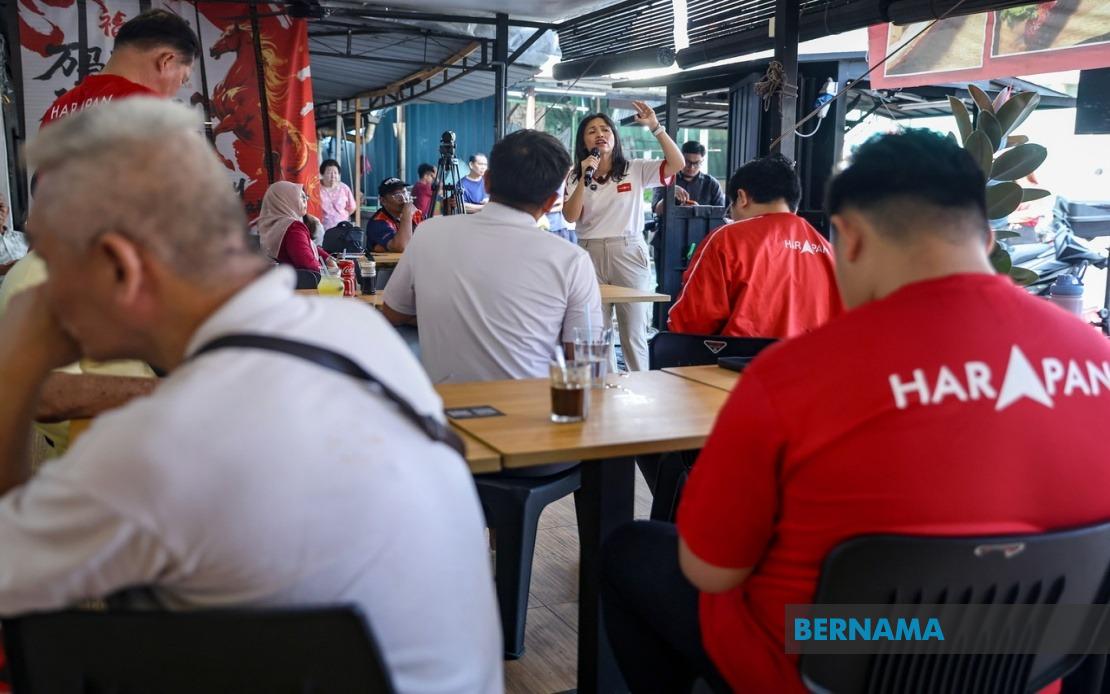
Lim Kit Siang, the DAP veteran leader who attended the forum in Kulai alongside Teo and Senai parliamentary candidate Wong Bor Yang, endeavoured to steer the discourse toward a broader vision. Lim urged voters to transcend racial and communal voting patterns and instead coalesce around what he termed the Malaysian Dream, anchored in principles of equality, genuine freedom, shared prosperity, and respect for human rights. His intervention reflects a strategic choice by Pakatan Harapan to elevate the campaign narrative beyond accusations of procedural violations toward fundamental questions about the nation's political direction and values.
Lim acknowledged the gradualism required to construct a genuinely united Malaysia, cautioning voters against fragmenting their support in ways that undermine efforts to realise this vision. His appeal carries particular weight in Johor, a state where communal political identities have historically shaped voting behaviour. The suggestion that consolidation of opposition votes represents a prerequisite for meaningful political change implicitly addresses tactical voting dynamics that have defined Malaysian electoral contests.
The TVET incident occurs within the context of a broader Johor state election featuring 172 candidates vying for 56 seats. The timing of the allegations, emerging shortly before early voting commenced on July 7 and ahead of the scheduled July 11 polling date, ensures maximum electoral salience. Questions about whether and how state authorities might have blurred lines between governance and campaigning touch on core issues of institutional integrity and democratic fairness that extend beyond single incidents.
For Malaysian observers, the episode illuminates persistent tensions in the country's electoral architecture. Government resources—buildings, time, attendance requirements imposed on students—remain entangled with party political objectives in ways that formal regulations may fail to prevent. The DAP's documentation of the incident suggests that opposition parties are increasingly equipped to monitor and publicise such alleged transgressions, raising accountability pressures on incumbents even if enforcement mechanisms remain limited.
Regarding follow-up steps, Teo indicated that Pakatan Harapan candidates would determine whether to lodge formal complaints with the Election Commission. The decision to escalate complaints through official channels could transform an isolated allegation into a systematic examination of campaign conduct. Such formal complaints create a record for post-election review, potentially influencing discussions about electoral reform and the codification of clearer boundaries between government and campaign activities.
As Johor voters prepare to cast ballots, the TVET controversy encapsulates broader anxieties about power, resources, and institutional neutrality. Whether Onn Hafiz issues clarifications responsive to Teo's demands will itself constitute a political statement, indicating either confidence in his position or defensiveness about the underlying conduct. The manner in which this allegation develops through the remainder of the campaign cycle will offer insights into contemporary Malaysian expectations regarding governmental propriety and the mechanisms available for enforcing such expectations.

