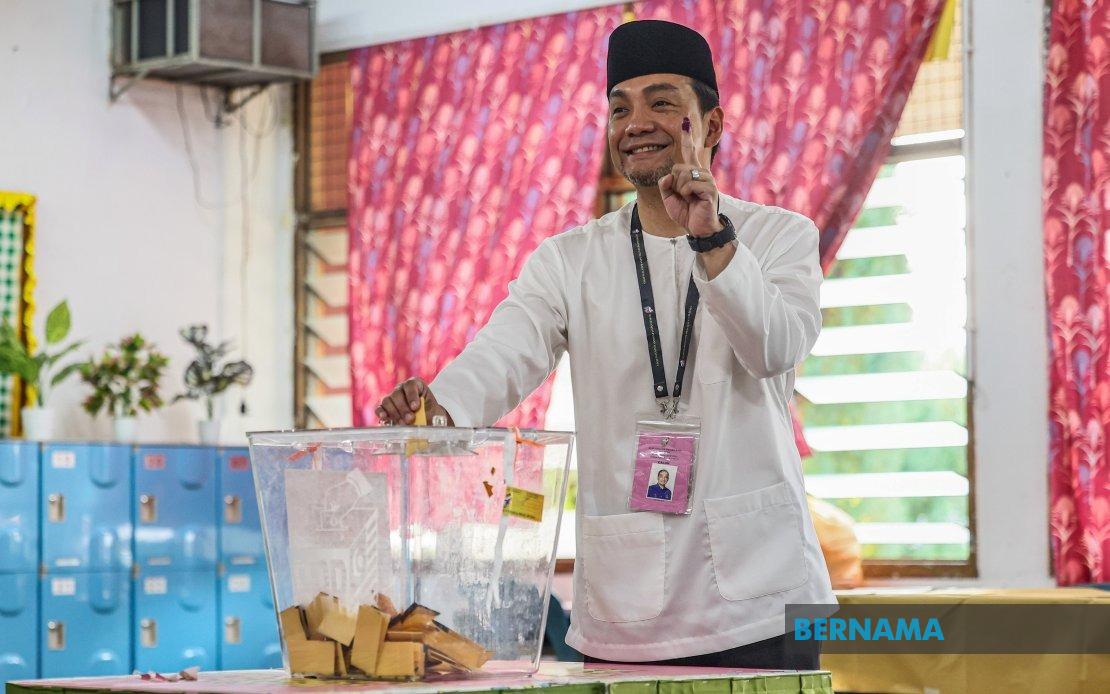
Johor's political battle reached the ballot box on July 11 as Menteri Besar Datuk Onn Hafiz Ghazi voted in the 16th state election at Sekolah Kebangsaan Simpang Renggam. The Barisan Nasional chairman submitted his vote at 8.33 am, marking a pivotal moment in his bid to secure a second term leading Malaysia's southern state. His participation underscored the significance of the election for BN's control of the state government, a crucial stronghold in the coalition's efforts to maintain relevance across the country.
Before heading to the voting booth, Onn Hafiz demonstrated traditional campaign courtesies by engaging with fellow voters lined up to cast their ballots. This early-morning interaction at the polling station reflected the personal touch many politicians employ during electoral contests, attempting to connect with constituents on voting day itself. The Menteri Besar's willingness to wait and chat with ordinary voters highlighted the personal dimension of Malaysian politics, where visible presence at grassroots level remains symbolically important regardless of pre-election polling and predictions.
Onn Hafiz faces a head-to-head matchup against Nur Hafiz Roslan, representing the Pakatan Harapan coalition. This straight fight represents a consolidation in the electoral landscape, with the two major political coalitions lining up candidates against each other. The contest encapsulates broader themes of governance and policy direction that separate the coalition blocs, with voters choosing between BN's vision for Johor and the alternative presented by the opposition alliance.
After completing his civic duty, the Menteri Besar took the opportunity to address gathered media representatives with a message emphasizing public participation. Onn Hafiz called on voters to arrive early and fulfil their democratic obligation, framing the electoral process as a collective responsibility requiring widespread engagement. His appeal for orderly polling reflected official concern about turnout and the administrative challenges of managing large numbers of voters throughout the day.
Elsewhere in Simpang Renggam, Pakatan Harapan's Dr Maszlee Malik cast his vote at SJK (C) Tuan Poon slightly later in the morning. The former education minister, now contesting the Puteri Wangsa state seat, arrived at 8.58 am to participate in what represented a more complicated electoral scenario than his counterpart's race. Unlike Onn Hafiz's straight fight, Maszlee Malik entered a five-cornered contest that would require navigating a fragmented opposition and independent challenge.
The Puteri Wangsa seat illustrated the increasing complexity of Malaysian state politics beyond the traditional two-coalition framework. Maszlee Malik competed against Rashifa Aljunied from MUDA, a newer political force attempting to establish itself in state legislatures. The presence of Teow Chia Ling representing BN, Nicholas Paul Vincent from Parti Bersama Malaysia, and independent candidate Wang Wee Siong demonstrated how electoral contests had evolved beyond the simple BN-versus-opposition binary that once dominated Malaysian politics.
Maszlee Malik's participation as a PH candidate carried particular significance given his previous ministerial credentials. His background in education policy and past government experience positioned him as an established political figure with executive experience, contrasting with several of his opponents who represented newer or less established political entities. This distinction highlighted how even within opposition coalitions, voters encounter candidates with varying degrees of political maturity and institutional knowledge.
The emergence of multi-cornered contests in Johor reflected broader fragmentation affecting Malaysian electoral politics. MUDA's presence in contests like Puteri Wangsa signalled the viability of newer political movements appealing to specific demographic segments, particularly younger voters and those dissatisfied with traditional opposition parties. Parti Bersama Malaysia's presence alongside independent candidates further complicated the electoral arithmetic, requiring voters to make increasingly fine distinctions between numerous options.
Johor's sixteenth state election carried implications extending beyond the state itself, affecting the broader political balance within Malaysia. The state historically served as a testing ground for coalition strategies and a major contributor to BN's parliamentary strength. Results from Johor would influence perceptions of both coalitions' momentum heading toward potential federal-level contests and demonstrated the continued strategic importance of state elections in Malaysia's political calendar.
Voter participation in early morning hours suggested engagement with the polling process, though the full significance would only become clear once balloting concluded. The visible presence of prominent political figures casting their votes in public settings, conversing with other voters, and communicating messages about civic responsibility reflected the theatrical dimension of electoral contests where performance and symbolic action accompanied actual political competition.
The election day scenes in Simpang Renggam and beyond encapsulated contemporary Malaysian electoral dynamics: traditional power holders defending positions against consolidated opposition while navigating challenges from newer political movements and independent candidates. Both Onn Hafiz and Maszlee Malik represented established political careers, yet they operated within electoral frameworks that had become significantly more complex and unpredictable than in previous decades, reflecting evolving voter preferences and the emergence of political alternatives beyond the BN-PH dichotomy.

