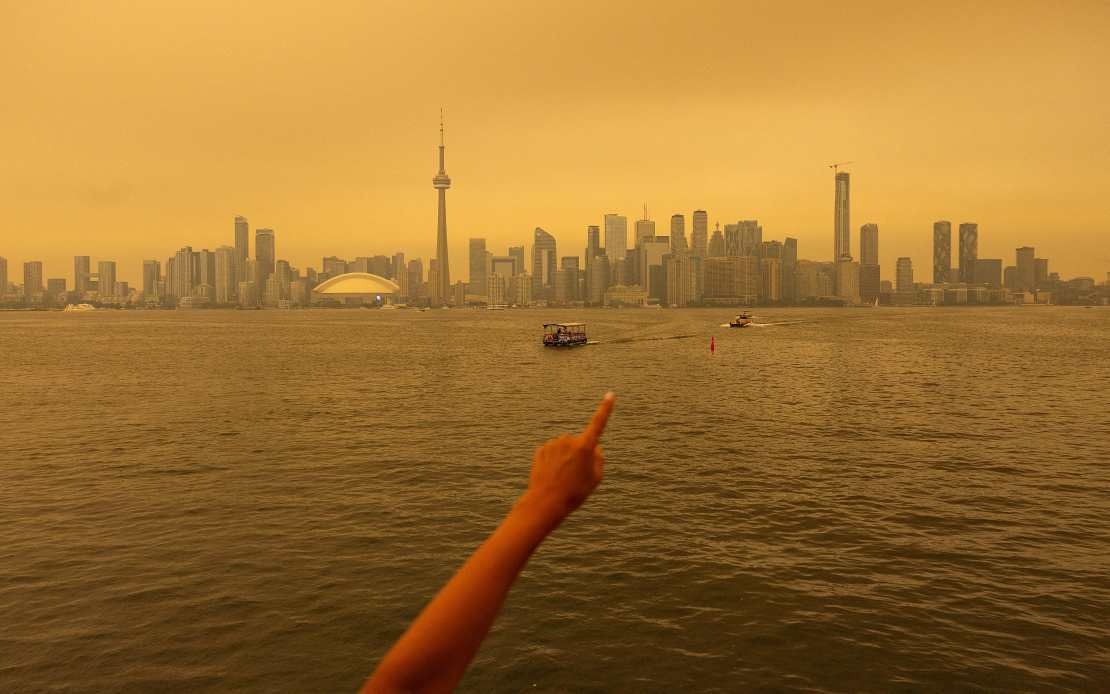
Massive wildfires raging across northwestern Ontario have transformed Canada's largest cities into smoke-filled zones with hazardous air quality, sending major infrastructure operators scrambling to respond. The crisis has affected millions of residents across the country's most economically important region, with Toronto and the national capital Ottawa both grappling with severe environmental degradation that health authorities warn may persist for days.
The scale of atmospheric pollution overwhelmed Toronto's air monitoring systems on Wednesday morning, when the city registered the worst air quality among major metropolitan areas globally. Environment Canada classified Toronto's Air Quality Health Index as "very high risk," a designation that triggers public health warnings and recommendations for residents to limit outdoor activities. The capital city, Ottawa, simultaneously issued its own air quality alerts as wildfire emissions combined with high humidity to create a toxic atmospheric layer that trapped smoke particles and transformed daylight into an eerie yellow haze across the urban landscape.
The meteorological conditions exacerbating the crisis reveal the complex interplay between weather systems and wildfire behavior. High humidity levels, rather than dispersing smoke as might occur in drier conditions, actually intensified the problem by creating stagnant air masses that held particulate matter near ground level where residents breathed it. This combination of factors means that atmospheric cleansing will depend on weather pattern shifts that forecasters say may take several additional days to materialize, leaving urban populations vulnerable to prolonged exposure to unhealthy air.
The wildfire threat has extended beyond air quality concerns to critical infrastructure. A dramatic video that circulated widely on social media captured the raw danger posed by these fires, showing a Canadian National train crew surrounded by towering flames near Armstrong, Ontario. The footage, filmed late Monday by a locomotive operator aboard the train, depicted intense red glows illuminating the cab as raging flames consumed forests on both sides of the rails. The visual evidence proved compelling enough that CN formally authenticated the video on Wednesday and confirmed that the crew had been safely extracted from the immediate danger zone.
The threat to rail operations has prompted significant operational changes across Canada's freight network. Canadian National, a backbone of continental commerce connecting the United States, Canada, and Mexico, announced a temporary suspension of train movements through the fire-affected corridor in northwestern Ontario. This action, while necessary for crew safety, carries broader economic implications for supply chains dependent on rail transport through this critical route.
The scope of the wildfire activity underscores the magnitude of this environmental crisis. More than 100 active fires continue burning simultaneously across northwestern Ontario, overwhelming firefighting resources and forcing emergency management authorities to prioritize evacuation operations over fire suppression in many areas. Several communities have been placed under mandatory evacuation orders, displacing residents from their homes and straining emergency shelter and support services across the region.
For Malaysian observers and Southeast Asian readers, these events illustrate the transnational character of environmental hazards in the modern world. While Ontario's wildfires may seem geographically distant, they demonstrate how large-scale environmental disruptions can cascade through global supply chains and affect international commerce. Malaysia's significant involvement in North American trade means that disruptions to Canadian rail networks inevitably reverberate through shipping schedules and logistics planning for Malaysian exporters and importers.
The atmospheric conditions developing across Ontario also offer cautionary perspective on air quality management. Malaysia has confronted severe transboundary haze from regional sources multiple times, yet the Ontario situation demonstrates that even wealthy nations with sophisticated monitoring systems and advanced infrastructure can experience dramatic environmental degradation when natural disasters align with unfavorable meteorological conditions. The persistence of smoke despite advanced technology suggests that no region is immune to prolonged air quality challenges when fires spread across vast territories.
Weather authorities monitoring the Ontario situation have projected that prevailing wind patterns and airflow dynamics will likely maintain hazardous conditions for an extended period. The prediction of multi-day smoke persistence reflects the reality that atmospheric circulation systems that created the stagnant conditions will require significant weather changes to break down. Until such shifts occur, residents in affected areas face continued restrictions on outdoor activities and elevated health risks, particularly for vulnerable populations including children, elderly persons, and those with respiratory conditions.
The coordination between Canadian National, provincial emergency management agencies, and health authorities has focused on preventing loss of life rather than property protection. This prioritization reflects a recognition that infrastructure can be repaired but human safety cannot be recovered once compromised. The successful evacuation of train crews, despite the dramatic imagery of flames surrounding the locomotive, demonstrates that advance planning and quick decision-making can mitigate catastrophic outcomes even when disaster strikes transportation corridors.
Longer-term implications of the wildfire season extend beyond immediate air quality and safety concerns. Ecological damage across northwestern Ontario will take years to assess, forest regeneration will require substantial time, and the carbon emissions from the fires contribute to broader climate change dynamics. For a resource-rich region like northwestern Ontario, wildfire damage affects timber resources, mining operations, and tourism infrastructure, creating economic ripple effects that extend well beyond air quality advisories.

