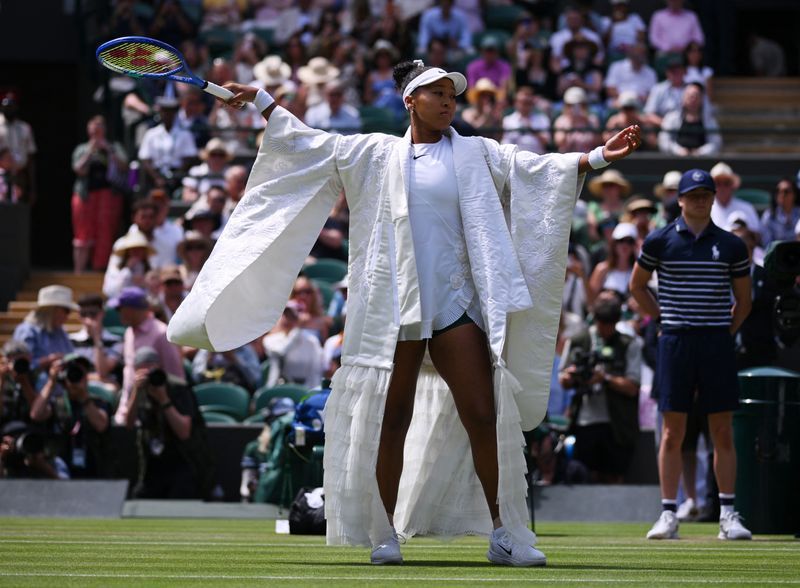
Naomi Osaka delivered a commanding performance on Centre Court's sister venue to dispatch unseeded Daria Kasatkina 6-1 6-3 and secure her maiden appearance in the Wimbledon last 16, demonstrating that her growing influence extends far beyond the tennis fashion sphere into the substance of her gameplay. The four-time Grand Slam champion from Japan has become synonymous with sartorial audacity throughout the opening week of the tournament, turning her on-court entrance into a gallery showcase featuring elaborate costume designs. Yet increasingly, the 14th seed is allowing her racquet work rather than her wardrobe to command attention from the thousands watching on what proved a glorious summer afternoon at the All England Club.
Osaka's pre-match ensemble drew further admiration from galleries assembled on Friday—a flower-patterned kimono robe continuing her playful homage to martial arts cinema through her "Kill Bill" themed walk-ons. However, what unfolded during the subsequent hour and twenty minutes on grass revealed a player whose technical arsenal has sharpened considerably following weeks of sustained competition on a surface traditionally less suited to her aggressive baseline game. The Japanese star's trajectory through the opening fortnight has transformed Wimbledon from a tournament where she previously struggled into a genuine arena for breakthrough performances.
The match's opening exchanges set the tone for Osaka's dominance. Breaking Kasatkina's service in the second game through a crisp backhand winner, she immediately consolidated momentum with a penetrating forehand drive that earned a second consecutive break of serve. This rapid accumulation of advantages permitted Osaka to cruise through the first set without significant resistance, her opponent unable to establish the rhythm necessary to compete with her opponent's power-driven approach. The clinical efficiency with which she dismantled the opening set—allowing Kasatkina merely a single game—suggested a player operating with supreme confidence on grass.
The second set initially appeared to follow a similar trajectory as Osaka established an early advantage. However, a momentary lapse in concentration threatened to squander momentum gained through superior strokeplay. Kasatkina, the 28-year-old Russian-born competitor, threatened to mount a credible comeback and reduce the deficit. Osaka responded with the combative spirit that defines champions, rallying after her temporary setback to manufacture two match points. She converted the second of these opportunities with characteristic flair, securing a dominant victory that extends her stay at the championships into the tournament's second week.
Speaking to the crowd immediately following her triumph, Osaka acknowledged the emotional significance of her achievement at the All England Club. "I've actually never won on this court, so I'm really glad to have made a really good memory here," she remarked while absorbing sustained applause from spectators who had witnessed her performance. Her gratitude toward the assembled crowd reflected not merely politeness but genuine appreciation for the encouragement that had manifested throughout her Wimbledon campaign. The Australian audience, comprised largely of tourists and local enthusiasts, had provided vocal support that she credited as contributing to her commanding display.
The context of Osaka's resurgence on grass courts bears particular significance for understanding her pathway through this tournament. She had contested the Bad Homburg final just weeks earlier, showcasing genuine competitiveness on the demanding surface despite ultimately retiring injured during that encounter. That experience appeared to have instilled confidence in her ability to navigate the peculiar challenges that grass presents to baseline players accustomed to harder courts. Her success across recent weeks of grasscourt competition has systematically dismantled doubts regarding her suitability for Wimbledon's demands.
Looking ahead to her fourth-round assignment, Osaka faces an opponent drawn from the contest between world number one Aryna Sabalenka and former French Open champion Jelena Ostapenko. Both competitors represent formidable challenges that would ordinarily present significant tactical difficulties for Osaka. Sabalenka brings exceptional power and a relentless attacking game that mirrors Osaka's own approach, potentially creating an intense baseline war. Ostapenko, conversely, possesses the creative shot-making and unpredictable brilliance characteristic of former major champions, requiring Osaka to exercise patience and consistency.
Osaka's philosophical approach to tournament progression—methodically navigating each encounter rather than contemplating distant outcomes—reflects maturity developed through years competing at sport's highest echelon. Her stated intention to "take it one day at a time, one point at a time" acknowledges both the psychological demands of Wimbledon's fortnight and the inherent uncertainty surrounding successive matches against increasingly accomplished opponents. This pragmatic mindset has historically served her well during major championship runs.
For Malaysian and Southeast Asian enthusiasts following tennis development within the region, Osaka's advancement represents a reminder of the calibre demanded at tennis's elite level. While the region has produced accomplished players, few have achieved the sustained success at Grand Slam tournaments that Osaka routinely demonstrates. Her ability to synthesize technical excellence with the mental resilience necessary for consecutive victories against top-ranked opponents provides a template for aspiring professionals throughout Asia. The contrast between her initial fashion-focused attention and her increasingly assured technical performance additionally illustrates how female athletes can command cultural influence through multiple dimensions rather than limiting their impact to singular spheres.
Osaka's journey through Wimbledon thus represents more than merely an individual player's success story. It exemplifies how contemporary tennis champions navigate the complex intersection between entertainment, fashion, and sporting excellence—realms that traditionally existed in parallel rather than in creative dialogue. Her progression to the tournament's second week, achieved through dominating strokeplay rather than fortunate draws or opponent withdrawals, establishes her as a genuine contender for the championship as the tournament enters its critical phase.

