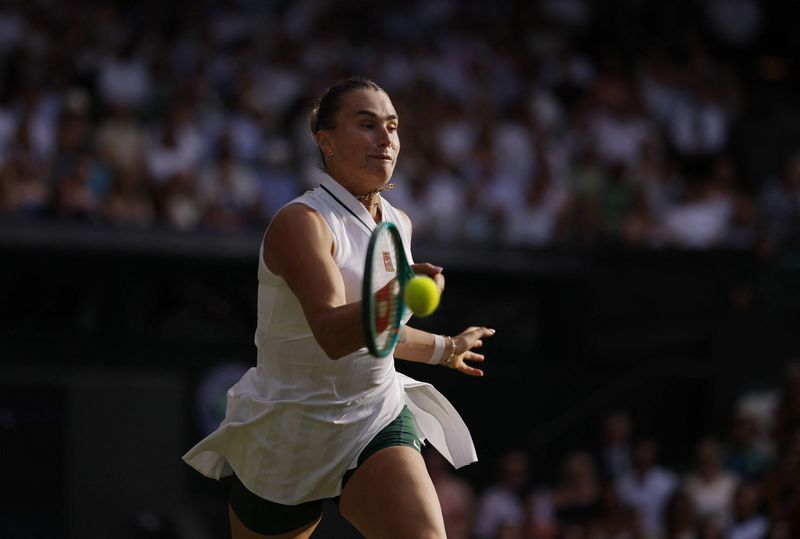
Japan's Naomi Osaka delivered a masterclass performance on Centre Court at Wimbledon on Sunday, dispatching women's top seed Aryna Sabalenka with a commanding 6-2 7-6(2) victory that sent shockwaves through the tournament. The 14th-seeded Osaka progressed to the quarter-finals for the first time at the All England Club, but more significantly, her win completed a stunning upheaval of the women's draw that has left the tournament's established hierarchy in disarray.
Sabalenka, despite holding the world's premier ranking and entering the competition as the favourite, was simply outplayed in a display that exposed the limitations of her power-based game on grass. The Belarusian struggled particularly in the opening set, which lasted just 32 minutes, during which Osaka's superior court positioning and tactical acumen rendered Sabalenka's signature aggressive approach ineffective. Sabalenka's frustration mounted visibly throughout that first set, her attempts to force the pace through sheer power finding the court's boundaries rather than the lines. The contrast between the two players' demeanours proved telling: Osaka remained composed and methodical, while Sabalenka's emotional volatility, evident in her self-directed racket blows and eventual outburst after losing the tiebreak, suggested a player increasingly losing control of the situation.
The second set provided the competitive chess match spectators had anticipated when these two four-time Grand Slam champions took to court. Yet even as the contest became more competitive, Osaka never relinquished her grip on proceedings. Her most impressive moment came in the tiebreak, where she dismantled Sabalenka's remarkable record of 21 consecutive tiebreak victories across all Grand Slam events. Sabalenka's post-match comment about wanting to drink and forget about tennis underscored the magnitude of her disappointment, but it also highlighted Osaka's psychological dominance on the day.
The broader significance of this result extends beyond the individual match. With defending champion Iga Swiatek and second seed Elena Rybakina both eliminated in the third round on Saturday, Osaka's victory over the top seed means the three highest-seeded women have all departed the draw. This development fundamentally alters the tournament trajectory and creates genuine uncertainty about who will ultimately claim the title. In recent seasons, the women's game has become increasingly dominated by a small group of elite players, making such scenarios relatively rare. Wimbledon 2024 has shattered that predictability in spectacular fashion.
Osaka's return to competitive tennis following the birth of her daughter Shai represents one of sport's most compelling narratives, particularly within the Asian sporting context where questions about women's professional careers and motherhood carry significant cultural weight. This victory represents her most substantial achievement since returning to the tour. While she has built her reputation on hardcourt surfaces, where she has accumulated all four of her Grand Slam titles, her adaptability to grass demonstrates genuine growth as a player. The Japanese star has also captured attention with her distinctive walk-on outfits inspired by her heritage, but Sunday's display proved conclusively that her game, not merely her presentation, commands respect.
The head-to-head history between these competitors adds another layer to the narrative. Osaka and Sabalenka, born just seven months apart, have followed remarkably divergent career paths despite similar talent levels. Osaka captured her first Grand Slam title at the 2018 U.S. Open before winning three additional majors, while Sabalenka, slightly younger, took longer to break through but has subsequently established herself as the world's dominant force. Their first meeting occurred eight years ago when Osaka prevailed en route to that U.S. Open triumph, but Sunday represented only their second career encounter at a Grand Slam level. This rarity highlights how carefully drawn tournament brackets and the unpredictability of elite women's tennis have kept these rivals apart at the sport's biggest stages until now.
Osaka's path to Sunday's victory was built on a foundation of superior shot-making and tactical discipline. Her service returns, often considered the foundation of success on grass courts, repeatedly destabilised Sabalenka's normally authoritative serving game. Breaking serve twice in the opening set proved the decisive factor in that section, as Sabalenka never recovered from the early deficit. The Japanese player's willingness to stay patient during baseline exchanges, avoiding the temptation to match Sabalenka's power with power, demonstrated maturity and understanding of the conditions. She controlled the points through court positioning and precise placement rather than outright hitting, a formula that contemporary grass-court specialists have largely adopted.
Sabalenka's attempts to regain composure during the second set—including a moment where she struck her racket against her head—reflected growing desperation. She managed to keep pace with Osaka in terms of game points, but the psychological momentum had shifted decisively. The fact that Sabalenka won the second set to force a tiebreak suggested she might mount a comeback, yet her three-times-in-a-row losses to Osaka before Sunday made this matchup particularly challenging mentally for the Belarusian. When it mattered most, in the tiebreak, Osaka's superior composure prevailed.
The quarter-final draw now sees Osaka facing Czech 10th seed Karolina Muchova, a formidable opponent on grass given her all-court capabilities and recent form. However, the momentum lies entirely with the Japanese champion. Her quarter-final appearance at Wimbledon represents uncharted territory in her Grand Slam record at this venue, suggesting significant room for additional progress. The tournament's sudden opening, with the three highest seeds eliminated, has created opportunities for multiple players to stake legitimate claims to the final prize.
Osaka's impressive performance carries particular significance for Asian tennis audiences, as female players from the region have historically struggled to achieve consistent success at Wimbledon, where the sport's traditions and grass-court specialization create specific barriers. Her victory sends a powerful message about adaptability and the capacity of players from non-traditional tennis regions to excel at any venue when equipped with proper preparation and mental fortitude. The timing of her breakthrough at Wimbledon, combined with her status as a young mother navigating the demands of elite professional sport, provides context that extends beyond tennis and resonates across gender and regional boundaries.

