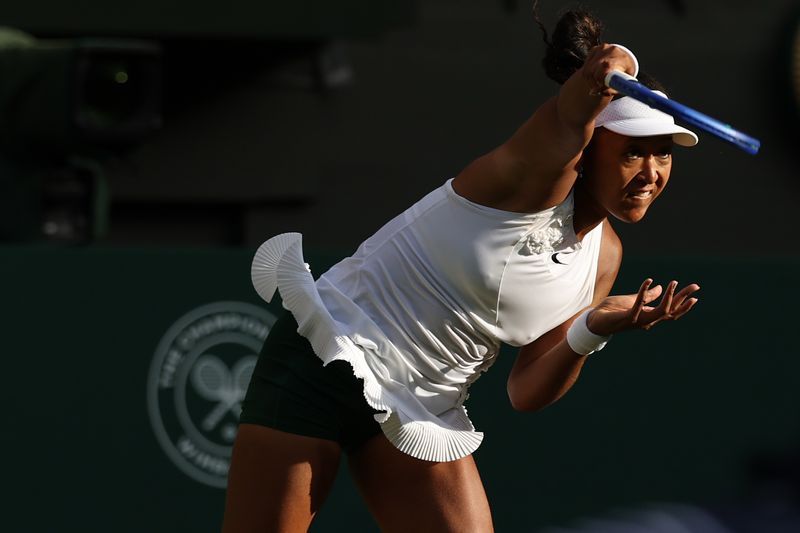
Naomi Osaka capped an impressive week at the All England Club by dismantling top-seeded Aryna Sabalenka in commanding fashion, securing a 6-2 7-6(2) victory to advance to the Wimbledon quarter-finals for the first time in her career. The Japanese 14th seed, who arrived on Centre Court in a striking kimono-inspired ensemble reminiscent of a Quentin Tarantino protagonist, departed having delivered the kind of authoritative tennis that characterised her four Grand Slam championship runs. Her elimination of Sabalenka represents a watershed moment in the tournament, removing one of the most dangerous remaining contenders from the women's bracket.
Osaka's demolition of the Belarusian powerhouse, who had defeated her three times consecutively this season, proved cathartic for the Japanese player. The psychological weight of those recent losses appeared to have dissipated entirely as she orchestrated a masterclass in sustained precision and controlled aggression. Rather than matching Sabalenka in raw power exchanges, Osaka dictated rallies with surgical accuracy, forcing the top seed into unforced errors while maintaining composure under pressure. This victory holds particular significance as the 26-year-old's most substantial scalp since her return from maternity leave in 2024, suggesting she is regaining the physical and mental sharpness that defined her earlier dominance.
Sabalenka's departure compounds an unprecedented collapse in the women's draw. The elimination of defending champion Iga Swiatek and 2022 winner Elena Rybakina in earlier rounds, combined with Sabalenka's exit, means the top three seeds have all been removed from contention. The loss of Barbora Krejcikova to fellow Czech Karolina Muchova in the fourth round has created a vacuum at the summit of the tournament that virtually guarantees a first-time Wimbledon champion will be crowned this year. Such a scenario would mark a ninth consecutive maiden Grand Slam victor at the grasscourt venue, reflecting both the competitive depth in women's tennis and the unpredictable nature of extended tournaments.
On the men's side, Novak Djokovic advanced to his 17th Wimbledon quarter-final despite admitting he endured a thoroughly uncomfortable afternoon against Russian qualifier Roman Safiullin. The 39-year-old Serbian secured a 7-6(6) 6-3 3-6 6-3 victory that lacked the fluidity and rhythm he prefers, yet demonstrated the resilience and match-craft that have sustained his longevity at the highest level. Djokovic acknowledged his struggles candidly after departing the court, stating he had not felt comfortable and was merely relieved to escape with a win rather than energised by the performance.
Despite the aesthetic shortcomings of his display against Safiullin, Djokovic achieved a significant historical milestone by recording his 106th match victory at Wimbledon, surpassing the legendary Roger Federer's men's record. This achievement underscores Djokovic's unparalleled consistency at the grass-court championship and his continued pursuit of an eighth men's singles title, which would equal the all-time record. At an age when most players have retired or substantially diminished their competitiveness, the world number two remains a formidable obstacle for any opponent fortunate enough to face him.
Djokovic's path to a potential semi-final meeting with defending champion Jannik Sinner runs through Canadian third seed Felix Auger-Aliassime in the quarter-finals. Auger-Aliassime earned his passage by outlasting Spain's Alejandro Davidovich Fokina in a gruelling four-hour 26-minute marathon that tested both players' physical reserves and mental fortitude. The encounter concluded acrimoniously with heated words exchanged at the net, demonstrating the intensity and frustration that accumulates during such extended battles. Davidovich Fokina's elimination meant Spain lost its final representative in the men's singles competition, further shifting the tournament's narrative away from the traditional powerhouses.
The tournament witnessed another injury-induced withdrawal when Poland's Hubert Hurkacz was forced to retire during the fifth set of his match against German veteran Jan-Lennard Struff. At 36 years old, Struff reached his first Grand Slam quarter-final, a remarkable achievement that typifies the open nature of this year's competition. Struff's presence in the last eight, having never previously reached this stage at a major championship despite a lengthy professional career, exemplifies how injuries and upsets have reshaped the tournament's landscape.
Osaka's display against Sabalenka showcased a player operating with considerably greater clarity of purpose than during the early stages of her comeback. When asked about her measured approach to pre-match pageantry, the Japanese champion indicated she deliberately toned down her characteristically flamboyant entrance attire to maintain psychological focus on the match itself. This shift in mentality suggests Osaka is consciously prioritising competitive performance over external showmanship, a tactical adjustment that may serve her well as the tournament progresses. Her next opponent will be Muchova, who demonstrated her own quality by defeating Krejcikova 7-5 5-7 6-3 in a tightly contested fourth-round encounter.
The women's draw featured a notable performance by American players, with five reaching the last 16—the strongest American representation since 2002. Fourth-seeded Jessica Pegula continued her improved Wimbledon campaign by dispatching 18-year-old sensation Iva Jovic 4-6 6-3 6-1, using her experience and tactical acumen to methodically dismantle the talented teenager. Pegula has now matched her best career showing at the All England Club and could potentially face another American opponent if Coco Gauff overcomes Belinda Bencic in her quarter-final matchup. This proliferation of American players in the latter stages suggests the depth of talent within the United States women's programme continues to strengthen substantially, potentially reshaping the competitive landscape of women's professional tennis in the coming years.

