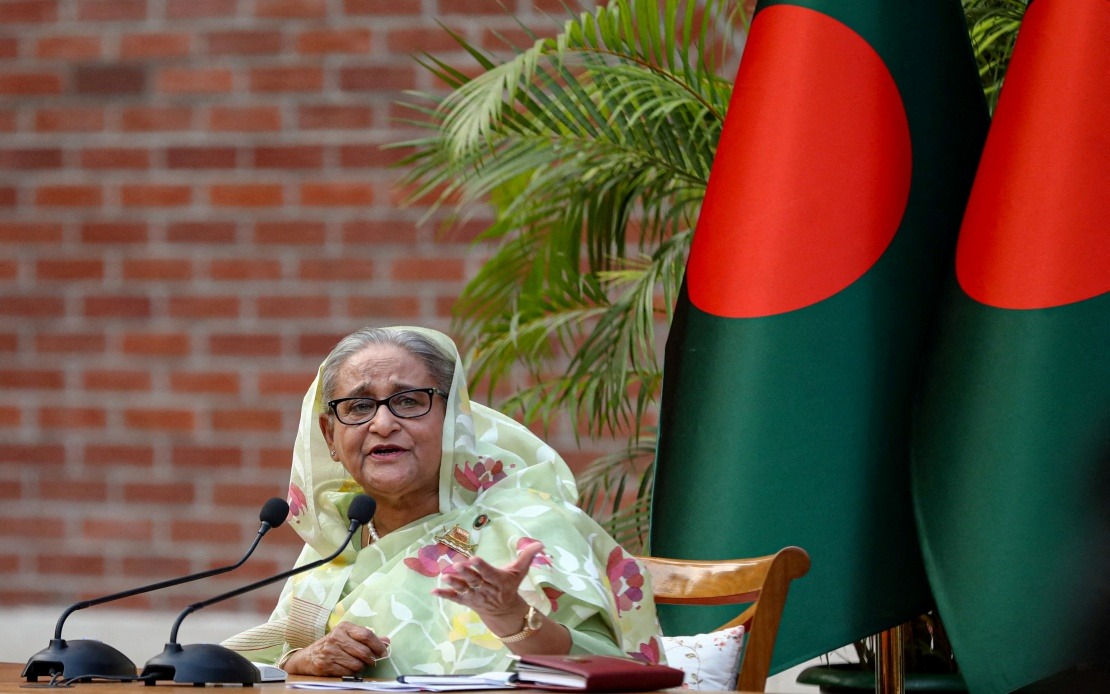
Sheikh Hasina, Bangladesh's ousted Prime Minister, has declared her intention to return to her homeland and submit to judicial proceedings, even as she faces a death sentence handed down by a war crimes tribunal. Speaking through a written interview with Kyodo News, the 78-year-old politician rejected the conviction stemming from a violent government response to student-led protests in 2024, characterising it as a verdict shaped by political considerations rather than impartial justice. Her statement carries enormous weight in South Asia, signalling defiance amid mounting pressure from Bangladesh's new administration to bring her back for trial.
Hasina fled Bangladesh in August 2024 following her resignation, seeking refuge in India as massive demonstrations against her government spiralled into a broader uprising. The protests originated from a court decision to reinstate a 30 percent job quota for descendants of veterans of Bangladesh's 1971 independence war, a ruling that triggered intense backlash from university students and civil society. What began as a focused campaign against educational inequality swiftly transformed into a comprehensive challenge to her political authority, with demonstrators demanding systemic reform and accountability for governance failures.
The ensuing crackdown proved catastrophic in scale. United Nations researchers documented approximately 1,400 fatalities during the period of unrest, with the majority of deaths attributed to gunfire from security forces deployed to suppress the movement. Hasina has consistently maintained that she did not authorise the killings, asserting instead that opposition politicians and foreign adversaries manipulated the student movement to orchestrate her downfall. This competing narrative remains central to Bangladesh's political divisions, with her supporters and opponents offering starkly different interpretations of who bears responsibility for the bloodshed.
In November 2025, Bangladesh's war crimes tribunal convicted Hasina in her absence and imposed a capital sentence for crimes against humanity connected to the crackdown. The tribunal's proceedings took place without her physical presence, a procedural concern that international human rights organisations have flagged as problematic. Human Rights Watch acknowledged that accountability for abuses during her administration remains essential, yet raised questions about the legitimacy of convicting a defendant who could not mount a direct defence. These tensions between justice and due process reflect broader debates about transitional accountability mechanisms across South Asia.
Hasina's current residence in India complicates efforts to return her to Bangladesh. New Delhi has received an extradition request from the Bangladesh government and is examining the matter through established legal and diplomatic frameworks. The Indian Ministry of External Affairs has indicated that decisions will follow careful evaluation of legal protocols, suggesting India may be weighing multiple considerations including bilateral relations, precedent, and human rights implications. For Malaysia and other regional states, this diplomatic standoff underscores the challenges facing South Asian neighbours when former leaders flee across borders.
The new Bangladesh government, led by Prime Minister Tarique Rahman of the Bangladesh Nationalist Party, has made Hasina's return a priority after winning a general election in February 2026. Government spokesman Zahed Ur Rahman declared the authorities' commitment to bringing her back to face trial while guaranteeing her the opportunity to mount a legal defence. This assurance partially addresses concerns about procedural fairness, though sceptics question whether genuine impartiality is achievable given the intensely polarised political climate surrounding her case.
Hasina's tenure as Prime Minister spanned multiple periods, with her serving for five separate terms between June 1996 and August 2024, accumulating nearly 15 years in office. During her time leading Bangladesh, she navigated complex security challenges and development initiatives. Her administration witnessed a particularly devastating attack in July 2016 when militants struck the Holey Artisan Bakery in Dhaka, killing 20 hostages including nine Italian nationals, seven Japanese citizens, two Bangladeshis, one Indian, and one American of Bangladeshi descent. Two police officers also died responding to the assault. Seven militants received death sentences in 2019, later commuted to life imprisonment, with the Japanese victims working on a railway infrastructure project supported by Japan International Cooperation Agency.
In her statement, Hasina suggested that independent international forensic examination could still establish objective facts about the circumstances of deaths during the 2024 unrest. She proposed that careful investigation of how each person died and analysis of the weapons and ammunition involved could reveal truths about the crackdown. This proposal implicitly challenges the tribunal's conclusions while offering a pathway toward evidence-based accountability that might satisfy regional and international observers concerned about the trial's impartiality.
Hasina's emphasis on Bangladesh's regional importance carries particular resonance for countries like Japan, Malaysia, and others invested in South Asian stability. She highlighted that a functioning Bangladesh matters not only to its own citizens but to the broader Indo-Pacific region, Bay of Bengal maritime security, development partners, and nations that have extended considerable diplomatic and economic support. Her framing positions Bangladesh's recovery as a shared concern rather than an isolated domestic matter, reflecting the interconnected nature of Southeast and South Asian geopolitics.
The interim government that assumed power following her departure, led by Nobel laureate Muhammad Yunus after student protest leaders nominated him, governed before the February 2026 elections brought the Bangladesh Nationalist Party to office. Since May 2025, all operations of Hasina's Awami League have been banned, a sweeping prohibition that prevents her party from functioning as a political force. This prohibition fundamentally alters Bangladesh's opposition landscape and raises questions about democratic restoration and party pluralism in the coming years.
Hasina's call for both healing and accountability reflects the profound challenge facing Bangladesh. She acknowledged that the nation requires recovery from the divisive events of 2024, yet insisted that reconciliation cannot extend to impunity for those who orchestrated crimes. This position attempts to chart a middle course between transitional justice advocates demanding prosecutions and those seeking broader national forgetting to enable healing. Whether such equilibrium can be achieved remains uncertain given the competing political interests at stake.
Looking forward, Hasina positioned the next decade as potentially transformative if democracy is genuinely restored and Bangladeshi citizens are empowered to determine their political direction. Her vision of recovery and renewal implicitly critiques the current government's trajectory while appealing to democratic principles. For regional observers including Malaysia, the unfolding Bangladesh situation serves as a cautionary tale about political polarisation, the fragility of constitutional order, and the complexities of managing leadership transitions in divided societies. How Bangladesh navigates the Hasina question will influence regional stability and international confidence in South Asian governance for years ahead.

