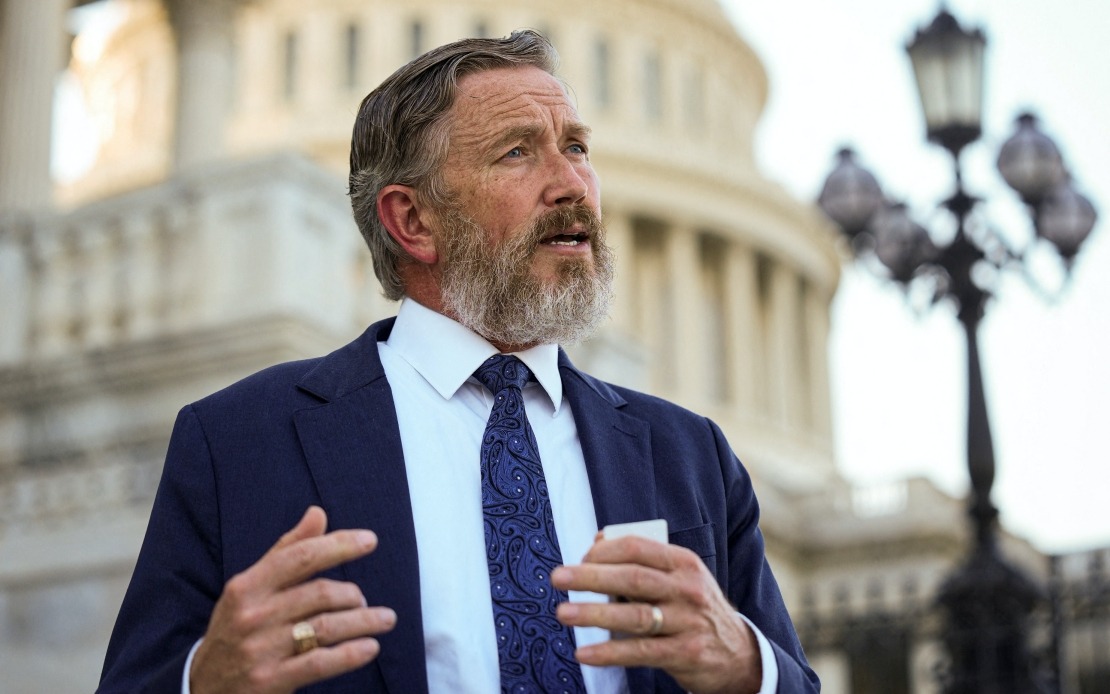
A symbolic but striking congressional moment unfolded in Washington as more than 100 House Democrats threw their weight behind legislation to strip away billions of dollars in annual military assistance to Israel, underscoring deepening fissures within America's traditionally pro-Israel political establishment. The amendment, introduced by Republican Representative Thomas Massie of Kentucky to eliminate approximately US$3.3 billion in defence support during the next fiscal year, failed to secure passage on Wednesday evening with a final tally of 314 to 104, yet the level of Democratic backing revealed a substantial realignment in party thinking on Middle East policy.
The significance of the vote lay not in its legislative outcome but in the message transmitted by the Democratic caucus. Among the House's 215 Democrats, 103 voted to support the measure while a further 10 abstained, meaning that nearly half the Democratic membership signalled openness to conditioning or terminating the military aid package. This represented a dramatic acceleration in sentiment compared to earlier moments of congressional debate on this contentious issue. Just over two years previously, when a comparable vote had taken place, only 37 Democrats had endorsed reducing assistance to Israel, illustrating how sharply attitudes have shifted within the party's ranks in an unusually compressed timeframe.
Massie's amendment came as part of broader House deliberations focused on appropriating funds for the United States State Department and the various agencies responsible for national security matters. His proposal explicitly targeted the annual military aid allocation that has long been regarded as a cornerstone of the strategic partnership between Washington and Jerusalem. Notably, Massie stood as the sole Republican to vote in favour of his own amendment, a reflection of the stark partisan divide on this question and the near-unanimous opposition from the Republican caucus to any reduction in support for Israel's defence capabilities.
The Democratic Party's internal struggle over Israel policy has become increasingly visible in recent congressional sessions, particularly as the military campaign in Gaza has extended beyond initial expectations and generated considerable international humanitarian concerns. While the party's leadership structure, including senior figures in Congress, has continued to publicly affirm support for military assistance to Israel, the progressive wing of the Democratic coalition has mounted a mounting challenge to this orthodoxy. Many of these lawmakers have explicitly linked their position on aid to concerns about civilian casualties and displacement in Gaza, framing the question as one of human rights and accountability rather than mere foreign policy pragmatism.
The growing Democratic opposition to unconditional military aid reflects broader changes in the party's constituency and worldview. Younger voters, immigrant communities, and progressive activists have increasingly questioned America's role as Israel's primary military benefactor, particularly when such assistance is provided without conditions tied to behaviour or compliance with international humanitarian law. This generational and ideological tension within the Democratic Party has manifested in repeated congressional votes and increasingly vocal public campaigns by activist organizations aligned with the party's left wing.
The voting pattern also suggests that the calculation of political risk around this issue may be shifting among mainstream Democrats. In previous years, backing any amendment critical of Israel could invite accusations of antisemitism or disloyalty from opponents and party rivals. The fact that nearly half the Democratic caucus now felt comfortable publicly supporting such a measure suggests that some of these political inhibitions may be eroding, at least among certain segments of the party. The amendment's failure by a wide margin—210 votes separated the winning and losing sides—ensured that no actual policy change would result, allowing the vote to serve primarily as a barometer of opinion rather than a threat to the existing aid relationship.
For Malaysian and Southeast Asian observers, these congressional dynamics offer insights into the changing nature of American foreign policy decision-making and the domestic political pressures that increasingly constrain unilateral support for any single country's interests abroad. The vote illustrates how democracies grapple with competing values and constituencies, and how public opinion, generational change, and activist mobilization can gradually reshape what once appeared to be settled policy consensus. The Middle East's continuing volatility and the humanitarian dimensions of regional conflicts have clearly penetrated American domestic political consciousness in ways that demand response from elected officials, even when that response remains ultimately unsuccessful in achieving legislative change.
The Republican position presented its own internal complexity, with Thomas Massie representing a libertarian strain within the GOP that questions overseas military commitments on principle, distinct from the more mainstream Republican support for Israel rooted in strategic alliance considerations and domestic political alignment with evangelical Christian voters. His isolation within the Republican caucus on this particular vote underscored how thoroughly the party had coalesced around unconditional support for Israeli military capacity, leaving dissenters few allies or platforms for advancing alternative perspectives.
Looking forward, the trajectory demonstrated in these voting numbers suggests that Democratic party divisions on Israel policy will likely persist and potentially intensify, particularly if the situation in Gaza remains unresolved or if civilian harm statistics continue to mount. The next major congressional test of this sentiment will arrive when the House revisits defence appropriations in subsequent fiscal cycles, offering progressive Democrats repeated opportunities to press their case. Meanwhile, the Biden administration will continue attempting to balance its stated commitment to Israel's security against mounting pressure from its own party's activist base and international diplomatic concerns about the humanitarian consequences of unconditional military support.

