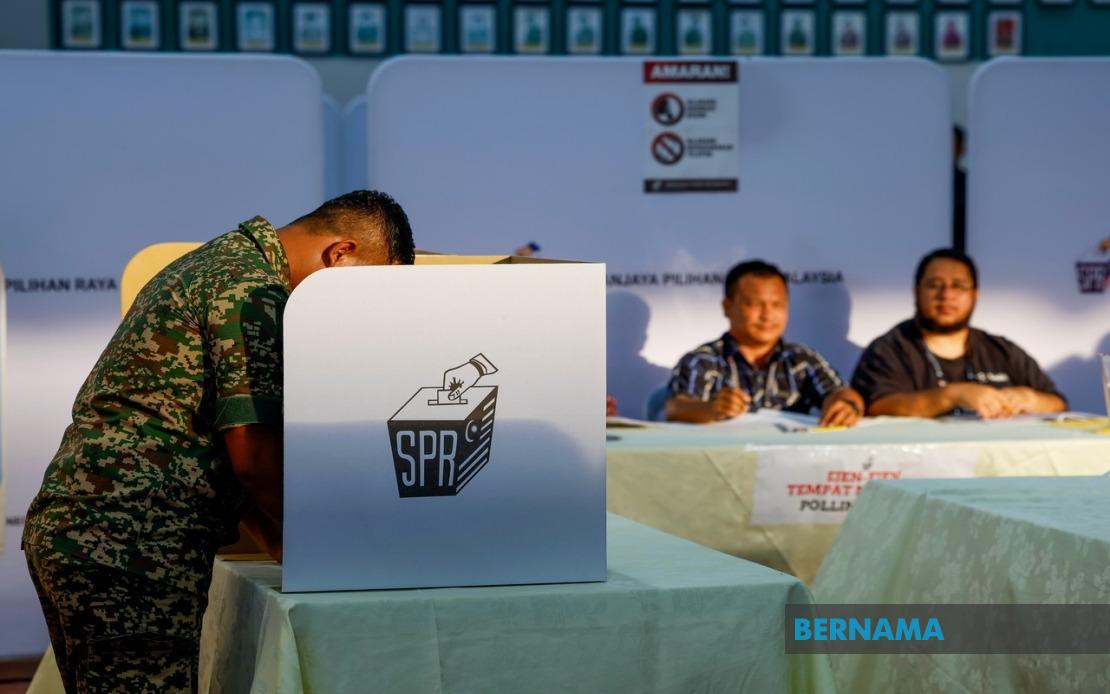
The 16th Negeri Sembilan state election saw brisk early voting activity on July 28, with the Election Commission reporting that 14.31 per cent of designated early voters had already exercised their franchise by 9 am. The turnout reflects sustained momentum among uniformed services and their families, who comprise the bulk of early voting participants in Malaysian electoral cycles.
According to the EC's official social media update, the early voting pool consisted of 1,431 military personnel and 925 police officers, including their respective spouses. This combined group of 3,681 individuals represented the core of the early voting cohort, underscoring the traditional pattern whereby security and defence personnel cast ballots in advance of the general election day to maintain operational readiness.
Thirty-eight polling centres operated simultaneously from 8 am across Negeri Sembilan to accommodate the 22,389 registered early voters. The simultaneous opening reflected careful logistical planning by the EC to ensure smooth processing and minimise congestion. These centres remained open throughout the morning and early afternoon, with staggered closing times between noon and 5 pm depending on each location's voter load and registration numbers.
The early voting window operates as a critical safety valve in Malaysia's electoral system, allowing security personnel and other designated groups to participate without compromising their operational duties on the main polling day. The participation rate suggests that the majority of eligible early voters viewed this arrangement favourably, though the absolute numbers also hint at lower-than-expected early voter registration in some cases.
The broader election context reveals a competitive three-way contest across the state. A total of 103 candidates are contesting the 36 state assembly seats available in Negeri Sembilan, suggesting considerable fragmentation or strong representation from multiple political parties. This multi-candidate scenario typically creates more complex electoral dynamics than straightforward two-way contests, potentially affecting campaign strategies and voter decision-making processes.
The general polling day scheduled for July 28 was anticipated to draw 889,490 registered voters, a substantially larger figure than the early voting contingent. This main election day represented the definitive moment when Negeri Sembilan's electorate would determine the state's political direction and which coalition or party would command the assembly. The vast majority of voters would participate in this phase, making the overall turnout during general polling a key indicator of public engagement with the electoral process.
Negeri Sembilan occupies strategic importance within Malaysia's political landscape, as a state where electoral outcomes can shift control and influence broader national politics. The state has historically experienced competitive elections where margins between leading candidates remain narrow, making every vote potentially consequential. The early voting performance suggested that voter interest remained reasonably strong, though final turnout figures would offer more comprehensive insights into public enthusiasm.
From a regional perspective, Negeri Sembilan's electoral exercise contributes to the broader Southeast Asian democratic experience. Malaysia's conduct of state-level elections demonstrates the country's commitment to regular democratic cycles and the franchise, even as broader political debates continue regarding electoral systems, representation, and democratic deepening. The smooth operation of early voting centres and the apparent orderly participation of uniformed services reflects institutional competence in electoral administration.
The EC's real-time reporting of voting figures through social media represented contemporary practice in electoral transparency, allowing citizens and observers to track voting progress as it unfolded. This openness contrasts with historical patterns in some jurisdictions where voting data remained closely guarded during polling periods. The practice enhances public confidence in electoral integrity by enabling independent monitoring and verification of reported figures.
Looking forward to the final tallies, election observers and political analysts would scrutinise not only which party or coalition emerged victorious but also overall turnout percentages and geographic voting patterns. Variations in turnout across different constituencies might signal shifting voter preferences or changing demographics in particular areas. Results from Negeri Sembilan could provide early signals about voter sentiment heading into any future national elections, making this state contest nationally significant despite its regional scope.

