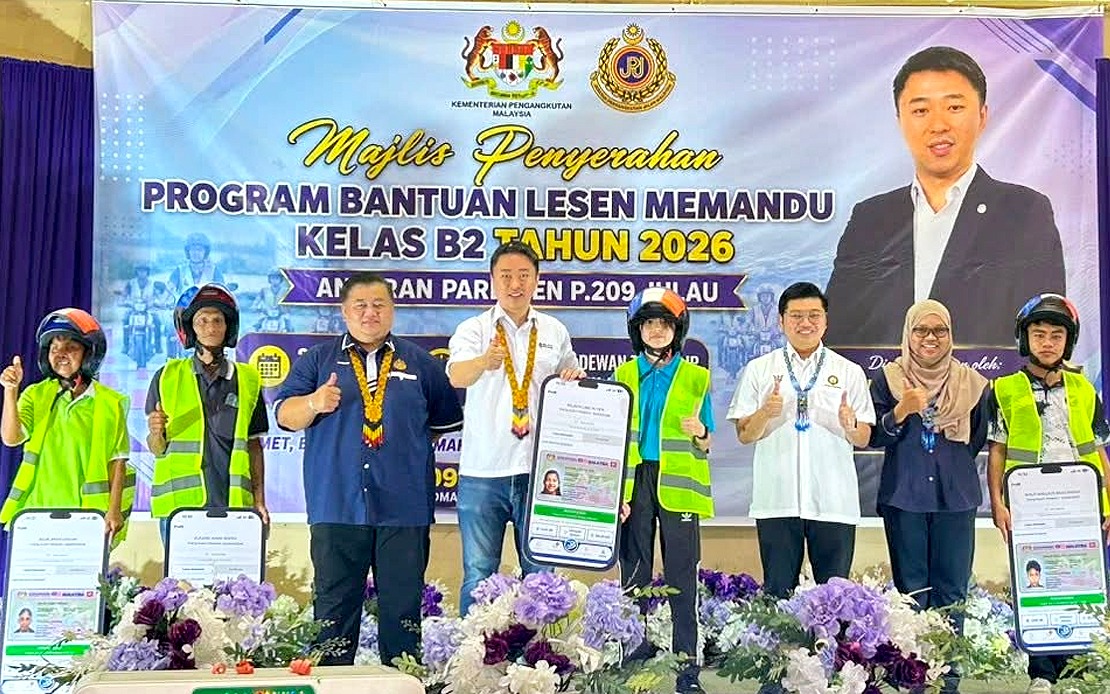
The Driving Licence Assistance Programme in Julau has concluded with substantial benefits for rural residents, as 885 participants from remote areas of the parliamentary constituency received their Class B2 Probationary Driving Licences at a ceremony held at the Julau Closed Stadium here today. The initiative, which aims to extend formal licensing to underserved communities, represents a significant step toward improving both road safety and economic accessibility in the region. Officials including Julau MP Datuk Larry Sng Wei Shien, who chairs the Malaysian Timber Industry Board, and Sarawak Road Transport Department director Norizan Jili attended the closing event, underscoring the programme's importance to state authorities.
For residents across scattered rural settlements in the constituency, the inability to obtain valid driving licences has long created a dual burden: operating motorcycles without legal authorisation while remaining ineligible for the government's subsidised fuel scheme. Petrol prices have climbed steadily across Malaysia, placing particular strain on agricultural and forest-dependent communities where motorcycles serve as essential transport to smallholdings, orchards, and workplaces. The licensing assistance programme directly addresses this gap by removing administrative and cost barriers that previously kept legitimate users locked out of subsidised purchasing channels.
Bajik Undum, aged 57 and the oldest female participant, exemplifies the programme's practical impact. Residing in Rumah Ajau within Ulu Kuntau, Pakan, she previously managed an orchard and transported produce using an unlicensed motorcycle, compelled to purchase non-subsidised petrol at significantly higher prices. With her new licence in hand, she now qualifies for government fuel subsidies, a shift that directly reduces her operational costs and improves the viability of her smallholding enterprise. Her participation also signals that rural development initiatives can successfully reach older residents who may have faced earlier obstacles to formal licensing.
The male cohort tells a parallel story. Kudang Jenggi, the programme's oldest male participant at 64, works as a bird's nest house caretaker in Bayong, Sarikei, a role requiring reliable daily transportation. Previously, encounters with road enforcement officers posed a constant anxiety given his lack of valid documentation. More importantly, the mounting cost of non-subsidised fuel threatened to erode his modest income. Obtaining his licence has eliminated both the legal vulnerability and the financial drag, allowing him to work with confidence and preserve cash for household needs.
Daniel Padong's situation reveals the cumulative economic effect of fuel prices on smallholder farmers. At 45, he depends on his motorcycle to reach his oil palm plot daily, and the recent upward trajectory of petrol prices had begun cutting into already-thin margins. By securing a licence through this assistance programme, he gains access to subsidised rates, transforming his daily transport economics and making his farming operation more sustainable. For a farmer with limited capital, even modest reductions in fuel outlays can determine whether operations remain viable.
The programme's emphasis on Class B2 Probationary Licences—designed for motorcycle riders—reflects a deliberate policy targeting the primary transport mode in rural Sarawak. Motorcycles offer affordability and manoeuvrability across rough terrain and dispersed settlements where road infrastructure may be limited. By formalising motorcycle licensing within rural communities, authorities simultaneously improve road safety awareness and unlock eligibility for subsidised fuel, creating a multiplier effect that encourages compliance and supports livelihoods.
For Malaysian policymakers, the Julau initiative offers lessons in inclusive governance. Rural regions often experience lower formal licensing rates due to distance from licensing centres, documentation requirements, costs, or simple awareness gaps. Dedicated assistance programmes that bring licencing services directly to communities and eliminate administrative friction demonstrate how targeted interventions can bridge the gap between national fuel subsidy policies and their intended beneficiaries. The 885 participants represent individuals who were previously excluded from economic support mechanisms despite operating vehicles legitimately.
The broader context matters significantly. Malaysia's fuel subsidy system aims to support cost-of-living pressures and economic participation across income groups. However, without valid documentation, rural residents remain unable to access these benefits even as they bear the full brunt of rising energy prices. Transport costs directly affect agricultural productivity, market access, and employment opportunities. By extending formal licensing to previously unserved populations, this programme effectively widens the reach of subsidy benefits while simultaneously raising road safety standards in areas where enforcement has often been limited.
Sarawak's unique geography compounds these challenges. Vast distances, dispersed settlement patterns, and limited public transport mean that motorcycles remain the primary means of personal mobility in many constituencies. The Road Transport Department's commitment to bringing licensing services to Julau demonstrates recognition that centralised bureaucratic systems often fail rural populations. Mobile or decentralised licensing initiatives that meet residents where they are, rather than requiring them to travel to distant urban centres, represent a more equitable approach to national policy implementation.
Beyond individual beneficiaries, the programme generates broader social benefits. When rural workers can operate legally and access subsidised fuel, their productivity increases, their earnings stabilise, and their participation in formal economic activity expands. Agricultural communities gain improved transport efficiency for produce delivery to markets, enhancing supply chains and competitiveness. Small traders and service providers likewise benefit from reduced operating costs. These cumulative gains ripple through rural economies, supporting small businesses and household resilience against external price shocks.
The presence of high-level officials at the closing ceremony—including Datuk Larry Sng Wei Shien in his role as both MP and MTIB chairman—signals political commitment to rural economic development. Sarawak's timber industry depends significantly on rural labour and smallholder participation; supporting transport accessibility and cost efficiency for rural residents thus aligns with broader state economic interests. The visibility given to this programme suggests it may serve as a model for replication in other constituencies facing similar challenges.
Looking ahead, the success of Julau's licensing assistance programme raises important questions about scalability and sustainability. Are similar programmes planned for other rural constituencies in Sarawak and Malaysian states? What mechanisms ensure that future cohorts of eligible residents remain informed and able to access these services? How can licensing accessibility be maintained as populations grow and administrative demands increase? These questions will determine whether today's 885 newly licensed riders represent the beginning of sustained inclusive governance or a one-off initiative.

