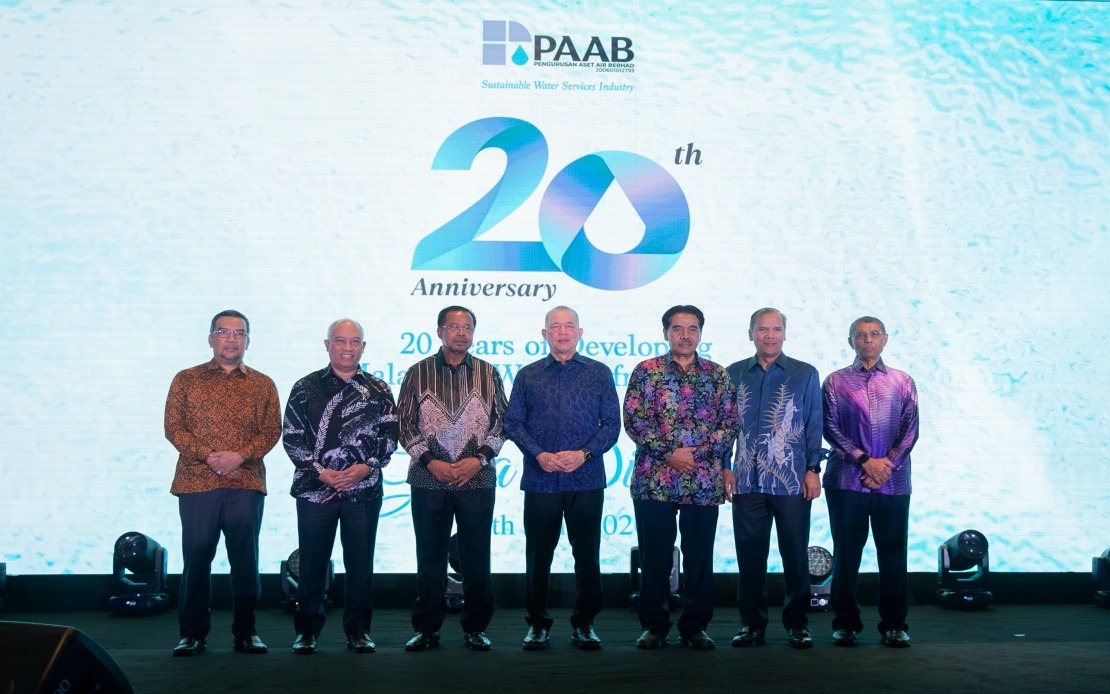
Pengurusan Aset Air Berhad (PAAB) is marking two decades of restructuring Malaysia's water services industry, a milestone that underscores the entity's pivotal role in modernising the nation's critical water infrastructure and safeguarding supply reliability for millions of residents and businesses. Since its incorporation on May 5, 2006, the wholly owned Finance Ministry subsidiary has become a cornerstone institution in the country's push to stabilise and expand water supply networks, orchestrating a transformation that extends across multiple states and encompasses thousands of kilometres of upgraded pipelines and dozens of new treatment facilities.
The scale of PAAB's financial commitment reveals the magnitude of restructuring required to address longstanding gaps in Malaysia's water sector. Over two decades, the organisation has financed RM23.04 billion in water industry debt absorption while committing RM23.84 billion toward infrastructure development, bringing total capital deployment to RM46.88 billion. This substantial injection of funds reflects recognition among policymakers that fragmented, underfunded water systems cannot sustain economic growth or meet rising demand from expanding urban centres and resource-intensive sectors such as semiconductor manufacturing and data centre operations. The capital investments span multiple infrastructure categories, with RM8.33 billion allocated to projects already handed over to operating authorities, RM1.84 billion currently under construction, and RM13.67 billion still in design and planning phases.
As of December 2025, ten states have formalised participation in the National Water Services Industry Restructuring Plan, creating a coordinated framework for upgrades and expansions. The completed works demonstrate tangible progress: twenty-one new water treatment plants with combined daily capacity exceeding two thousand million litres, forty-two storage facilities holding seven hundred eighty-three million litres, and more than three thousand kilometres of pipeline upgrades and extensions connecting communities nationwide. These infrastructure improvements directly enhance water security for consumers while reducing vulnerability to supply disruptions stemming from ageing distribution systems or seasonal fluctuations.
Deputy Prime Minister and Energy Transition and Water Transformation Minister Datuk Seri Fadillah Yusof, who officiated the anniversary celebration at Menara Felda Platinum Park in Kuala Lumpur, identified non-revenue water losses as an urgent crisis demanding immediate intervention rather than reliance on extended timelines. The national non-revenue water rate of approximately forty per cent represents an enormous drain on system efficiency, with nearly half of treated water lost through leakage, theft, and metering failures before reaching consumers. Fadillah emphasised that this rate of loss directly undermines water security for households and threatens the operational stability that multinational corporations require when investing in Malaysia.
The urgency articulated by Malaysia's second-highest ranking minister reflects the stakes involved in attracting and retaining foreign direct investment in sectors with significant water demands. Data centres, which have become increasingly prominent in Malaysia's economic development strategy, demand guaranteed water supplies for cooling systems operating continuously throughout the year. Without aggressive action to curb non-revenue water losses, Malaysia risks losing competitive advantage against competing regional hubs such as Singapore and Thailand, where water infrastructure reliability is viewed as a core competitive asset. Fadillah stated bluntly that waiting until 2050 to achieve full cost recovery and system stabilisation represents an unacceptable timeline given the losses occurring today.
PAAB's restructuring roadmap divides the transformation into four distinct phases spanning more than four decades. The initial Migration phase ran from 2008 to 2020, establishing the institutional framework and beginning debt absorption. The Stabilisation phase, currently underway through 2030, focuses on completing critical infrastructure and reducing system vulnerabilities. Subsequent Consolidation and Full Cost Recovery phases extending through 2050 will progressively transfer financial responsibility toward users and operators while completing network modernisation. PAAB chairman Datuk Seri Jaseni Maidinsa framed this extended timeline as necessary for sustainable transitions, though the contradiction between long-term planning and the immediate crisis of forty per cent water losses remains unresolved.
The investment portfolio breakdown reveals strategic prioritisation within constrained resources. Projects already completed and transferred to operators represent a foundation of completed capacity, while ongoing construction projects maintain momentum toward stated targets. However, the substantial portion of capital still in design and planning stages, approximately RM13.67 billion, indicates that major system overhauls remain years away from completion and impact. This pipeline of future work suggests that immediate supply challenges will persist even as long-term infrastructure development proceeds, reinforcing the tension between the extended restructuring timeline and the acute problems facing operators and consumers today.
Context from Malaysian water sector challenges illuminates why PAAB's twenty-year existence represents only partial progress toward system reliability. Water supply interruptions remain common in major urban areas, particularly Selangor and Kuala Lumpur, where aging infrastructure in some districts dates to the 1970s and 1980s. Multiple water operators managing fragmented geographic territories create coordination difficulties, with some delivering better service quality than others. Industrial water demand has grown substantially with manufacturing expansion, while residential demand continues climbing alongside urbanisation. These structural pressures mean that PAAB's infrastructure investments, while substantial, must be considered against a baseline of significant unmet needs.
The participation of ten states in the National Water Services Industry Restructuring Plan leaves significant gaps, with several major water-consuming regions not yet formally integrated into the coordinated framework. This partial adoption suggests either that remaining states face budgetary constraints preventing participation or that negotiation difficulties persist regarding debt assumptions and operational control. For consumers in non-participating states, system improvements may be delayed further, and access to PAAB's financing mechanisms may remain limited. This uneven geographic implementation creates disparities in water infrastructure quality across Malaysia, with implications for equity and regional economic development.
Malaysian business stakeholders, particularly multinational investors evaluating facility locations, monitor water infrastructure reliability as a key risk factor alongside electricity supply and logistics access. PAAB's two decades of work have produced visible improvements in treatment capacity and distribution infrastructure, yet the persistent forty per cent non-revenue water rate signals that operational and maintenance challenges remain substantial. For Malaysian manufacturers competing globally on cost and reliability metrics, water supply interruptions translate into production losses, missed export deadlines, and damaged customer relationships. Conversely, investment in reducing non-revenue water and expanding treatment capacity creates competitive advantages that could attract additional foreign investment in water-intensive sectors.
Moving forward, the challenge facing PAAB and policymakers involves accelerating concrete improvements in system performance while maintaining the extended restructuring timeline required for complete transformation. Deputy Minister Datuk Seri Abdul Rahman Mohamad and other officials present at the anniversary event acknowledged that federal agencies and state governments must coordinate more aggressively on non-revenue water reduction, suggesting that institutional barriers and resource constraints have slowed progress below policymakers' initial expectations. Whether Malaysia's water sector can simultaneously pursue multi-decade structural reform and deliver near-term improvements in supply reliability will largely determine the success of PAAB's next phase and the broader sustainability of Malaysia's water infrastructure development.

