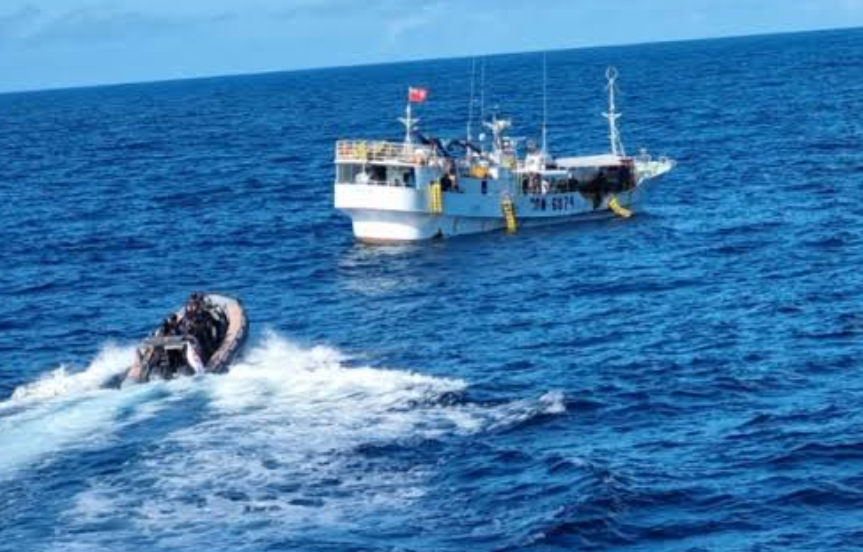
Authorities across the Pacific have intensified enforcement action against foreign fishing fleets, with four vessels detained this month for illegal operations or licensing violations across Kiribati, Palau, and Papua New Guinea. The Pacific Islands Forum Fisheries Agency disclosed the coordinated crackdown following a region-wide surveillance initiative involving 11 island nations that conducted inspections of more than 100 boats across 28 million square kilometres of ocean between 3 and 14 August.
The enforcement operation, dubbed Operation Island Chief, deployed sophisticated monitoring capabilities including aerial surveillance from Australian military aircraft and maritime patrols conducted by United States Coast Guard vessels and regional police forces. The scale of the initiative reflects growing concerns among Pacific island states about protecting their marine resources and maximising economic returns from tuna stocks that sustain both commercial operations and local communities. The FFA has declined to reveal details about 16 additional vessels flagged during the two-week operation as requiring further investigation, citing the sensitivity of such disclosures in an already complex geopolitical environment.
The tuna fishery represents a critical economic pillar for Pacific island economies. The region accounts for approximately half of the world's tuna catch, yet Pacific island nations process or handle only 15 per cent of this total themselves. Despite this limited direct participation in processing, the fishery generates substantial revenue streams: access fees alone contribute US$500 million annually, whilst export earnings total US$1.2 billion per year. Beyond these figures, the sector supports the livelihoods of approximately one-third of all households across Pacific island communities, making fishing rights and stock conservation matters of existential importance for these nations.
Most tuna extraction in the region occurs through distant-water fishing operations conducted by foreign vessels—predominantly Asian-owned fleets—that operate under licensing arrangements with island governments. These long-distance fishing operations have created a complicated dependency dynamic: island states receive necessary revenue by leasing access to their exclusive economic zones, yet they exercise limited direct control over catch volumes or environmental impacts. The arrangement has proven particularly lucrative for Asian operators, who transport catches directly to processing facilities and consumer markets in their home countries, effectively capturing downstream economic value that remains beyond the reach of island authorities.
The detention of vessels represents a notable enforcement moment, but it occurs against a backdrop of persistent challenges. Between 2008 and 2026, inspectors working under the Western and Central Pacific Fisheries Commission recorded 278 penalty notices issued to Chinese fishing vessels, representing the second-largest infringement tally in the region. Taiwan-flagged vessels accumulated 319 violations during the same period, suggesting that violations by Asian distant-water fleets remain a systemic concern rather than isolated incidents. These statistics underscore the scale of illegal fishing activity occurring within Pacific waters and the difficulty regional authorities face in monitoring and controlling operations across vast ocean territories.
The political dimensions of enforcement actions add considerable complexity to Pacific fisheries management. Naming Chinese vessels suspected of illegal activity remains diplomatically fraught, as Chinese companies operate extensive distant-water fleets throughout the region and maintain fisheries joint ventures with several Pacific island governments. These commercial relationships translate into significant political influence, creating disincentives for public enforcement actions that might strain bilateral ties. Kiribati's maritime police declined to comment on Operation Island Chief, whilst authorities in Palau and Papua New Guinea did not respond to media inquiries, suggesting institutional reluctance to publicly discuss enforcement outcomes.
The sensitivity surrounding Chinese fishing operations became evident following a separate incident in Tuvalu, which maintains diplomatic recognition of Taiwan rather than the People's Republic of China. Tuvaluan authorities detained a Chinese vessel caught operating illegally within Tuvaluan waters whilst transmitting false location coordinates to authorities. Following 24 days in detention and imposition of financial penalties, the vessel was released. The incident illustrates both the determination of some island states to enforce fishing regulations unambiguously and the limited consequences available to regional authorities when violations occur.
These enforcement efforts arrive at a critical juncture for Pacific fishing governance. An annual summit of 18 Pacific island leaders scheduled to commence on 30 August in Palau is expected to deliberate on revised strategies aimed at strengthening fishing rights protection and expanding revenue generation from tuna resources. Climate change introduces additional urgency to these discussions, as shifting ocean temperatures and ecological transformations threaten the long-term sustainability of tuna stocks upon which island economies depend. Regional leaders face mounting pressure to develop frameworks that maximise economic extraction from diminishing resources whilst simultaneously preventing overfishing that could undermine the resource base itself.
For Southeast Asian countries with significant fishing interests in Pacific waters, including Indonesia, the enforcement actions signal that Pacific island states are becoming more assertive in regulating foreign vessel operations. This trend has implications for regional fishing industries and suggests that Pacific island governments, despite their limited economic and military capacity, are finding mechanisms to assert greater control over their maritime domains. The coordination demonstrated through Operation Island Chief indicates that island nations, when united through regional organisations like the FFA, can mount sophisticated enforcement campaigns that impose real costs on violators through vessel detention and penalties.
The broader context involves questions about the sustainability of current fishing arrangements and the distribution of benefits from tuna exploitation. As climate change and overfishing pressures mount, Pacific island governments increasingly recognise that maximising short-term access fees may prove counterproductive if resource depletion occurs. The August summit presents an opportunity for island leaders to reassess approaches to fisheries management, potentially shifting toward models that emphasise sustainability alongside revenue generation. Such shifts could reshape the operating environment for distant-water fishing fleets and their home countries, including major Asian operators.
The detention of vessels this month, whilst representing important enforcement action, ultimately reflects only the visible portion of a larger struggle over Pacific fishing resources. Beneath headline enforcement actions lies a persistent tension between the economic desperation of island states dependent on fishing revenues and their desire to protect marine resources for future generations. As global demand for tuna remains robust and climate pressures intensify, Pacific island governments will continue attempting to balance these competing imperatives whilst navigating complex geopolitical relationships with distant-water fishing nations.

