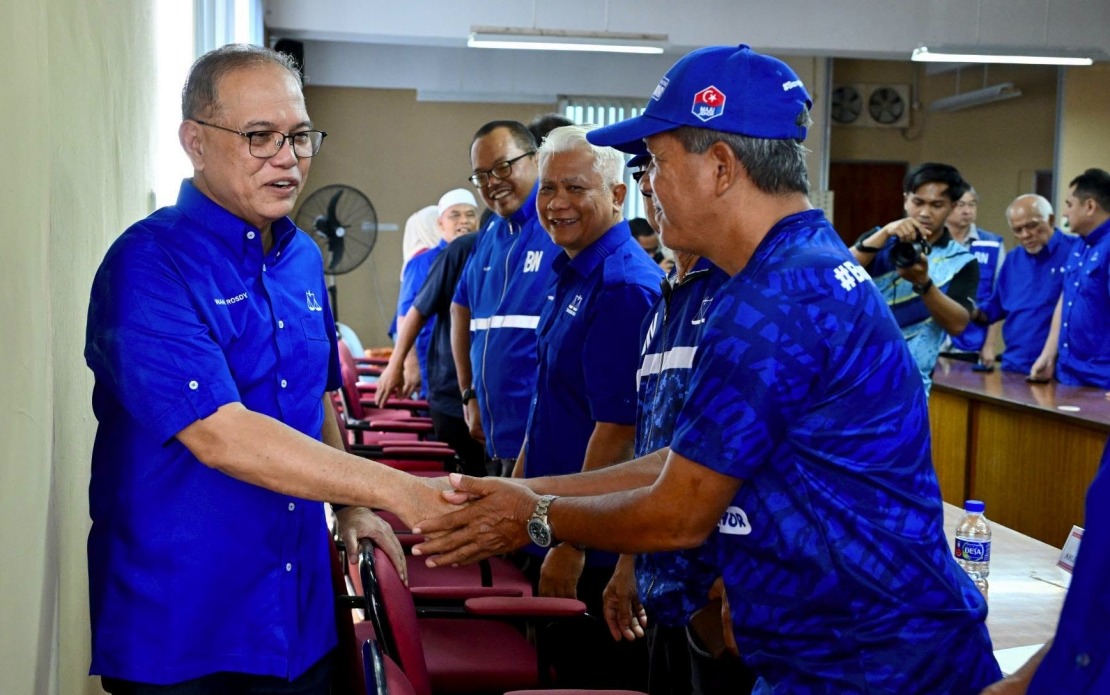
The Barisan Nasional coalition in Pahang has committed substantial resources to bolster campaign efforts in the Johor state election, focusing on a strategically targeted cluster of four constituencies. Pahang Menteri Besar Datuk Seri Wan Rosdy Wan Ismail disclosed this mobilisation effort on June 30, clarifying that party machinery from his state is concentrating support across the Pekan Nanas, Pulai Sebatang, Benut, and Kukup state seats—all situated within the Tanjung Piai parliamentary constituency. This cross-state coordination demonstrates the coalition's determination to consolidate its hold on Johor, a state traditionally considered a BN stronghold despite recent political volatility across Malaysia.
The deployment of Pahang's political machinery represents a broader strategy by the national coalition to leverage support from allied state governments. Wan Rosdy himself announced plans to venture into Segamat on the campaign trail, specifically targeting the FELDA (Federal Land Development Authority) settlement areas, which historically comprise significant voting blocs in rural Johor. Such targeted canvassing in agricultural communities reflects BN's understanding that rural constituencies remain crucial to electoral success in the state, where constituency boundaries often encompass mixed urban and agricultural populations.
Wan Rosdy's observations from his three-day presence in Johor during the nomination period conveyed optimism about the coalition's prospects. He highlighted what he characterised as robust enthusiasm among the party machinery and emphasised that BN candidates competing in these contests display genuine commitment to public service. This assessment, though necessarily cautious as party leadership commentary, suggests that BN operatives perceive a competitive but winnable scenario across these four seats. The tone of his remarks indicates the coalition recognises the importance of maintaining momentum through grassroots engagement and candidate enthusiasm as polling approaches.
The Johor state election has become a significant bellwether for Malaysian politics, particularly given the state's historical importance to BN's electoral fortunes and its substantial number of parliamentary seats. With 172 candidates contesting across 56 state seats, the election encompasses the full spectrum of Johor constituencies, ranging from urban centres to rural and semi-urban areas. The polling will occur on July 11, with an earlier voting opportunity available on July 7 for those eligible to cast ballots before polling day. These dates place the election in a mid-year political calendar that has increasingly become crowded with state and federal electoral contests.
The four constituencies receiving particular attention from Pahang BN—Pekan Nanas, Pulai Sebatang, Benut, and Kukup—collectively represent a geographic and demographic cross-section of Johor's southern and western regions. These seats fall within Tanjung Piai, a parliamentary constituency that has itself become a closely watched electoral indicator. The concentration of cross-state support in this particular cluster suggests BN believes these seats are either competitive or require reinforcement to prevent opposition gains. Such tactical deployment of resources underscores how Malaysian politics increasingly operates through coordinated campaigns across state lines, with coalition members pooling party machinery and leadership attention to support allied electoral campaigns.
The involvement of Pahang's political leadership, particularly Wan Rosdy as both state chairman and Menteri Besar, reflects the hierarchical coordination within BN. The participation of a sitting Menteri Besar in another state's election campaign demonstrates the level of integration within the coalition and the priority assigned to the Johor contest. For Malaysian readers following electoral trends, this cross-state mobilisation signals that BN leadership regards the Johor election as sufficiently consequential to warrant deployment of senior figures and party infrastructure from neighbouring states. Such coordination has become increasingly important as BN navigates a more competitive political landscape than it faced during earlier decades of uncontested dominance.
The FELDA areas targeted in Segamat represent a particularly strategic voting cohort. These land settlement schemes, comprising smallholder farmers granted land parcels by the federal authority, have traditionally formed a reliable support base for BN, though this relationship has shown signs of strain during recent electoral cycles. Wan Rosdy's explicit mention of visiting FELDA communities demonstrates BN's strategy to maintain these crucial rural constituencies through direct engagement from senior leadership. Agricultural communities across Johor face specific economic concerns—from commodity prices to irrigation management—that FELDA settlers have historically expected their elected representatives to address directly.
The broader context of this campaign deployment reflects the intensifying competition for state-level control in Malaysia. Johor, as the second-largest state by population after Selangor and a critical economic hub, represents more than symbolic importance. Control of the state government translates to influence over substantial state revenue, infrastructure projects, and patronage networks. For BN, maintaining Johor remains essential to national political standing, while for opposition coalitions, gaining ground in this state would represent a significant breakthrough. The decision to commit Pahang's resources illustrates how seriously BN assesses the stakes involved.
Political coordination across state lines has become standard practice in Malaysian electoral contests, yet the specificity of Pahang BN's targeting—naming four individual constituencies rather than offering blanket support—suggests a data-driven approach to campaign allocation. This precision indicates that BN's strategists have identified these particular seats as either marginal contests where additional support could prove decisive or constituencies facing unexpected pressure from opposition advances. The narrowness of the focus contrasts with earlier political eras when electoral support tended to be distributed more evenly or standardised across regions.
Looking forward to the July 11 polling day, the Johor state election will test whether cross-state coalition mobilisation translates into increased electoral performance. The participation of Pahang's leadership and machinery provides BN with additional human resources, speaker capacity, and promotional apparatus during the campaign period. However, the ultimate determinant of electoral outcomes remains with Johor voters themselves, whose preferences have increasingly diverged from historical voting patterns observed in earlier decades. The election will illuminate whether BN's investment of political capital and cross-state coordination succeeds in securing these four targeted constituencies and maintaining broader control over Johor's state government.

