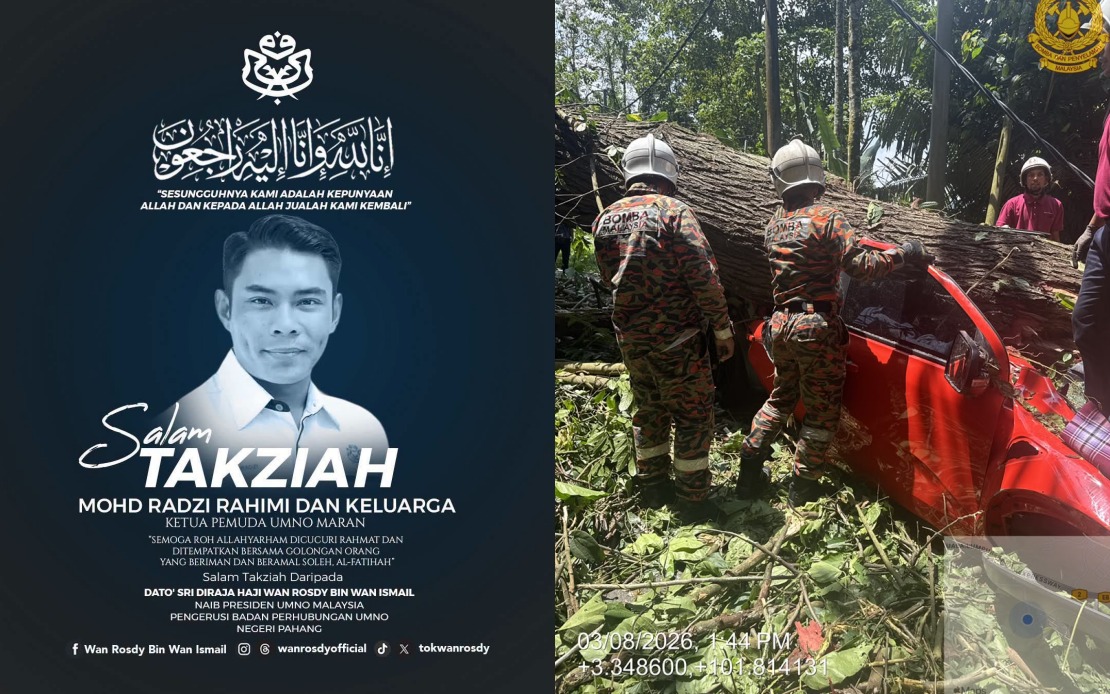
Pahang's top political leadership has paid tribute to Mohd Radzi Rahimi, the Maran UMNO Youth chief who perished in a tragic accident on the old Kuala Lumpur-Bentong road near Janda Baik on August 3. The fatality has shocked the state's UMNO establishment, prompting expressions of grief from senior party figures who recognised his contributions to youth development and community engagement in Pahang.
Datuk Seri Wan Rosdy Wan Ismail, who serves as both Pahang Menteri Besar and chairman of the Pahang UMNO Liaison Committee, released a statement characterising the late Edy Radzi—as he was commonly known—as a dedicated public servant whose commitment to grassroots politics exemplified the values the party seeks to cultivate among its younger members. Wan Rosdy's remarks underscored the personal nature of the loss, emphasising that Mohd Radzi's death represented a significant blow to multiple layers of the party structure, from the immediate Maran division through to the broader Pahang UMNO Youth movement.
The accident involved four individuals travelling in a four-wheel-drive vehicle when a tree suddenly fell across the roadway, trapping the occupants inside. Beyond Mohd Radzi, the victims included Nuriani Mohammad Jafri, her son Muhammad Rizz Hazim, and her younger brother Mohammad Nizam. A fifth person, a child, sustained injuries in the incident but survived. The sudden and violent nature of the tragedy—a natural hazard that offered little opportunity for avoidance—has amplified the shock felt across Pahang's political circles.
At the national level, UMNO Youth chief Datuk Dr Muhammad Akmal Saleh extended formal condolences to Mohd Radzi's family, invoking religious sentiments reflective of the party's deep integration with Islamic values. His statement called for divine forgiveness and eternal peace for the deceased, positioning the loss within a spiritual framework that resonates with UMNO's constituency. The convergence of statements from both state and national party hierarchies signals recognition of Mohd Radzi's standing within the broader UMNO ecosystem.
Mohd Radzi's role as Maran UMNO Youth chief placed him at a strategic juncture in the party's organisational structure, bridging the gap between youthful enthusiasm and the more established political machinery. Youth divisions within UMNO typically serve as incubators for future party leadership, and individuals in such positions often shoulder responsibility for mobilising younger voters and cultivating the next generation of party activists. His emphasis on people-centric approaches and community service aligned with contemporary expectations for political leadership, particularly among younger demographics increasingly conscious of substantive governance.
The incident has raised questions about road safety in the Bentong area, where the old Kuala Lumpur route traverses forested terrain vulnerable to weather-related hazards. The combination of dense vegetation and aging road infrastructure creates risk conditions that extend beyond this single tragedy. For Pahang, where such accidents highlight vulnerabilities in rural transportation corridors, the loss of a young political figure compounds the immediate human tragedy with practical concerns about infrastructure maintenance and hazard mitigation.
Within UMNO's organisational hierarchy, Maran division represents a relatively modest constituency by state standards, yet the party's decentralised structure accords considerable autonomy and responsibility to divisional youth chiefs. Mohd Radzi's death thus creates a leadership vacuum that extends beyond mere administrative succession to encompass the network of youth activists and community relationships he had cultivated. The mechanism for identifying and transitioning to new leadership in such roles often reflects broader factional dynamics within UMNO, potentially influencing local political alignments.
For Malaysia's political landscape more broadly, the tragedy underscores the personal dimensions underlying institutional politics. While UMNO has experienced leadership transitions and internal reshuffling in recent years, the loss of an individual mid-level leader through accident rather than political process carries different symbolic weight. It disrupts the normal calculus of political advancement and succession, introducing an element of randomness into career trajectories that are typically characterised by structured progression.
The incident also highlights risks faced by Malaysian public figures and community leaders who maintain active engagement in their constituencies. Unlike office-based political roles, ground-level leadership frequently demands travel through varied terrain and exposure to environmental conditions that carry inherent hazards. For Pahang specifically, where geography and weather patterns create particular challenges, such losses raise awareness of occupational risks accompanying grassroots political work.
Wan Rosdy's public expression of condolences served multiple functions simultaneously—acknowledging personal loss, reaffirming party cohesion during a moment of vulnerability, and reinforcing narratives about Mohd Radzi's character and contributions. Such statements establish official memory within party structures, shaping how successors and younger party members understand the standards and values exemplified by lost leaders. The emphasis on people-centred approaches and community commitment projects an image of UMNO aligned with service-oriented governance.
Moving forward, Maran UMNO Youth will require new leadership to sustain the momentum Mohd Radzi established. The succession process will likely involve consultation among senior Maran UMNO figures and potentially state-level guidance, with candidates expected to demonstrate comparable commitment to the divisional youth movement. Such transitions offer opportunities for party renewal but also risk disrupting established relationships and community networks.
The broader implications for Pahang's political ecosystem extend beyond immediate grief and tribute. Mohd Radzi's loss removes an experienced voice from discussions about youth engagement and community mobilisation within UMNO structures. For a party increasingly concerned with maintaining youth participation amid changing demographic patterns and political preferences, the unexpected loss of committed young leaders represents a strategic concern alongside personal tragedy. The incident thus operates on multiple levels—human tragedy, institutional disruption, and broader questions about UMNO's capacity to nurture and retain young talent essential for long-term organisational vitality.

